



Abstract
Background:
CF Foundation guidelines recommend lung function testing every 3-6 months. Many factors can impact the performance of spirometry in people with cystic fibrosis (pwCF), often requiring alternative diagnostic tools. Previous studies have shown correlation of body mass index (BMI) with lung function (FEV1). Lean body mass (LBM) has been found to have a strong correlation with FEV1 in pwCF. Handgrip strength (HGS) measurement is a tool that can assess LBM, muscle function, and nutritional status; however, few pediatric studies have evaluated the correlation between HGS and FEV1, and the results of these studies have been inconsistent. We aimed to evaluate the correlation between HGS and FEV1 in pediatric pwCF. This determination may assist in identifying patients at risk of declining lung function and guide recommendations to maintain/improve lung function through physical activity and nutrition.
Methods:
In an IRB-approved retrospective chart review from 1/1/2022 to 12/31/2023, 53 healthy pediatric pwCF between 7 to 20 years of age were included for review. Participants included in the study were age-appropriate to complete spirometry. Lung function was assessed in all participants using a portable spirometer to measure FEV1. HGS was measured using a Jamar dynamometer. Exclusion criteria were incomplete spirometry, incomplete HGS testing or lack of available baseline FEV1 within 6 months of HGS testing.
Results:
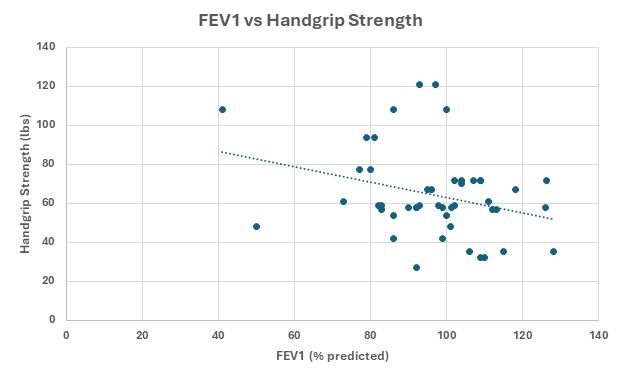
44 participants met inclusion criteria (mean age 14.2 y, 50% males and females). 39 participants were on CFTR modulator therapy at the time of testing. The average BMI was 20.6 kg/m2 (range 14.7-28 kg/m2). The range of FEV1 was 41-128% (mean 96.1%) and range of HGS was 27.1-121 lbs (mean HGS 64.5 lbs). Pearson correlation coefficient is -0.3 with a P-value of .04. Data shown in Figure 1.
Conclusions:
In this study group, there was a weak correlation between HGS and FEV1. Results may have been affected by the sample size, age range, and children in different stages of pubertal development. The role of HGS testing in CF exacerbation was not explored and this could be an objective measurement to assess for declining lung function. Future research is essential to explore the role of strength and postural training programs on HGS and lung function. Additional data are needed to identify if HGS is an appropriate surrogate for lung function for pwCF who are unable to complete spirometry.
Get full access to this article
View all access options for this article.