




Abstract
Background:
Patients undergoing thoraco-abdominal surgery often experience limited spontaneous deep breathing due to pain, resulting in inadequate lung expansion. Thus, interventions for peri-operative respiratory care are crucial for lung expansion and airway secretion clearance. Peri-operative respiratory care includes the active cycle of breathing technique and incentive inspiratory exercise for incentive spirometry (IS). However, extended treatment durations can adversely affect patient satisfaction and resource management. This study endeavors to optimize peri-operative respiratory care by employing a quality control circle approach to achieve a 50% reduction in treatment time.
Methods:
Data regarding treatment duration were gathered both prior to (May 2021) and subsequent to (September 2021 to May 2022) the initiation of quality control circle initiatives. The data, analyzed from 30 treatment sessions, were used to inform the process. Employing the PDCA (Plan-Do-Check-Act) method iteratively, the study aimed to refine and improve the efficiency of the interventions. The analysis of the care process identified two primary issues: 1) Patients expend considerable time self-preparing IS. 2) The utilization of abstract teaching methodologies prolongs patient learning durations. To optimize this process, the following solutions are proposed: 1) After medical order approval, nurses at the nursing station will provide IS to patients. 2) Record instructional videos for peri-operative respiratory care and place the video links along with IS at the nursing station. This allows patients to watch the instructional videos while receiving IS. Subsequently, a respiratory therapist will proceed with therapy.
Results:
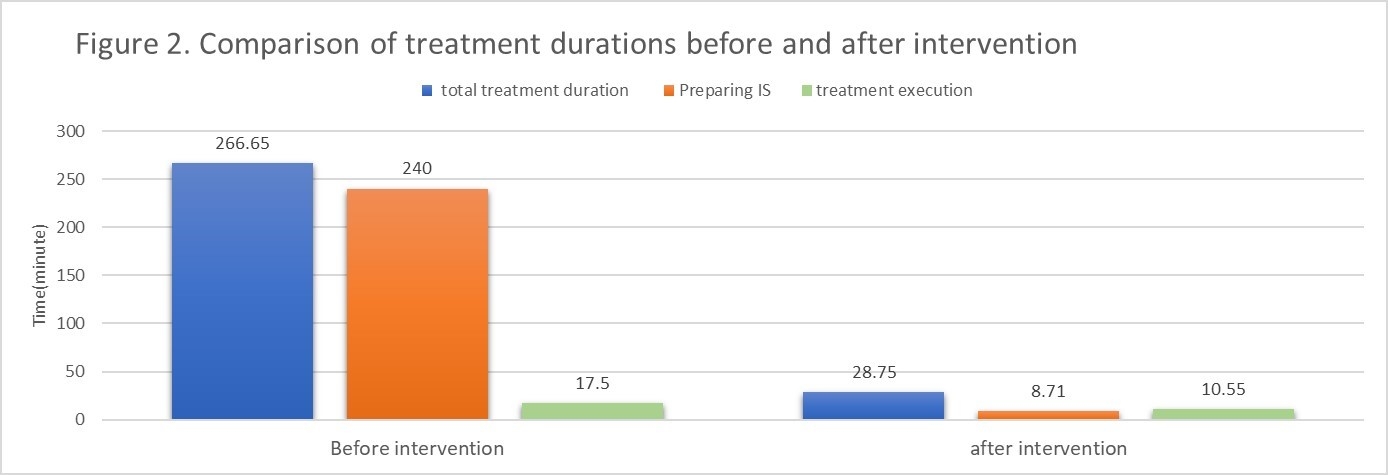
Post-intervention, there was a significant reduction in treatment time. The average total duration decreased from 266.65 to 28.75 min. Preparing IS decreased from 240 to 8.71 min, and treatment execution decreased from 17.5 to 10.55 min. The achievement rate was 178%, with an improvement rate of 89.2%.
Conclusions:
The quality control circle approach has effectively optimized peri-operative respiratory care, notably reducing treatment time. This method shows promise in enhancing patient outcomes and streamlining healthcare delivery. Additionally, amid the COVID-19 pandemic, it minimizes unnecessary contact, lowering infection risks. Further research is needed to fully assess its long-term impact and refine its application.
Figure1. Pre-intervention date collection and analysis Figure 2. Comparison of treatment durations before and after intervention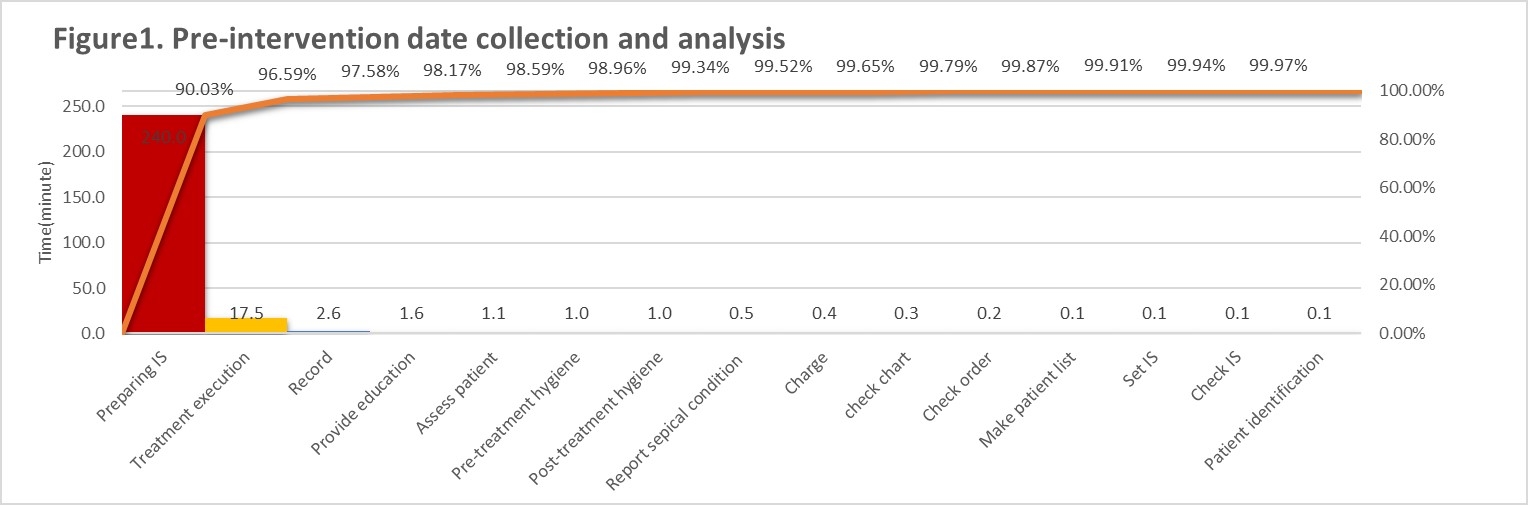
Get full access to this article
View all access options for this article.