



Abstract
Background:
Aerosol delivery during invasive mechanical ventilation is significantly affected by multiple factors related to the patient, device, and ventilator settings. Thus, we aimed to assess the impact of different ventilator settings, nebulizer positions, bias flows, circuit adaptors, and humidification on aerosol delivery during invasive ventilation.
Methods:
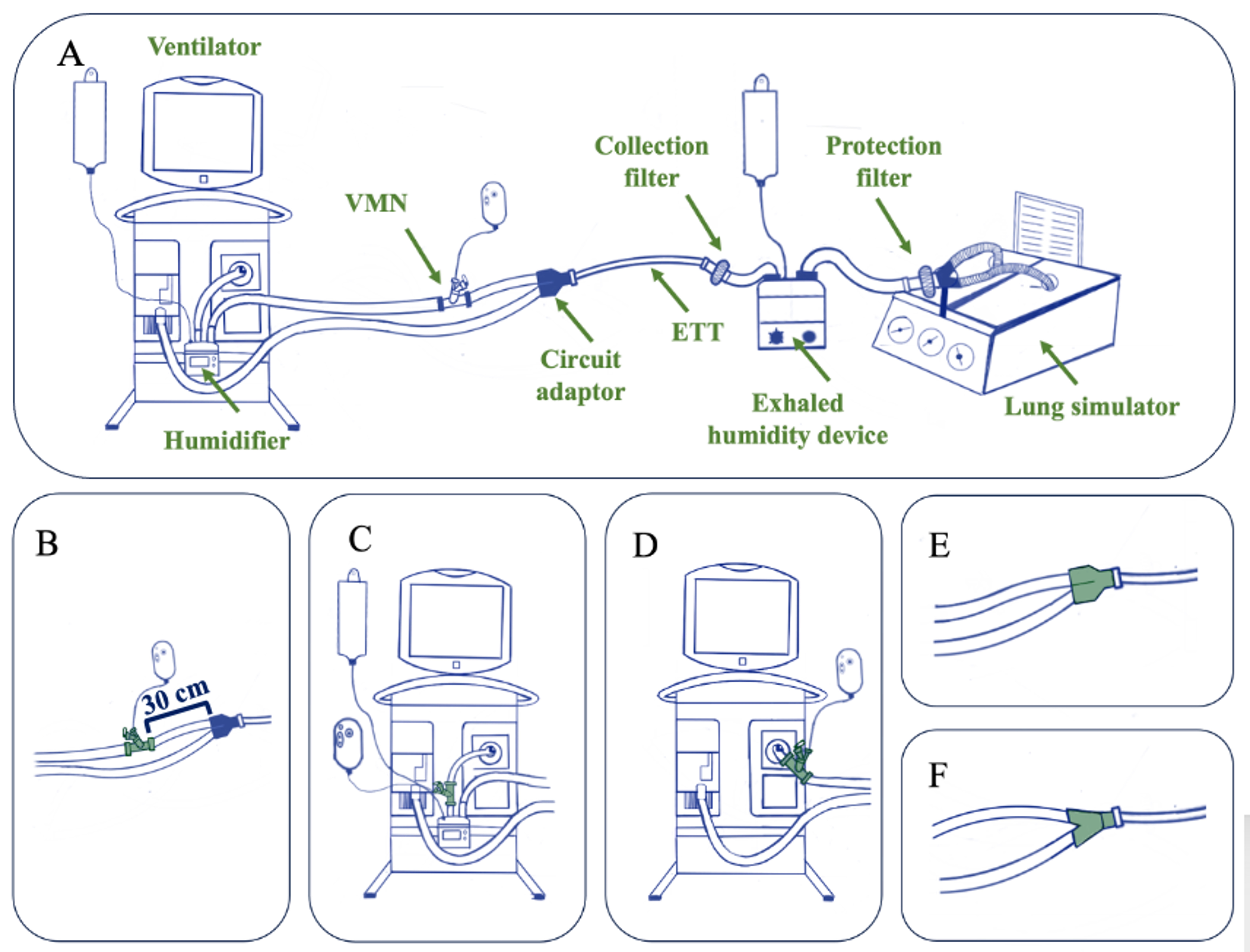
An experimental setup was used to evaluate aerosol delivery using a vibrating mesh nebulizer (VMN) during invasive ventilation (Figure 1). Albuterol at 2.5 mg/3 mL was used under different ventilator settings, nebulizer placements, bias flows, and circuit connectors in the dry circuit. The exhaled humidity and the use of heated humidified circuits were only used in some settings. Each condition was repeated five times. The drug was eluted from the collecting filter and assayed using ultraviolet spectrophotometry at 276 nm.
Results:
The inhaled dose was higher with high settings compared to low settings regardless of nebulizer position, bias flow, heated humidification, and presence or absence of exhaled humidity (Table 1) (all P < .05) except at 2 L/min bias flow with exhaled humidity and VMN placed proximal to the endotracheal tube in dry circuits. The presence of exhaled humidity or heated humidification tended to diminish the differences between high and low settings in the inhaled dose. In dry circuits, no significant differences were observed in the inhaled dose when comparing Y-shaped and V-shaped connectors, except when the nebulizer was placed proximally at a bias flow of 2 L/min. Also, in dry circuits, proximal placement of the nebulizer at high settings generated higher inhaled doses than distal placement, regardless of the bias flow and connector type used. At low settings, with a Y-connector, no significant differences in the inhaled dose were observed between the two nebulizer placements.
Conclusions:
In dry circuits, high ventilator settings generated a greater inhaled dose than low settings, with the nebulizer placed 30 cm proximal to the circuit connector showing higher inhaled doses at high settings. Exhaled humidity or the use of heated humidified circuits reduced the differences between high and low settings.
High settings: VT: 500mL, RR:12bpm, Ti: 2.5 sec, Tplat: 0.5 sec, PEEP: 5 cmH2O; Low settings: VT: 380mL, RR:16bpm, Ti: 1.2 sec, Tplat: 0 sec, and PEEP: 5 cmH2O; Bias flow reported in L/min; Proximal: VMN placed 30 cm away from the circuit connection; Distal: VMN placed at the humidifier inlet with heated and humidified circuit or at the ventilator outlet with dry circuit.
A) The study set up of a simulated adult intubated with an endotracheal tube (ETT) and mechanically ventilated while receiving invasive aerosol delivery using a vibrating mesh nebulizer (VMN). B) proximal VMN position placed 30 cm away from the circuit connection. C) distal VMN position placed at the humidifier inlet with the heated and humidified circuit. D) distal VMN position placed at the ventilator outlet with the dry circuit. E) Y-shaped connector. F) V-shaped connector. View all access options for this article.Percentage of the inhaled dose delivered during invasive ventilation with high and low ventilator settings in various conditions
Nebulizer position
Bias flow
Circuit connector
Percentage of inhaled dose (%)
Dry circuit without exhaled humidity
Dry circuit with exhaled humidity
Heated and humidified circuit with exhaled humidity
High settings
Low settings
P value
High settings
Low settings
P value
High settings
Low settings
P value
Proximal
2
V
36.9±1.6
20.7±1.8
.009
Y
39.8±1.7
18.3±1.6
.009
25.7±4.3
20.1±1.7
.076
P
.021
.076
5
V
32.8±1.5
16.6±1.8
.009
Y
34.5±0.8
16.3±1.4
.009
21.8±1.1
17.7±1.3
.009
23.3±1.2
19.3±1.9
.009
P
.076
.917
.117
.076
Distal
2
V
31.0±2.4
15.4±1.6
.009
Y
31.1±1.6
18.2±2.3
.009
23.0±1.6
17.2±1.3
.009
P
.175
.076
5
V
31.7±2.1
18.3±1.6
.009
Y
28.7±2.3
17.9±2.0
.009
23.7±2.2
16.9±1.6
.009
26.1±2.4
19.5±1.7
.009
P
.754
.754
.602
.675
.076
.917
Get full access to this article