



Abstract
Background:
The choice of SpO2 target significantly influences oxygen utilization. It was recently shown that oximeter brand influenced the SpO2 measurements, with differences between oximeters of up to 4%. The objectives of the study were to evaluate the impact of the combination of SpO2 target and oximeter brand on O2 utilization, O2 weaning, high O2 flow requirements, occult hypoxemia and occult hyperoxemia.
Methods:
We have conducted a randomized cross-over study in 20 stable ICU patients requiring oxygen therapy delivered through nasal canula after cardiac surgery. Patients without adequate SpO2 signal were excluded. Four randomized periods of 10 min were conducted in all patients with different SpO2 targets (90 and 94%) and different oximeters (Nonin and Philips). For each period we collected the oxygen flow and oxygen blood gases at the end of the period. We compared the O2 flow, the rate of occult hypoxemia (SaO2 below 90% with SpO2 ≥ 90%) and occult hyperoxemia (SaO2 above 96% with SpO2 ≤ 96%), O2 partial weaning (below 0.5 L/min) or complete weaning and the rate of high O2 flow requirements (above 5 L/min).
Results:
20 patients were studied (mean age 68 ± 8 years, 16 were men, all had light skin pigmentation (Fitzpatrick skin scale 1 or 2) reflecting our local population, none had shock). At baseline, SpO2 was 93.4 ± 1.8% and oxygen flow was 2.1 ± 1.4 L/min. O2 flow requirements and oxygenation parameters in the different study periods are displayed in the Figure 1. Differences in mean O2 flow during monitoring with the Nonin with an SpO2 target of 90% and Philips with an SpO2 target of 94% were not statistically different (P = .74). However, all other comparisons for the O2 flow were statistically different. The rate of complete O2 weaning was 55% in the Philips 90% period and 0 to 5% in other periods. Oxygenation parameters (SaO2, PaO2) were similar during Nonin 90% and Philips 94%. Conversely, there were statistically significant differences for oxygenation parameters and for other comparisons.
Conclusions:
In patients requiring conventional oxygen therapy, the SpO2 target, the oximeter brand and even more the combination of both have major impact on O2 utilization, O2 weaning and both occult hypoxemia and hyperoxemia. Patients managed with Nonin with SpO2 target of 90% and Philips with SpO2 target of 94% had similar O2 flow and similar arterial oxygenation parameters. These data underline the necessity to use corrected SpO2 targets rather than universal SpO2 targets to manage O2 therapy.
Mean oxygen flow utilization in the different study conditions comparing two SpO2 targets (90 and 94%) and two oximeters brand (Philips and Nonin): Philips 90, Nonin 90, Philips 94, and Nonin 94. SpO2 targets of 90% are represented with hatched bars while SpO2 targets of 94% are represented with plain bars. Nonin conditions are represented with blue bars while Philips conditions are represented with light orange bars. Oxygen Ratio were 1.2 (Philips 94/Nonin 90), 4.0 (Nonin90/Philips90), 3.0 (Nonin94/Philips94), 3.6 (Nonin94/Nonin90), 4.7 (Philips94/Philips90) and 14.1 (Nonin94/Philips90).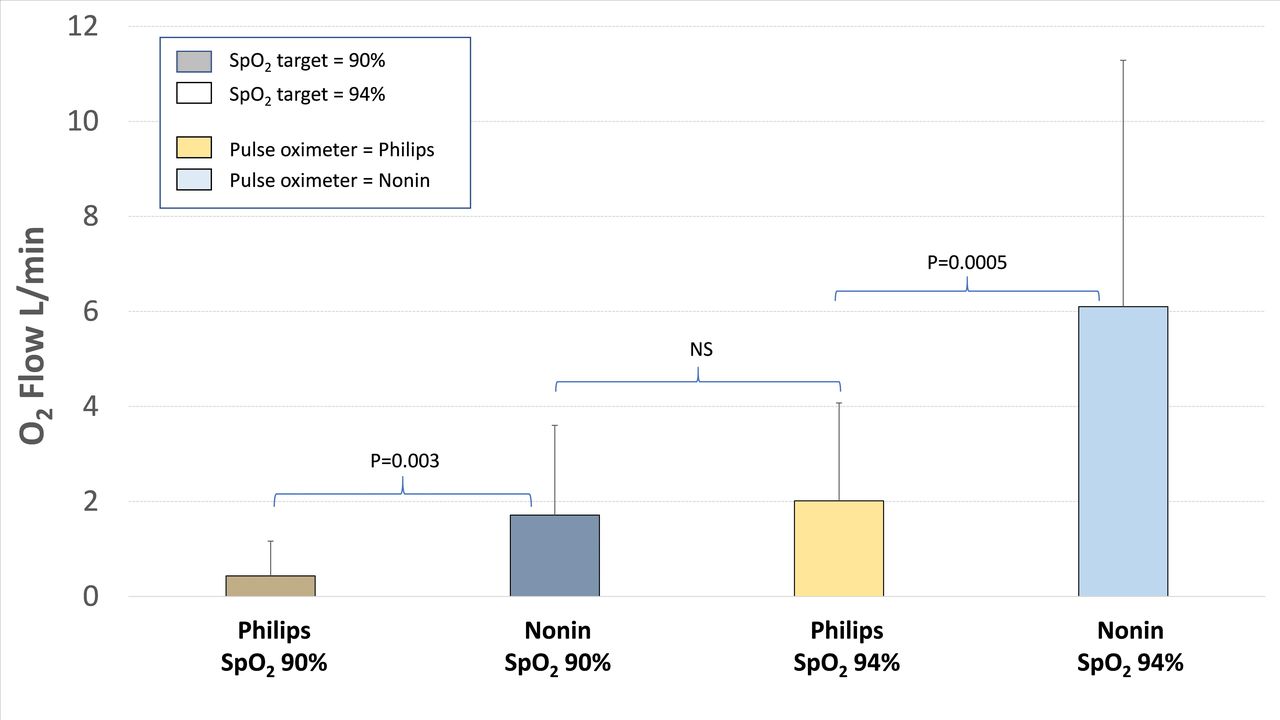
Get full access to this article
View all access options for this article.