




Abstract
Background:
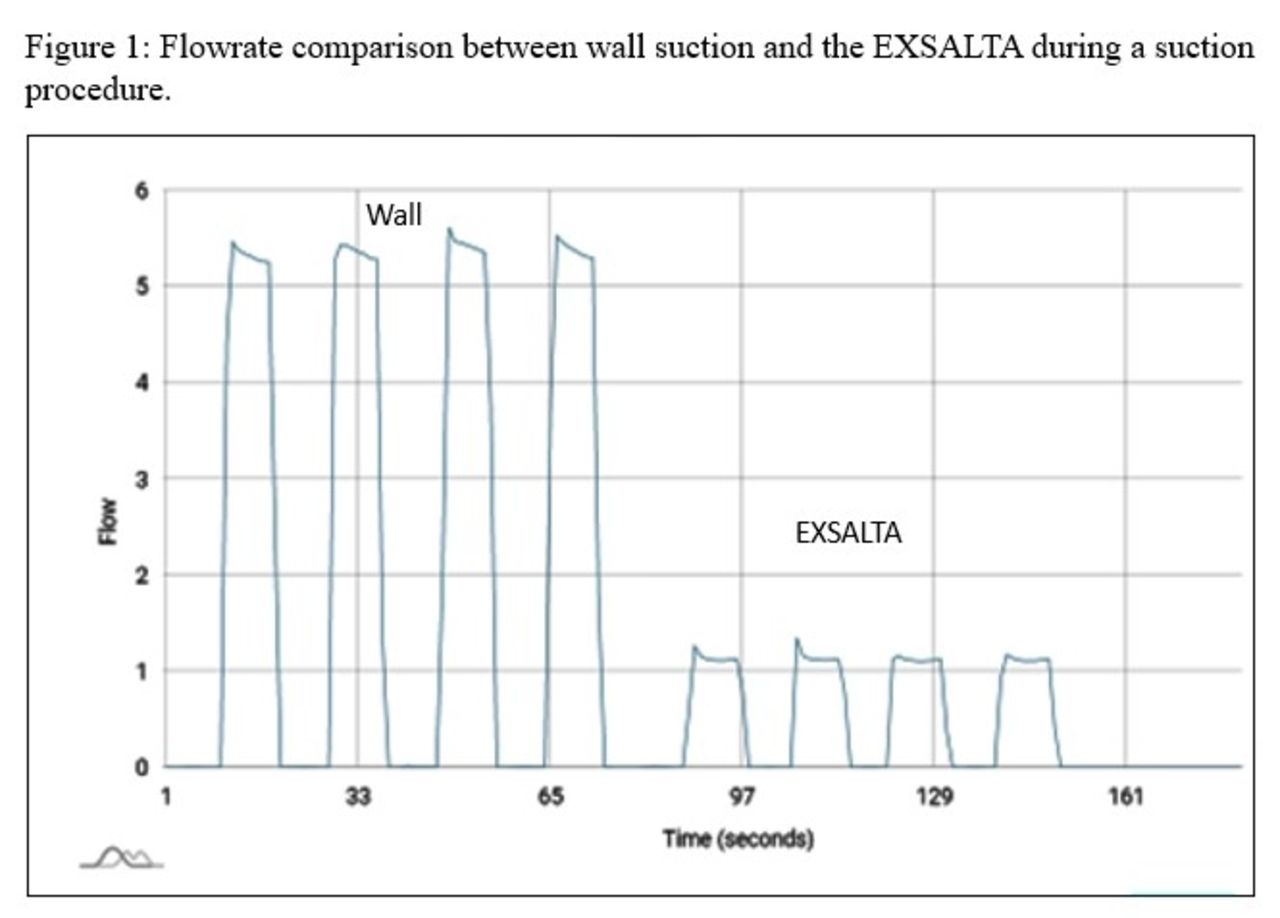
Suctioning the airway is a crucial procedure to maintain airway patency and prevent mucus retention for mechanically ventilated patients. Negative suction pressures can cause hypoxemia, reduced lung volume and compliance, and airway tissue trauma. The primary reasons for these complications are the suction pressure setting, the ratio of the suction catheter (SC) to the ETT, the length of the procedure, and the amount of air removed. The EXSALTA Suction Pump uses a peristaltic system to generate low flows and limit free flow of air from the lungs during suctioning. The goal of this project is to compare the performance of the EXSALTA to wall suction. The research questions (RQ) are 1: Does the EXSALTA reduce the amount of flow withdrawn compared to wall suction? 2: Does the EXSALTA generate less negative pressure compared to wall suction? 3: Does the EXSALTA remove an equivalent amount of mucus from the ETT compared to wall suction?
Methods:
Testing included ETTs from 2.0 mm to 8.0 mm and SCs from 4 Fr to 14 Fr. SC:ETT ratio and suction pressure was matched based on the AARC Clinical Practice Guideline recommendations. During all testing, negative pressure was applied for the same time for EXSALTA and wall suction. During all testing events, the SC was inserted to the tip of the ETT with suction applied as the SC was withdrawn. For RQ1, differences in volume were assessed using a TSI 5000 flow sensing device attached to the distal end of an airway model. For RQ2, distal pressure was assessed with a digital manometer and a gauge manometer. The manometers were placed distal to the lung model and ETT. Data were recorded as peak and sustained pressures. For RQ3, sputum removal was assessed using artificial sputum. Each ETT was filled with sputum and subjected to a suction procedure. ETTs were weighed using a digital scale before and after suctioning.
Results:
For RQ1, the EXSALTA generated lower suction flows. The differences were statistically significant (P < .05). For RQ2, the EXSALTA generated lower peak and sustained pressures during suctioning. Both differences in pressures were statistically significant (P < .05). For RQ3, the wall suction removed more sputum, based on ETT weight. The differences were statistically significant (P < .05). The effect size was weak for weight difference.
Conclusions:
The peristaltic pump may reduce complications associated with ETT suctioning by generating less negative pressures and lower flows, while suctioning a nearly equivalent amount of sputum when compared to wall vacuum.
*p<.05
View all access options for this article.Table 1: Paired samples data comparing the EXSALTA to wall suction for research questions 1, 2, and 3
N
Mean
Std. Deviation
Minimum
Maximum
t-value
Effect Size
RQ1
Mean Flowrate-Wall (LPM)
18
9.410
5.662
1.10
16.27
6.308*
1.68
Mean Flowrate-EXSALTA (LPM)
18
1.052
0.114
0.8
1.22
RQ2
Peak Pressure-Wall (cmH2O)
18
-48.56
37.672
-120+
-8
4.441*
0.68
Peak Pressure-EXSALTA (cmH2O)
18
-12.67
4.433
-20
-6
RQ2
Sustained Pressure-Wall (cmH2O)
18
-38.83
35.741
-112
-2
4.444*
1.78
Sustained Pressure-EXSALTA (cmH2O)
18
-1.06
0.725
-2
0
RQ3
Difference in Weight After Sx-Wall (g)
18
1.283
0.835
0.09
2.95
4.976*
0.358
Difference in Weight After Sx-EXSALTA (g)
18
0.939
0.645
0.11
2.24
Get full access to this article