




Abstract
Background:
The purpose of this study is to determine how smoking may impact the hospital length of stay, ICU stay, and days on the mechanical vent for motor vehicle accidents patients at a Level-1 Trauma Center. Hypotheses is that such a trauma patients who are smokers will experience a greater length of stay in the ICU, greater amount of time on a mechanical ventilator, with increased total length of stay in the hospital than non-smokers. The mean age of smokers in the ICU will be higher than that of non-smokers.
Methods:
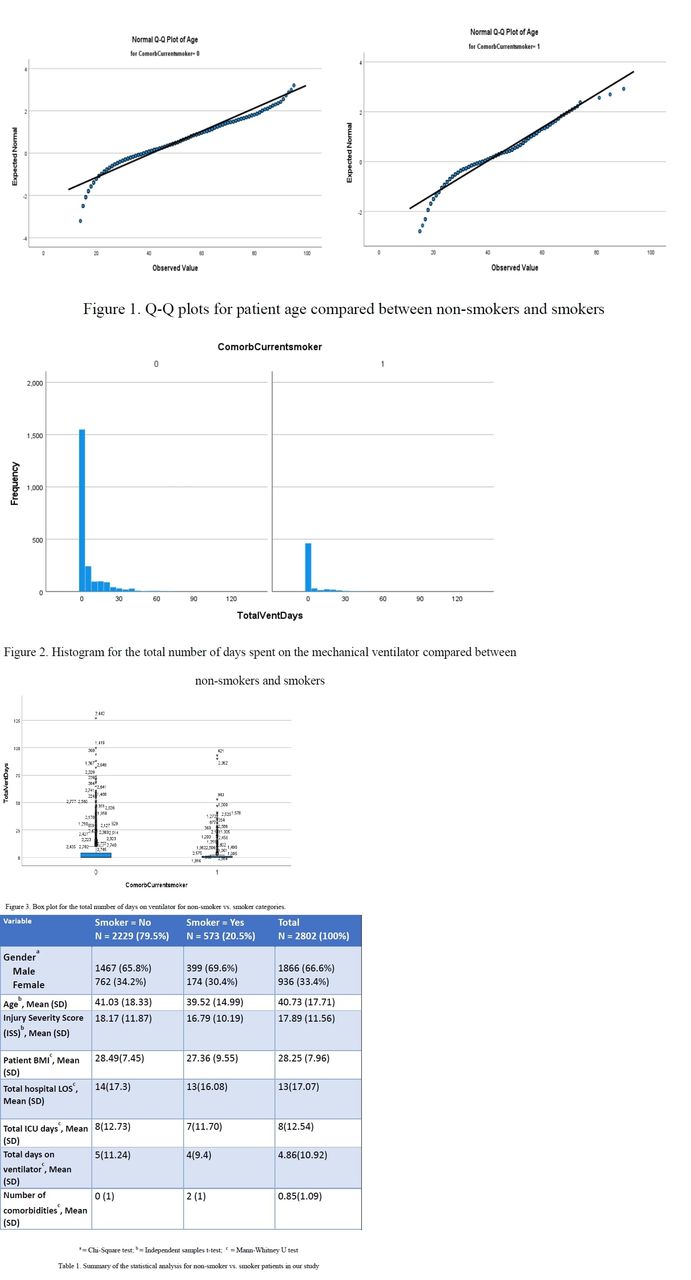
The dataset consisted of a total of 2,802 patients who were divided into two groups based on their present smoking status: smokers and non-smokers. Detailed records of the injury severity score (ISS), age, gender, body mass index (BMI), number of comorbidities, total length of hospital stay, length of ICU stay, and total ventilator days are obtained from the dataset. Using SPSS, Mann-Whitney U test, Chi-square test, and independent samples t-test were conducted to examine differences of age, gender, BMI, comorbidities, and patient outcomes (hospital stay, ventilator days, and ICU stay).
Results:
Out of the total of 2,802 patients, 2,229 (79.5%) as a non-smokers and 573 (20.5%) as a smokers classified. Among non-smokers, 1,467 (65.8%) were male, and 762 (34.2%) were female. Among smokers 399 (69.6%) were male, and 174 (30.4%) were female. No significant difference (P = .084) based on gender were found. The mean age difference between nonsmokers and smokers was not statistically significant (P = .068). Also, the mean difference for ISS between those categories was not statistically significant (P = .01). However, the difference between the mean of BMI was statistically significant (P < .001).The total length of hospital stay was not statistically significant (P = .656). The total days in the ICU was also not statistically significant between the two categories (P = .444). However, the total number of days on a mechanical vent was found to be statistically significant (P < .001). Finally, the number of comorbidities present between two categories found to be statistically significantly (P < .001), with non-smokers experiencing a mean of 0, but the smokers had a mean of 2 comorbidities.
Conclusions:
We also showed that the mean of BMI of the patients who were classified as smokers was slightly lower than the BMI for the non-smoking population. Finally, our analysis showed that the smoking population on average had a higher number of comorbidities than the non-smoking population.
Get full access to this article
View all access options for this article.