




Abstract
Background:
Physical activity and sufficient sleep are associated with individuals’ overall health. Studies have further shown using wearable devices for self-monitoring can aid in modification of health behavior. This investigation tested the utility of a wearable device and short message prompts to increase physical activity. The objective of this study was to explore the feasibility of using wearable fitness devices to quantitatively measure daily physical activity and sleep levels. This project explored approaches for designing activities to incorporate physical activity to help participants self-interpret to develop healthier sleep patterns.
Methods:
This study comprised of participants (n = 38) from public health gerontology and respiratory care with qualitative data, from wearable fitness trackers and quantitative data through key informant interviews.The wearable fitness trackers were provided to each participant with necessary instructions. The data was collected weekly for up to 3 months. Key informant interviews were conducted to ascertain the usefulness of wearable fitness in physical activity. 80% of participants were female with all participants above 18 years of age.
Results:
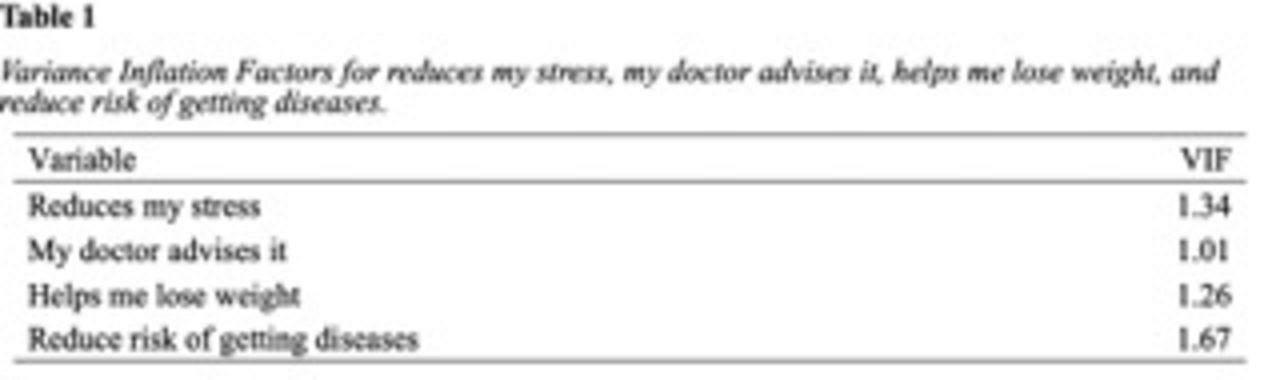
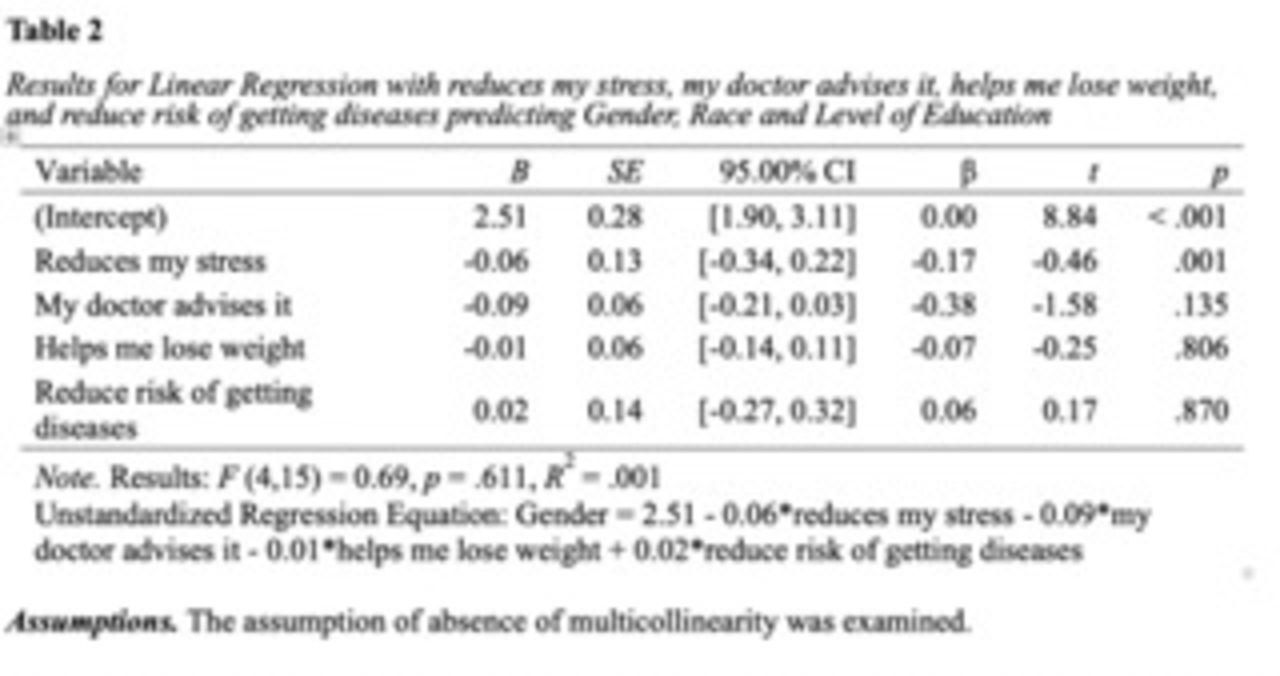
Regression analysis was conducted to assess if 28 of the independent variables had statistical significance on the odds of observing effects by the dependent variables of race gender or level of education. The results of the analysis were not statistically significant with the exception of ‘I like to exercise because it reduces my stress’, revealing F (4,15) = 0.69, P = .611, R 2 = 0.001. the remaining variables did not explain a significant proportion of variation in gender, race nor level of education. Table 2 summarizes the results of the regression model. Variance inflation factors (VIFs) were calculated to detect the presence of multicollinearity between predictors. All predictors in the regression model had VIFs less than 5. Table 1 presents the VIF for each predictor in the model.
Conclusions:
The objective of this study was to explore the feasibility of wearable devices to quantitatively measure daily physical activity, and sleep levels. The project was exploring approaches for designing activities to incorporate to help participants learn how to interpret data. It was found that the participants' sleep hours increased for the first month (6.39 hours), third month (8.5 hours) approximately 2 hours. The findings reveal there was an increase from 45.5 % in the first month maintaining 33% respectively by the third month of the study.
Get full access to this article
View all access options for this article.