




Abstract
Background:
Inhaled drug delivery during mechanical ventilation has been the topic of debate for years. There has been cross-examination when the nebulizer is placed on the dry side of the humidifier chamber regarding aerosol particle deposition. Lung morphology and length of the ventilator circuit are factors that may influence percent of deposition. Ari et al lung model studies demonstrated that aerosol deposition was 6.80% ± 1.55% with jet nebulizers and 23.16 ± 0.67% with vibrating mesh nebulizer (VMN) with a single dose 3 mL solution. With development of the VMN, this adds a novel chapter to continuously nebulized drug therapy (CNDT). The aim of this study was to demonstrate aerosol deposition with CNDT via syringe pump when a VMN is placed on the dry side of the humidifier.
Methods:
A ventilator was set up with a dry adult ventilator circuit; no active humidity for the study. Two sterile filters were installed in the circuit. Filter labeled (A) was attached at the ventilator y-piece that was attached to a lung model. Another filter (B) was attached to the ventilator exhalation valve. Ventilator settings: tidal volume (VT) 450 mL, VC-CMV 12 breaths/min, PEEP 8 cm H2O, peak inspiratory flow 50 L/min. Albuterol 20 mL was mixed with a non-toxic red dye. The solution was drawn up into a syringe which was attached to the syringe pump and VMN, that was connected to the ventilator circuit on the dry side of the humidifier. The syringe pump was programmed to deliver 15 mg/h = 3 mL/h. The VMN timer was set for continuous. The dye represented aerosolized particles from the VMN collected in filters.
Results:
Post study observation illustrated that at 15 mg/h, a total of 12 ± 2 mL/h was delivered over the 4 h study period. Filter A captured aerosol particles at the ventilator y-piece. Filter B captured aerosol particles in the expiratory circuit before the exhalation valve. Both filters demonstrated enhanced aerosol saturation (see figure). There were no abnormalities related to mechanical ventilator functionality. The red dye stained the inside walls of the (inspiratory, expiratory) ventilator circuit which may represent lost aerosol particle volume, no detectable red dye pre-humidifier.
Conclusions:
This study has limitations, one is aerosol deposition was only evaluated down to the y-piece. More study is needed to validate performance with and without humidity. With emerging novel applications for inhaled drug delivery (eg, inhaled vasodilators, β2-agonists, inhaled sedation), this study gives researchers conceivable insight into CNDT as this may impact aerosol delivery percent. An indirect observation demonstrated very minimal penetration of red dye past the protective median for both filters, which is propitious for infection control.
Filters labelled A & B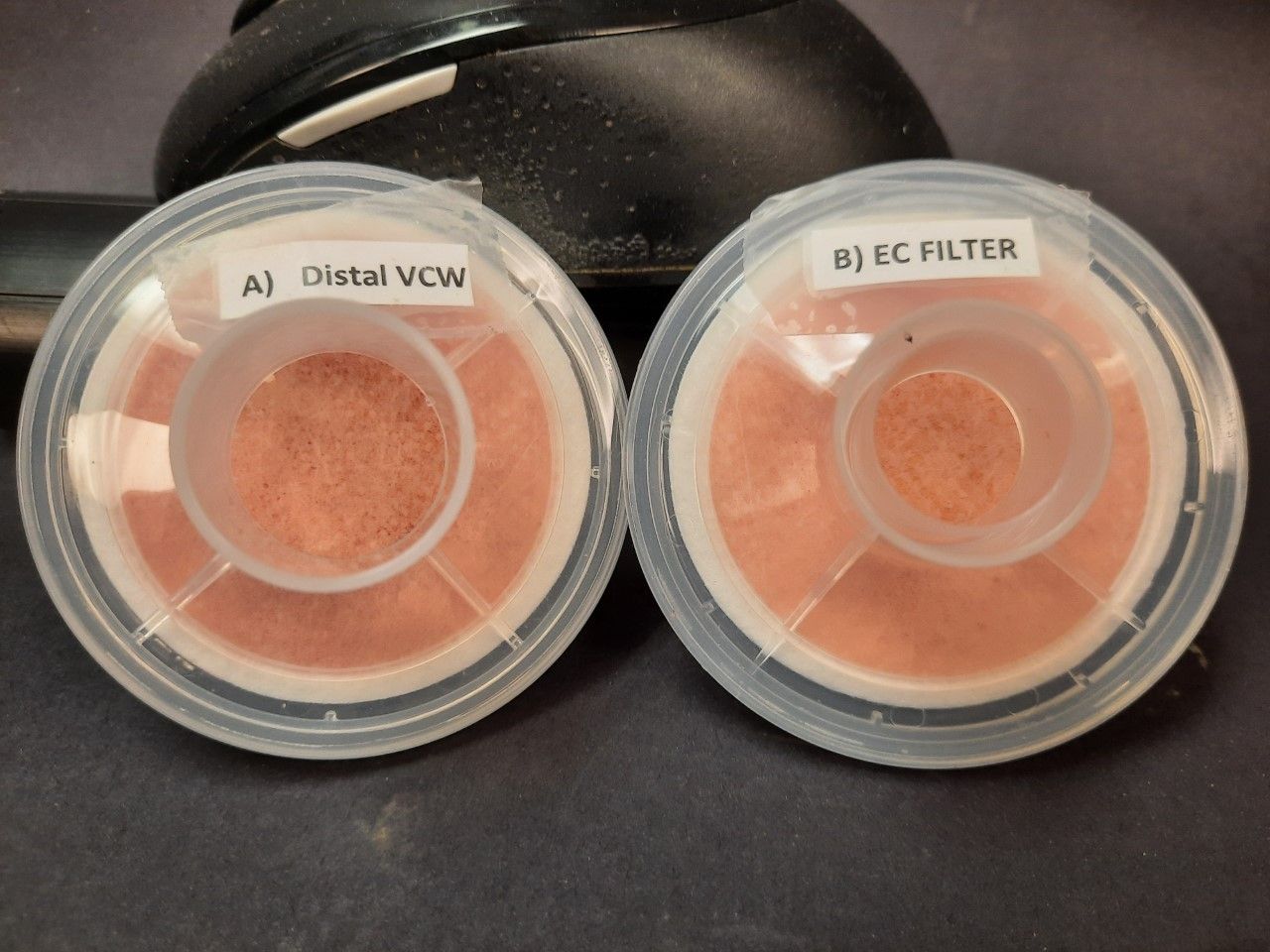
Get full access to this article
View all access options for this article.