




Abstract
Background:
Research plays a key role in evidence-based medicine, but few respiratory therapists (RTs) perform and publish research. Identifying the barriers experienced by RTs may help increase RT-driven research, thus we aimed to understand the barriers and research priorities for RTs through the use of a nationwide survey.
Methods:
A questionnaire was created by the authors after discussion with 10 experts in the field, content and convergent validity test was conducted with 20 expert participants. Upon IRB approval by University of Arkansas for Medical Sciences, a link to an anonymous online survey regarding respiratory care research including demographics, barriers, and specific research topics was posted on AARC Connect from May 18–May 27, 2022. Data analysis was descriptive.
Results:
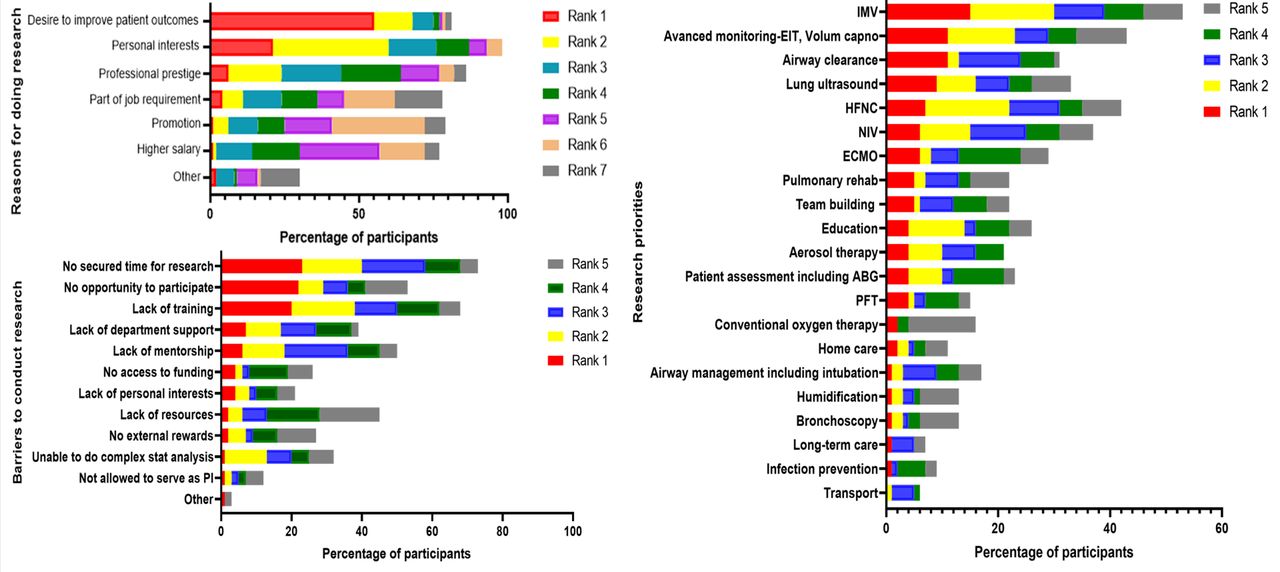
There were 86 complete responses, of whom 82 were from RTs in the United States. Among the 82 RT participants, 10 (12%) had a doctorate degree and 40 (49%) had a master’s degree, 25 (30%) had faculty appointments (Table 1). They had a mean of 25.3 ± 13.6 years of working experience, 47 (57%) published at least 1 peer-reviewed publication and a median number of peer-reviewed publications of 2 (0-9). The top 3 motivations for the participants to do research were: the desire to improve patient outcomes (55%), personal interest (21%), and professional prestige (6%) (Figure 1). In their opinion, the top 3 barriers for RTs to conduct research were: lack of secured time for research (23%), lack of opportunities to participate (22%), and lack of research training (20%). The most desired research training was one-on-one mentorship (45%). 95% of participants deemed that RTs could add valuable skillsets to the research team with the technical expertise in ventilators, hemodynamic monitoring, extracorporeal membrane oxygenation (ECMO), and intubation. The top 3 research priorities identified were: invasive ventilation, advanced monitoring such as electric impedance tomography or volumetric capnography, and airway clearance.
Conclusions:
Lack of research training and opportunities, along with the need for protected time were reported as key barriers for RTs conducting research, and one-on-one mentorship is highly desired.
Items
N (%)
Items
N (%)
Institution type
Research funding
18 (22)
Academic
63 (77)
Research types
Community
9 (11)
Quality improvement
52 (63)
Gender (male)
36 (44)
Bench evaluation
33 (40)
Job role
Clinical research
55 (67)
Staff therapist
14 (17)
Animal research
14 (17)
Supervisor
6 (7)
Surveys
36 (44)
Manager/Director
14 (17)
Research roles
Clinical specialist or educator
17 (21)
Principal Investigator
20 (24)
Research coordinator or specialist
5 (6)
Co-investigator
32 (39)
Faculty at a university or college
14 (17)
Research Coordinator
9 (11)
Years of working experience
25.3 ± 13.6
Research Assistant
18 (22)
Highest Degree Level
Data Collection
42 (51)
Associate
6 (7)
How can more RTs be engaged in research
Bachelor
26 (32)
Create funding
52 (63)
Master
40 (49)
Provide training
77 (94)
Doctorate
10 (12)
Inclusion as part as the research team
61 (74)
Type of research training received
Dedicated time
61 (74)
Graduate school or graduate level program including medical school
45 (56)
Type of training to improve research skills
Short term workshop
14 (17)
School or course work
11 (13)
One the job training
41 (50)
Workshop
29 (35)
Self-taught
36 (44)
One-on-one mentorship
37 (45)
Have not received training
7 (9)
Skill sets RTs bring to a research team
Do you have a formal research mentor?
21 (25)
Unique education curriculum
44 (54)
Publications
Close bedside involvement in patient care
69 (84)
published a paper in a peer-reviewed journal
47 (57)
Works closely with multidisciplinary team
70 (85)
published a paper in a peer-reviewed journal as a lead author
30 (37)
Technical expertise, ventilators, monitors, hemodynamic monitoring, ECMO, noninvasive ventilation, intubation
78 (95)
total number of published peer reviewed manuscripts
2 (0,9)
total number of published peer-reviewed manuscripts as lead author
0 (0,2)
Get full access to this article
View all access options for this article.