




Abstract
Background:
Compliance readings are important indications for determining and tracking lung health in ventilator patients and play a key role in determining readiness for extubation. The Hamilton C-6 (Hamilton Medical, Bonaduz Switzerland) compliance readings were compared to a bench model to determine their accuracy. Our hypothesis is there will be no difference in the compliance measurement from the ventilator compared to the set compliance of our control, the Michigan Instruments Single Adult Lung Simulator (Michigan Instruments, Grand Rapids, Michigan).
Methods:
The Hamilton C-6 ventilator was initiated in S (CMV) on the following settings: VT 500 mL, PEEP of 8 cm H2O, frequency of 12 breaths/min, and Ti of 1 s. It was attached to a Michigan Test Lung, which were set to compliances of 15, 50, and 100 mL/cm H2O. The test lung was calibrated by using the Pneuview3 (Michigan Instruments) software in conjunction with the Medgraphics (Medgraphics, St. Paul Minnesota) 3-L syringe, per Michigan Instruments instruction for use. To ensure consistent accuracy in the ventilator readings a flow sensor and leak test was performed between each run. The ventilator static compliance reading was recorded three times at each compliance and the average was recorded. The statistical difference between the set and measured compliance was also calculated and recorded.
Results:
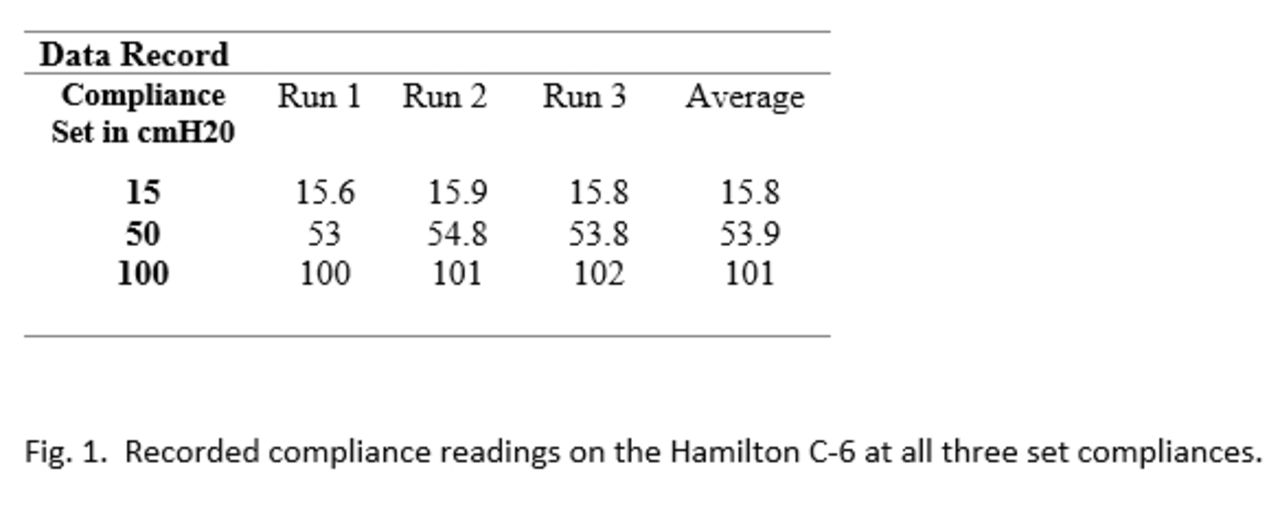
The Hamilton C-6 reading’s mean compliance results had a statistically significant difference at 15 mL/cm H2O and 50 mL/cm H2O when compared to the control (P = .01, P = .02). There was no statistical difference at 100 mL/cm H2O(P = .23). The compliance of 15 mL/cm H2O had an average of 15.8 mL/cm H2O, the compliance of 50 mL/cm H2O average was 53.9 and the compliance of 100 had an average of 101 mL/cm H2O.
Conclusions:
The Hamilton C-6 ventilator’s compliance readings at 15 mL/cm H2O and 50 mL/cm H2O were different from the bench model. Despite these findings, further research needs to be done to determine clinical significance.
Get full access to this article
View all access options for this article.