




Abstract
Background:
Respiratory therapists (RTs) provide care to patients at all stages, including at the end of life. Noninvasive ventilation (NIV) may be a part of the care strategy. However, there are few studies that explore the RT’s perspective. This study aims to understand the RT’s perception of the use of NIV at the end of life.
Methods:
An electronic survey was conducted in April 2022. The survey was distributed as a REDCap link to AARC members through the AARConnect member platform. Demographic information was collected, as was level of agreement with various NIV application scenarios involving patients with comfort measure only (CMO) orders and patients with do not attempt resuscitation (DNAR) status. The survey was declared exempt by the Rush University IRB.
Results:
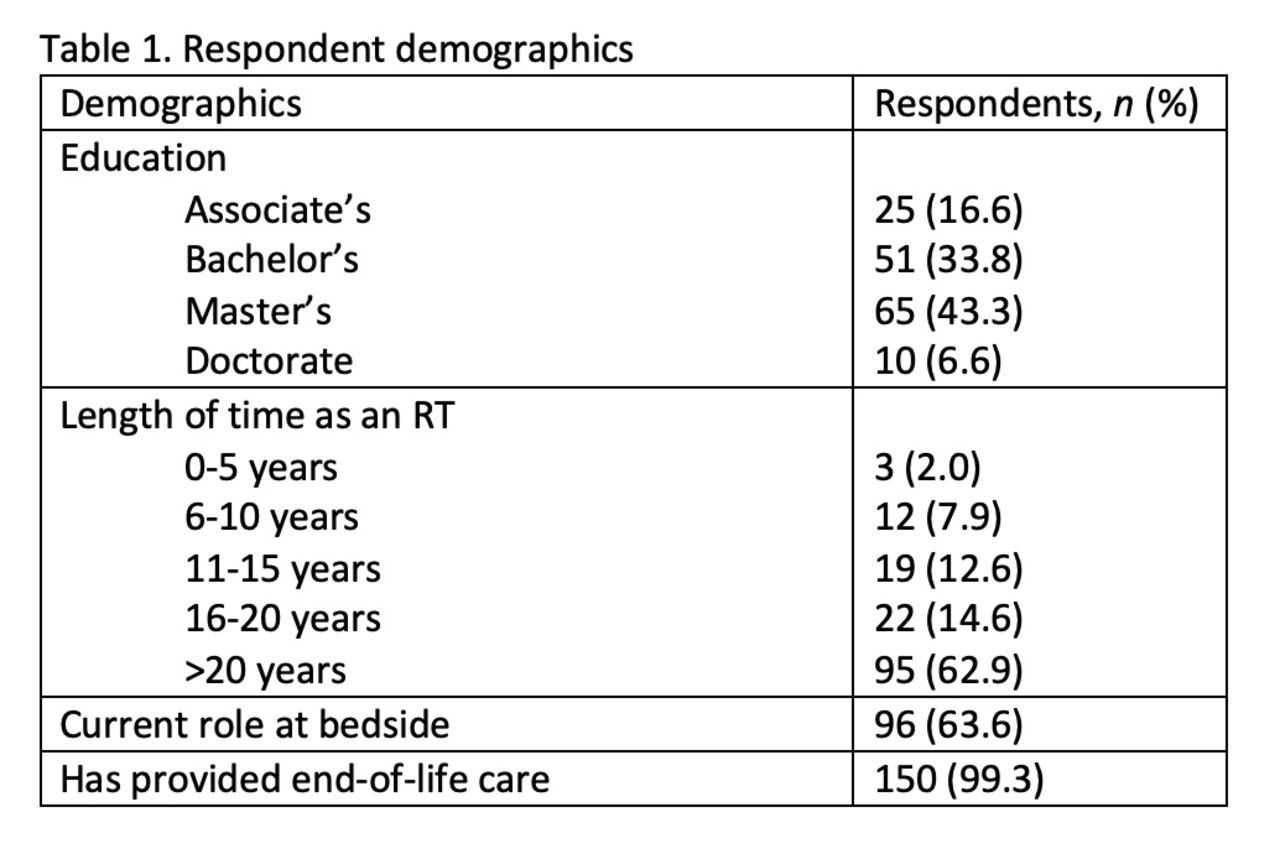
One hundred and fifty-one RTs from 39 states responded to the survey. Almost all (99.3%) of respondents indicated they have provided care to patients at the end of life. Fewer respondents agreed that NIV provided an additive effect to analgesics in patients with CMO orders (62.9%) versus those with DNAR status (81.5%) and fewer respondents agreed that NIV provided relief of dyspnea in patients with CMO orders (62.9%) versus those with DNAR status (82.8%). Only one third of respondents felt that NIV was helpful in patients with CMO orders with no contraindications, though respondents were more supportive of the use of NIV for patients with DNAR status and diagnosed COPD and cardiogenic pulmonary edema with no contraindications (63.6% and 70.2%, respectively) than the use of NIV for patients with DNAR status and malignancy or other underlying disorders. Regardless of CMO orders and DNAR status, most respondents (74.8%) agreed that it was acceptable to wean the patient from NIV but restart if the patient deteriorates. Only 17.9% of respondents agreed that it was acceptable to withdraw NIV and not restart when the patient deteriorates.
Conclusions:
Though the sample size was small, the data suggest that RTs are less supportive of the use of NIV for patients with CMO orders versus patients with DNAR status. Perceptions of NIV during end of life may depend on the patient disease processes, the care plan goals, and how NIV impacts the patient. More research is needed to understand the nuances of these situations and the RT’s perception.
Get full access to this article
View all access options for this article.