




Abstract
Background:
Aerosol delivery may be enhanced by utilizing an inspiration-synchronized nebulization mode, in which nebulization occurs only during inspiration. This study aimed to compare aerosol delivery of albuterol via a prototype of an inspiration-synchronized vibrating mesh nebulizer (VMN) with continuous VMN during invasive mechanical ventilation.
Methods:
A critical care ventilator with a heated ventilator circuit was utilized to deliver parameters of VT 420 mL, RR 16 breaths/min, PEEP 8 cm H2O, Ti 1 s, and bias flow 3.5 L/min, with humidifier temperature set at 37°C (Figure 1). The nebulizer was placed at different positions in the ventilator circuit (inlet of the humidifier vs inspiratory limb at y-piece vs between the y-piece and endotracheal tube [ETT, size 8.0 mm]). Two aerosol generation modes (inspiration-synchronized vs continuous) were compared, and a prototype VMN that generated aerosol particles < 3 µm was compared to a > 4 µm commercially available VMN (Solo, Aerogen). 1 mL of albuterol (2.5mg/mL) was used in each run (n = 5). The collection filter was placed between ETT and the model lung and removed after each run. The drug was eluted from the filter and assayed with UV spectrophotometry (276 nm).
Results:
When the VMN (Solo) was utilized, the inhaled dose was greater with inspiration-synchronized than continuous VMN, regardless of the nebulizer positions (at the inlet of the humidifier: 46.6 ± 1.9 vs 21.8 ± 2.3 %, P < .001; in the inspiratory limb close to the y-piece: 49.6 ± 2.3 vs 13.7 ± 1.7 %, P < .001; between the y-piece and ETT: 49.4 ± 1.6 vs 14.8 ± 1.9 %, P < .001) (Table 1). Regardless of the nebulizer placement and the aerosol generation mode, the new prototype of VMN (small particle) had a greater inhaled dose than VMN (Solo) (all P < .05). The inhaled dose was greater with the inspiration-synchronized VMN placed close to the endotracheal tube (all P < .001), while with continuous VMN, the inhaled dose was greater with VMN placed close to the humidifier (all P < .001).
Conclusions:
Inspiration-synchronized VMN generated 2-3 times greater inhaled dose than continuous VMN, regardless of nebulizer placement. The prototype of VMN that generated smaller particle aerosols had a greater inhaled dose than VMN (Solo), regardless of nebulizer placement and aerosol generation modes. To achieve the greatest inhaled dose with bias flow, the inspiration-synchronized VMN should be placed close to ETT and continuous VMN should be placed at the inlet of the humidifier.
Comparisons of aerosol delivery via inspiration-synchronized vs continuous vibrating mesh nebulizers at different nebulizer positions
Nebulizer Type
Placement
Inhaled Dose (%)
P-Value
Inspiration Sychronized
Continuous
Solo
Inlet of Humidifier
46.6 ± 1.9
21.8 ± 2.3
< 0.001
Inspiratory Limb at Y-Piece
49.6 ± 2.3
13.7 ± 1.7
< 0.001
Between Y-Piece and ETT
49.4 ± 1.6
14.8 ± 1.9
< 0.001
p-value
< 0.001
< 0.001
Small Particle
Inlet of Humidifier
50.4 ± 2.9
37.0 ± 1.1
< 0.001
Inspiratory Limb at Y-Piece
60.4 ± 1.8
20.4 ± 0.8
< 0.001
Between Y-Piece and ETT
61.2 ± 1.2
25.3 ± 1.1
< 0.001
p-value
< 0.001
< 0.001
Figure 1. Experiment Set-Up. A PB980 ventilator with a heated circuit was utilized to deliver parameters of VT 420 mL, RR 16 bpm, PEEP 8 cm H2O, Ti 1 sec, and bias flow 3.5 L/min, with humidifier temperature set at 37 °C. The vibrating mesh nebulizer (VMN) was placed at different locations in the ventilator circuit (inlet of humidifier, inspiratory limb at y-piece, and between y-piece and endotracheal tube [ETT, 8.0 mm]). The collection filter was placed between the ETT and model lung.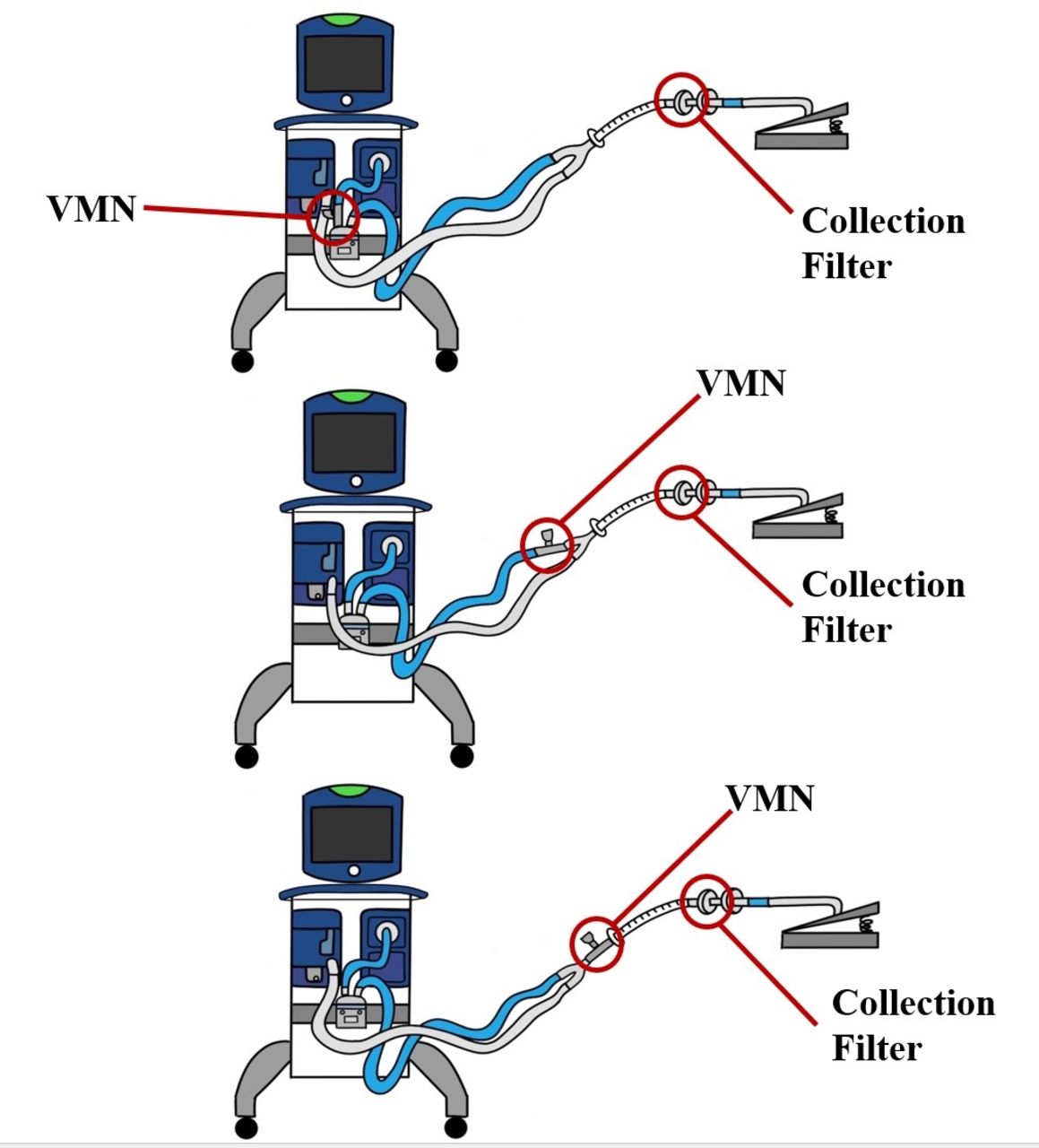
Get full access to this article
View all access options for this article.