




Abstract
Background:
During aerosol delivery via high-flow nasal cannula (HFNC), our previous in vitro study reported a higher inhaled dose with inspiration-synchronized vibrating mesh nebulizer (VMN) than continuous VMN. Recently, a prototype of VMN that generated aerosol particles < 3mm was reported to improve aerosol delivery during invasive ventilation in a porcine model, compared to the commercially available VMN (Solo, Aerogen). Its use during HFNC remains unknown.
Methods:
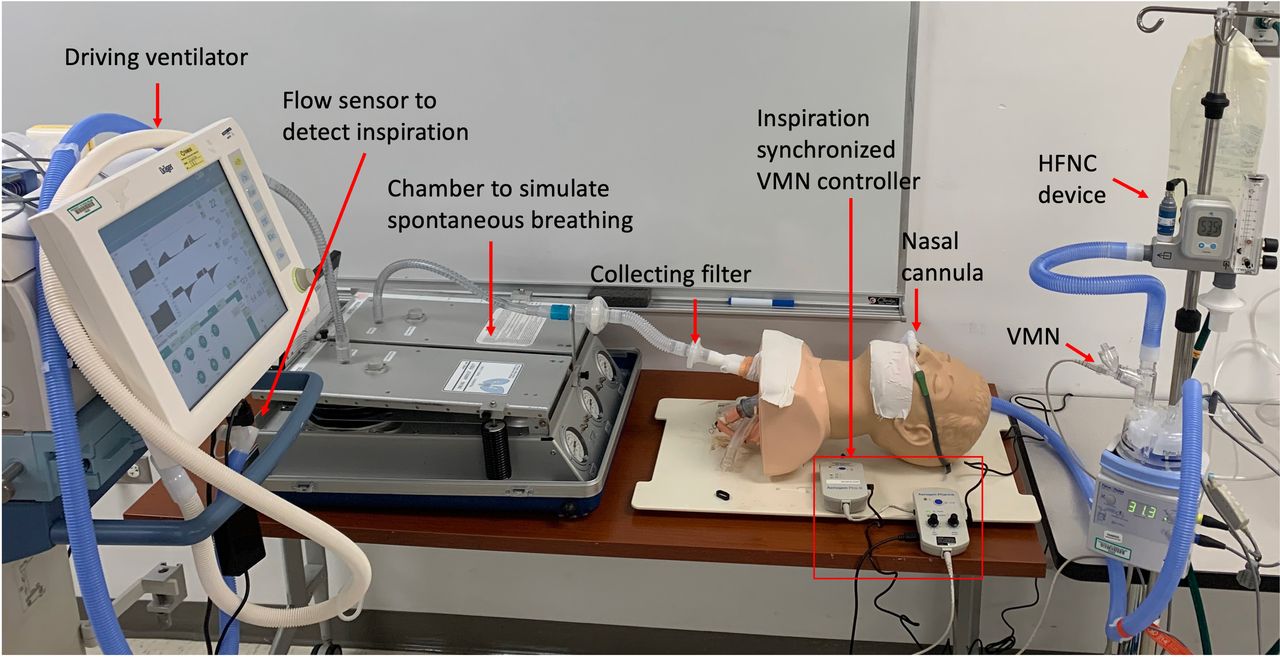
An adult manikin was connected to a dual-chamber model lung, which was driven by a ventilator to simulate spontaneous breathing (VT of 470 mL, RR 21 breaths/min, and Ti of 1.2 s) (Figure 1). An HFNC system was utilized with the temperature at 37°C with gas flows at 15, 30, and 60 L/min. Inspiration synchronized and continuous VMNs were compared at different positions (the inlet of the humidifier vs close to the nasal cannula), and small-particle VMN was compared to the commercially available VMN. 1 mL of albuterol (2.5 mg/mL) was used in each run (n = 5). The collecting filter was placed at the trachea and was removed after each run. The drug was eluted from the filter and assayed with UV spectrophotometry (276 nm).
Results:
When small-particle VMN was placed close to nasal cannula, inspiration synchronized VMN had a greater inhaled dose than continuous VMN, regardless of HFNC flows (all P < .05) (Table 1). When small-particle VMN was placed at the inlet of the humidifier, continuous VMN had a higher inhaled dose than inspiration synchronized VMN at HFNC flows of 30 and 60 L/min but not 15 L/min. Compared to inspiration synchronized VMN Solo, small-particle VMN had a greater inhaled dose at HFNC flows of 15 and 30 L/min, regardless of the nebulizer placements. The inhaled dose was higher with inspiration synchronized VMN placed close to the nasal cannula than at the inlet of the humidifier, while it was higher with continuous VMN placed at the inlet of the humidifier than close to the nasal cannula.
Conclusions:
During trans-nasal aerosol delivery, inspiration synchronized VMN delivered a greater inhaled dose than continuous VMN, and it should be placed close to the nasal cannula. The prototype of VMN that generated smaller aerosol particles could further improve aerosol delivery via HFNC.
# inhaled dose of inspiration synchronized VMN (small-particle) was compared to continuous small-particle VMN; *inhaled dose of inspiration synchronized VMN (small-particle) was compared to inspiration synchronized VMN Solo. VMN, vibrating mesh nebulizer; HFNC, high-flow nasal cannula.
View all access options for this article.Comparison of inhaled dose with inspiration synchronized vs continuous vibrating mesh nebulizer
Neb placement
HFNC flows
Inhaled dose (%) with small particle VMN
P#
Inhaled dose (%) with VMN Solo
P*
Inspiration synchronized
continuous
Inspiration synchronized
Inlet of humidifier
60
2.4 ± 0.3
5.2 ± 0.8
0.009
2.9 ± 0.6
0.047
30
5.7 ± 0.8
10.6 ± 1.4
0.009
3.6 ± 0.5
0.009
15
34.1 ± 1.4
16.7 ± 2.1
0.009
30.9 ± 0.9
0.009
Nasal cannula
60
4.3 ± 0.5
2.4 ± 0.2
0.009
4.2 ± 0.5
0.6
30
15.3 ± 0.9
6.9 ± 0.6
0.009
9.4 ± 0.7
0.009
15
33.5 ± 1.3
14.8 ± 1.1
0.009
18.1 ± 0.7
0.009
Get full access to this article