




Abstract
Background:
Fugitive aerosols from nebulizers are a great concern for health care workers as they administer aerosol therapy in a close distance, as well as for patients in a shared hospital room during the COVID pandemic. With a distressed respiratory pattern, patients tend to breathe forcefully which might distribute fugitive aerosol to a further distance. We aimed to evaluate the concentrations of fugitive aerosol with normal and distressed breath patterns with different interface at various distances.
Methods:
A breath simulator (Michigan Instrument) was connected to an adult intubation mannequin with a normal breath pattern (VT 500 mL, rate 15 breath/min, and inspiratory time to inspiration time (I/E) 1:3) and a distressed breath pattern (VT 500 mL, rate 30 breath/min, and I/E 1:1). A jet nebulizer filled with a united-dose salbutamol (5 mg/2.5 mL, GSK Inc.) and powered by compressed gas at 8 L/min was connected to three commercially available face masks: an aerosol mask with open side-holes, aerosol masks with the closed feature of a non-rebreathing mask, and an AerosoLess mask. Fugitive aerosol was measured by an aerodynamic particle sizer (GRIMM Corp) with measurement ranged 0.225 - 34 µm for aerosol concentrations, and the sizer was placed at 0.8 m (where a care provider stands), 1.8 m (the end of a bed), and 2.2 (distance between two hospital beds) from the face of the mannequin. Aerosol particle counts were sampled for a total of 30 min, including 5 min for baseline detection, 6 min for nebulization, and 19 min for the aerosol count returned to baseline. Experiments were repeated five times.
Results:
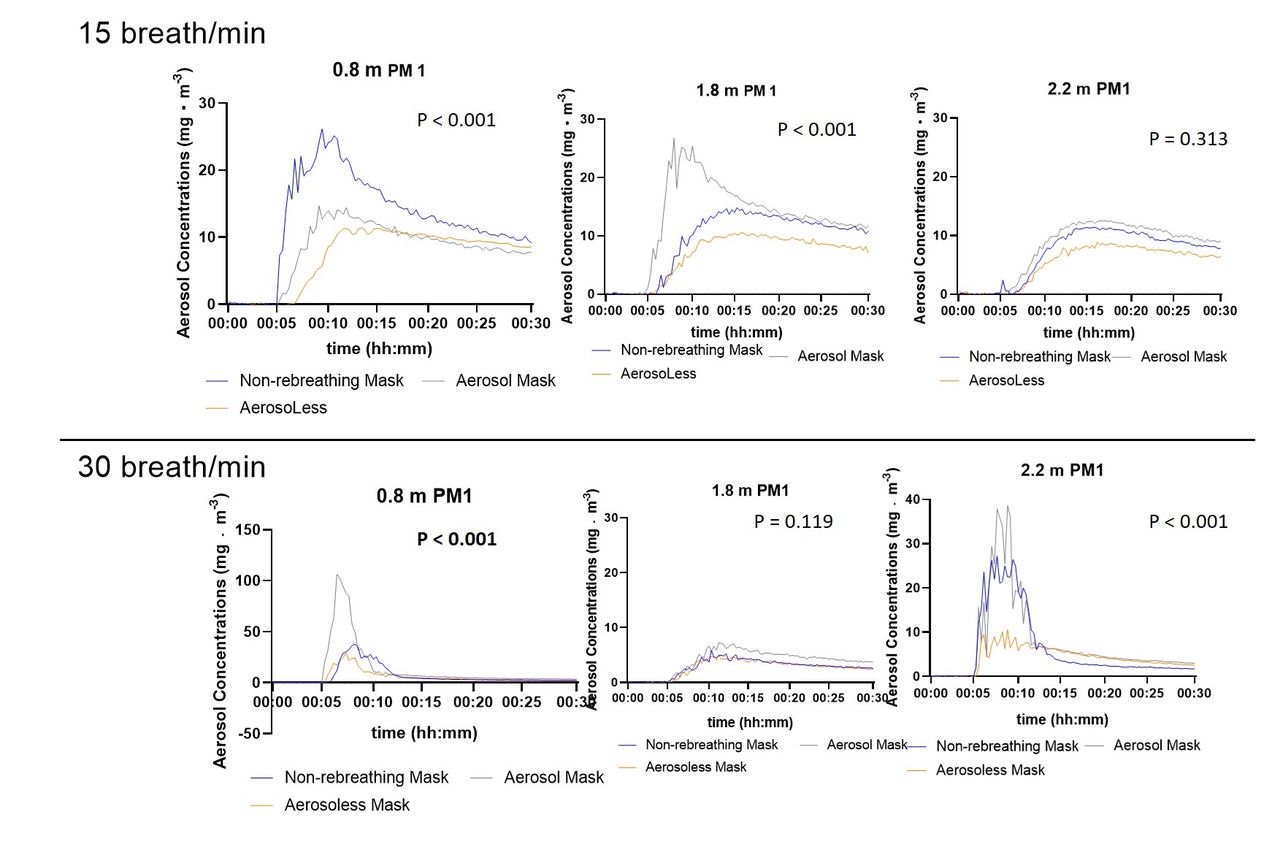
The figure below illustrates the aerosol concentrations with particle sizes of 2.5 µm and 1.0 µm with three masks at different distances. The aerosol concentrations during normal and distress breathing patterns were different at the three distances. Use of a standard aerosol mask with side-holes at a close distance under distressed breathing pattern yielded a 4-fold greater aerosol concentration at 0.8 m and 2-fold greater at 2.2 m.
Conclusions:
Breath patterns and mask features influence fugitive aerosol concentration during nebulization. The masks with closed features can eliminate fugitive aerosol at any distance.
Comparisons of aerosol concentrations with particle size of 2.5 µm with three masks at different distances. Comparisons of aerosol concentrations with particle size of 1.0 µm with three masks at different distances.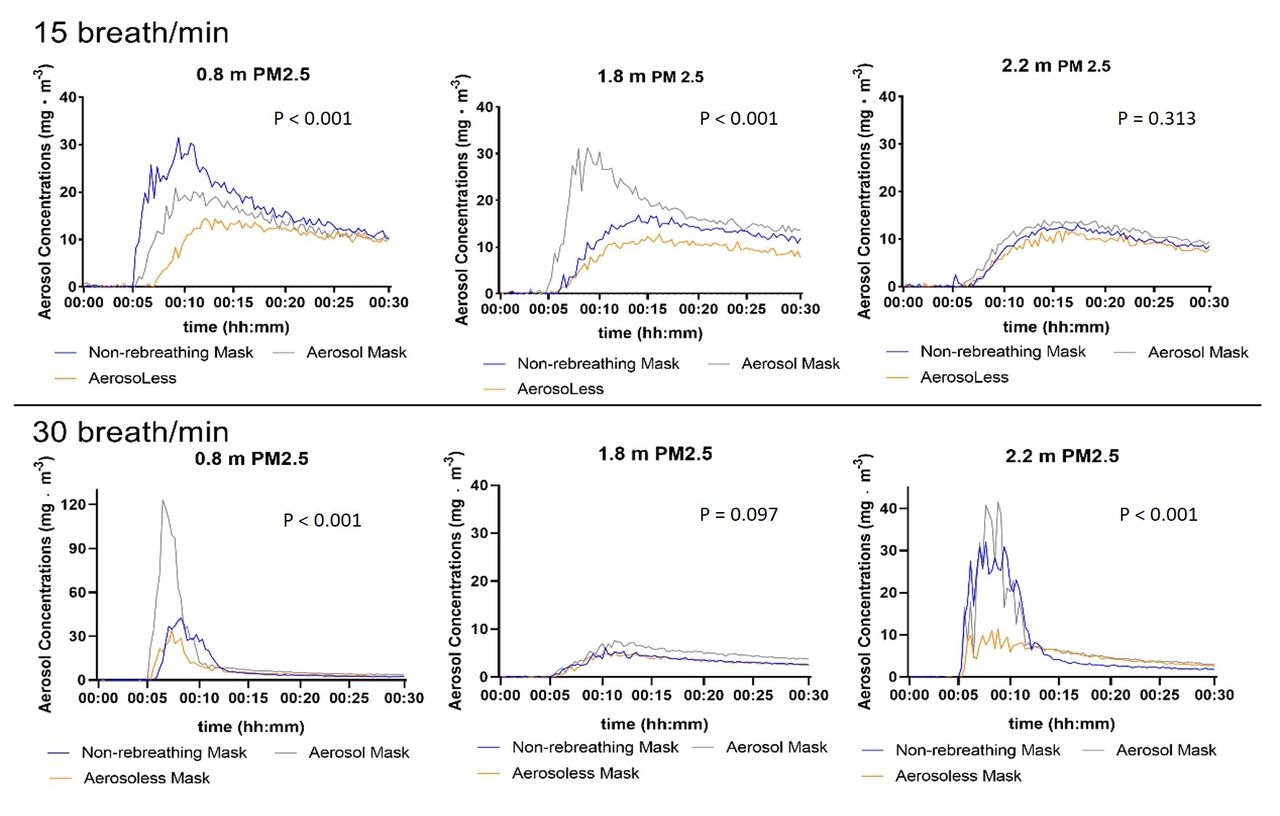
Get full access to this article
View all access options for this article.