




Abstract
Background:
A common concern with using masks to provide supplemental oxygen is claustrophobia experienced by the patient. The mask covers the nose and mouth limiting oral intake and speaking. An open concept mask (OCM) has been developed which has been suggested to address this issue while still maintaining sufficient delivered oxygen concentrations (FDO2).
Methods:
Four types of oxygen masks were evaluated, a simple mask, the OCM, a Venturi mask, and a non-rebreather (NRB). Each mask was mounted onto a piece of card stock with the sides of the masks sealed to the card stock. Each mask was connected to an oxygen flowmeter set at one of four flows (3, 6, 8, and 15 L/min). In addition, to simulate flow demand, tubing connected to suction was inserted into the volume of the mask with flows of -2, -4, -6, and -8 L/min. FDO2 was determined by inserting an oxygen analyzer through a port cut into the card stock. FDO2 was recorded once the measurement stabilized. Data was analyzed using ANOVA with P < .05 as significance.
Results:
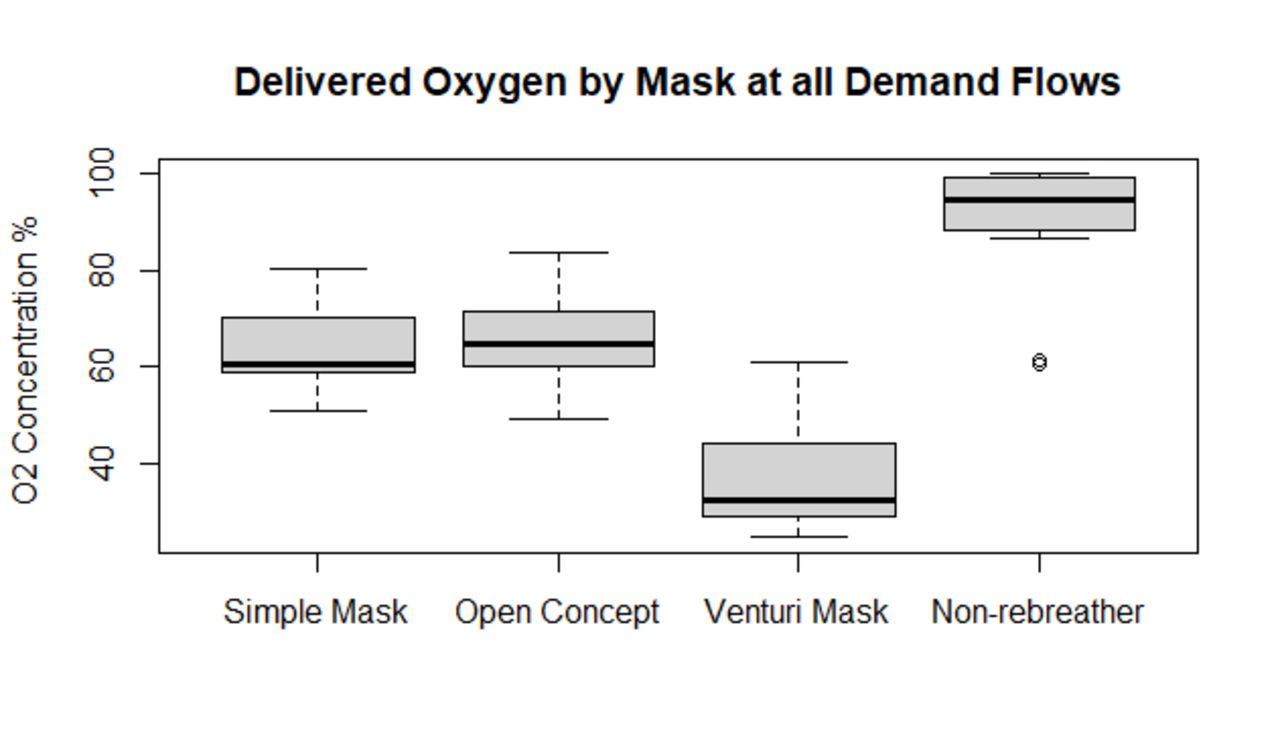
Overall mean FDO2 for the OCM was 0.66 ± 0.11 and 0.64 ± 0.10 for the simple mask, P < 0.01. The demand flow had no effect on FDO2 between the simple mask and the OCM P = .46. When compared to the NRB, mean FDO2 0.78 ± 0.17, P < .01
Conclusions:
The OCM has similar function to the standard simple mask. When compared with the NRB, the FDO2 was higher for the NRB, but less affected with increases in demand flow. The difference between the simple mask and the OCM is unlikely to be clinically significant. The non-rebreather and Venturi mask were able to supply consistent FDO2 regardless of the draw flow or the mask flow. Further investigation of this mask should be considered.
Get full access to this article
View all access options for this article.