




Abstract
Background:
For HFNC continuous infusion aerosol therapy, infusion rates for vasodilators are calculated by body weight-based protocol. Clinical response may be limited by aerosol losses and limitations of nebulizer output. Conventional nebulizers generate aerosol separate from high gas flow. Breath enhanced jet nebulization (BEJN) combines the energies of nebulizer jet flow plus cannula high flow to generate aerosol and overcome these limitations. BEJN may therefore increase drug delivery beyond typical levels at the highest flows to the cannula. To test this hypothesis, we used real time measurement of radiolabeled aerosol delivery to compare BEJN to a conventional vibrating mesh (VMN) system.
Methods:
The experimental in vitro setup is detailed in posters by McPeck et al. The heated Fisher & Paykel Optiflow circuit and cannula was interfaced to a 3D-printed nasal/head model. An inhaled mass (IM) filter placed distal to the model’s hypopharynx was connected to a Harvard pump for distressed ventilation (f 30 breaths/min, VT 750 mL, DC 0.5). A shielded ratemeter was positioned over the IM filter for real-time measurement of radioaerosol activity accumulating on the filter. Tc-99m radiolabeled 0.9% saline as a tracer was infused at rates of 5 to 60 mL/h for the BEJN and 5 to 20 mL/h for the VMN. HFNC gas flows of 10, 20, 30, 40, 50, and 60 L/min were used. IM data/min was converted to µg of salt (NaCl) and plotted versus time. The slope of each experimental condition represented the drug delivery rate (µg NaCl/min).
Results:
For each gas flow, aerosol delivery was a function of infusion rate and gas flow. Delivery that would have decreased with increasing gas flow was balanced by increases in infusion rate. Maximum infusion rate for VMN was 20 mL/h and 60 mL/h for BEJN, resulting in greater delivery for BEJN. For example, for the high flow of 60 L/min (Figure), rates of delivery ranged from 3.2 to 330.2 µg NaCl/min (BEJN) vs 23.6 to 104.5 µg NaCl/min (VMN). Overall, for all gas flows, BEJN maximal dosing ranged from about 2 to 4 times the VMN rates.
Conclusions:
BEJN utilized the high gas flow passing through the nebulizer to increase nebulizer output significantly beyond conventional technology. For clinically relevant high gas flows, the wide range in BEJN delivery may allow individualized treatment of critically ill patients by titrating delivery to clinical response, and by employing a wider range of infusion rates, rather than a weight-based dosing protocol.
Rates of HFNC drug delivery for combinations of nebulizer infusion flow and HFNC gas flow for VMN and BEJN.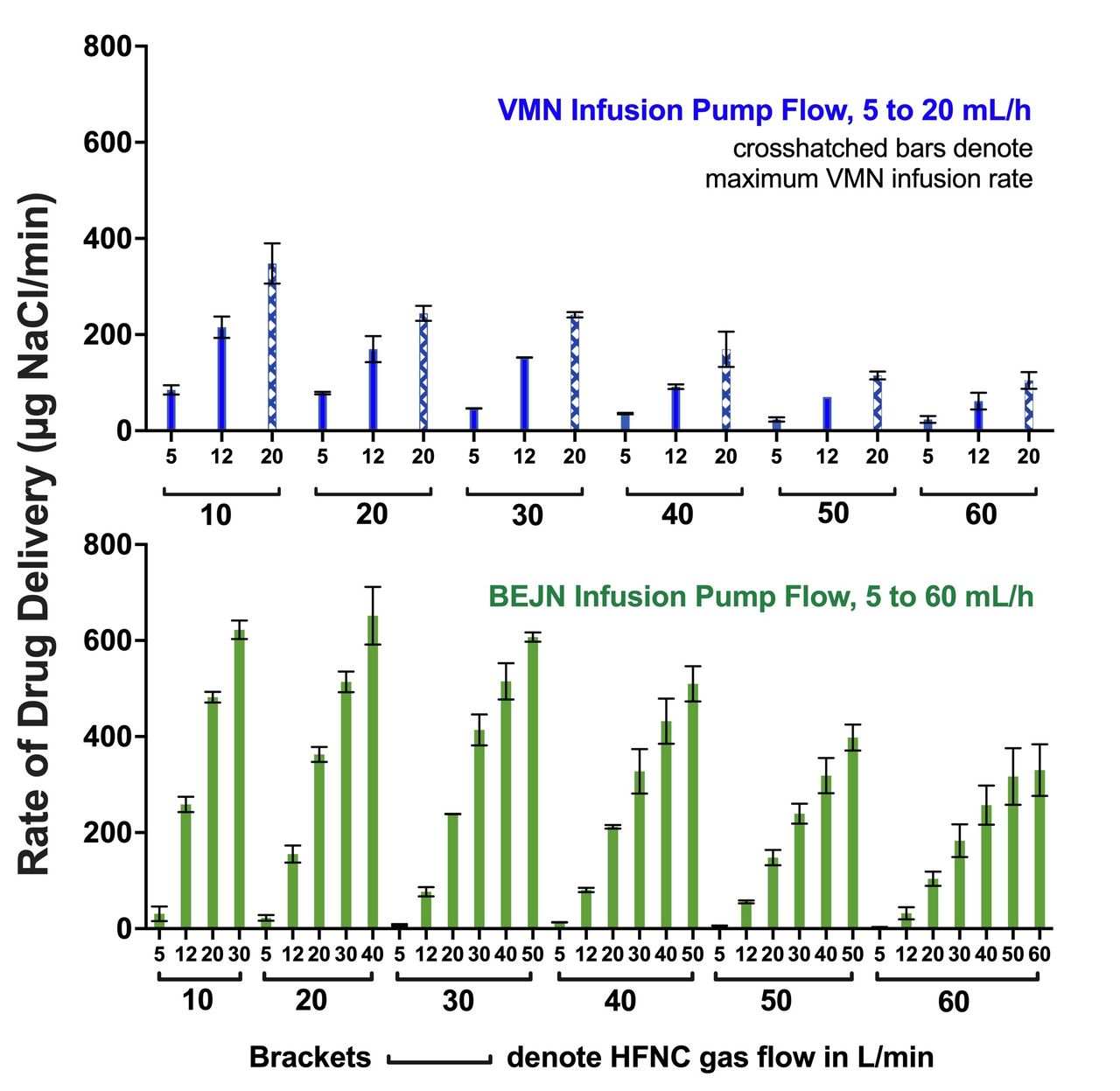
Get full access to this article
View all access options for this article.