




Abstract
Background:
HFNC oxygen therapy is routinely used to treat patients with gas flows of 30–60 L/min. Trans-nasal aerosol delivery is reduced at higher cannula gas flow. A new application of breath-enhanced jet nebulizer (BEJN) technology may reverse this occurrence. To test this hypothesis, the present study measured aerosol outputs during continuous infusion by applying a humidified gas flow of 60 L/min directly to a prototype BEJN. Results were compared to conventional vibrating mesh nebulizer (VMN) technology.
Methods:
In principle, BEJN uses the high flow gas to the cannula passing through it, combined with the high-pressure flow to the nebulizer jet orifice (5 L/min) to generate aerosol. BEJN output, therefore, should increase with increases in total gas flow to the cannula. The limitations of BEJN were first defined using visual assessment, and then confirmed by sampling radiolabeled aerosol. At a given combination of gas flow and infusion pump flow, the nebulizer residual volume was observed after 20 min of operation to define maximal infusion pump rates that generated a visual aerosol cloud without solution accumulating in the nebulizer. Then, using the clinical maximum gas flow of 60 L/min, radiolabeled saline was infused at 5, 12, 20, 30, 40, 50 and 60 mL/h for the BEJN and 5, 12, 20, and 30 mL/h for the VMN. Inhaled mass (IM) was measured for each infusion pump flow in real time using a ratemeter and output was defined as IM (% of syringe charge) per min.
Results:
At 60 L/min gas flow, VMN aerosol output (IM) ranged from 0.06 to 0.29 %/min and reached maximum output (started to fill) at an infusion rate of 20 mL/h (Figure). For the same gas flow, the maximum output of the BEJN was visualized at an infusion rate of 60 mL/h. Radiolabeled aerosol experiments confirmed the visual observations. For the BEJN, IM increased from 0.01 to 0.62 %/min as infusion rate was increased (Figure).
Conclusions:
HFNC drug delivery is limited by aerosol loss in the circuit and at the nasal interface. These limitations can be overcome by increasing nebulizer output. For conventional jet nebulizers and VMNs, aerosol delivery is constrained by limitations in nebulizer output. Breath enhancement increases drug output by several fold over conventional technology. BEJN potentially can deliver drug at all relevant HFNC gas flows, facilitating a dose response assessment based on clinical needs at the highest HFNC gas flows by simply adjusting the infusion rate during therapy.
Rate of drug delivery for VMN and BEJN at 5 to 60 L/min. VMN not shown at >20 L/min due to overfilling.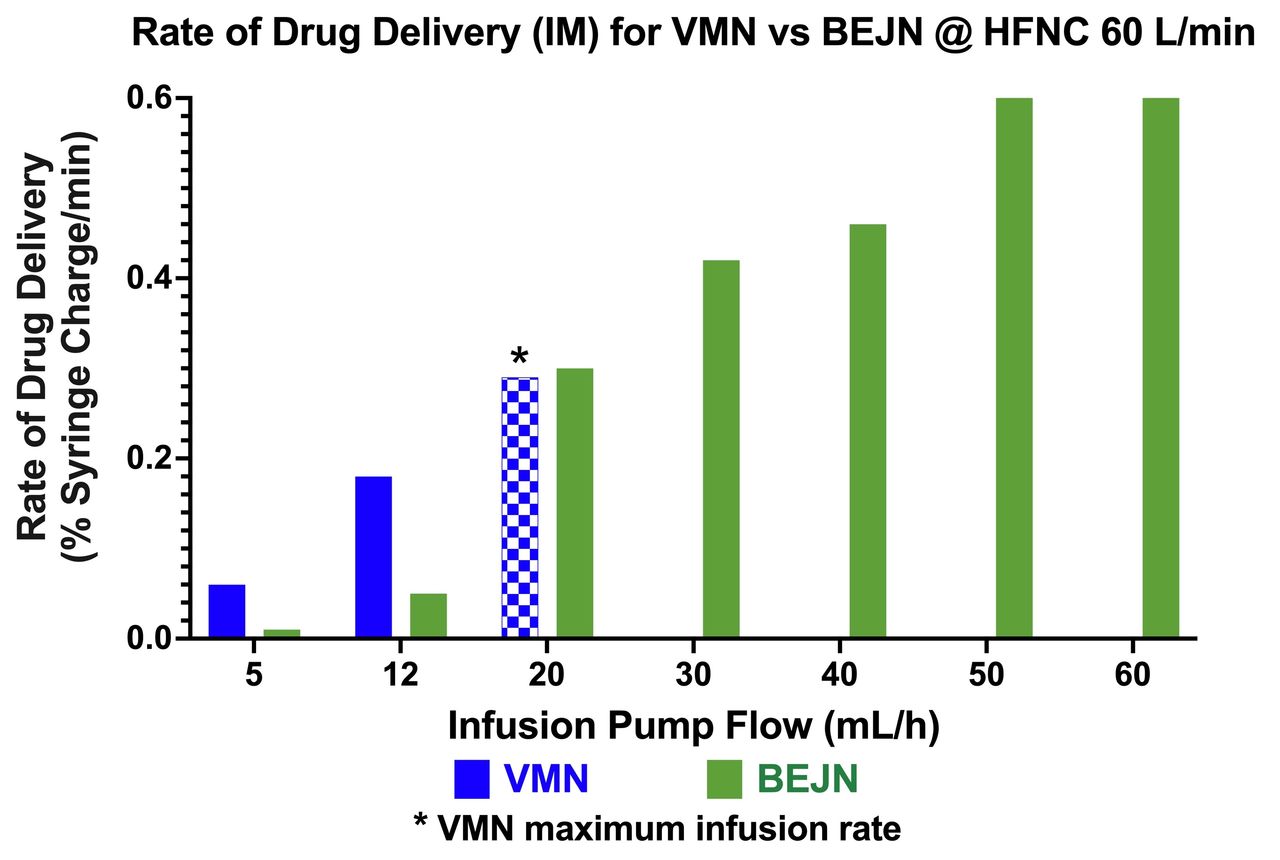
Get full access to this article
View all access options for this article.