




Abstract
Background:
The goal of this bench study was to simulate continuous infusion nebulization of short-acting drugs (albuterol/epoprostenol) during HFNC therapy to test the real-time gamma ratemeter technique with trans-nasal aerosol delivery to detect and measure inhaled mass (IM) dynamically during experiments.
Methods:
A breath-enhanced jet nebulizer (BEJN) operated in a heated Fisher & Paykel Optiflow HFNC system with a medium cannula fitted to a 3D-printed head model with nasal airway (described in poster by McPeck and Smaldone) was tested during continuous infusion aerosol delivery (10 mL/h). A sine-wave piston ventilator provided a distressed breathing pattern (f 30 breaths/min, VT 750 mL, DC 0.50). Gas flows to the HFNC were deliberately changed between 30 and 60 L/min at 30-min intervals. Radioactive (99m-Tc) saline was infused continuously by 60-mL syringe pump or 500-mL IV bag pump into the BEJN. A shielded gamma ratemeter was oriented to measure radioaerosol accumulating on an IM filter 18-in distal to the hypopharynx of the head model. Radioactivity measured at 5-min intervals, expressed as gamma counts/min, was graphed in real time in Microsoft Excel to allow visualization of aerosol delivery rate against time.
Results:
The effect of changing gas flow through the BEJN to the cannula every 30-min was immediately visualized in real time. Radioactivity delivered by syringe pump, measured by the ratemeter, and graphed against time quantitatively reflected accumulation of trans-nasal radioaerosol on the IM filter (Figure) as evidenced by different slopes for each condition (colored lines). Another test with a 500-mL IV bag/peristaltic pump showed no difference between infusing the nebulizer with an IV pump vs a syringe pump. A similar test run with different nebulizer infusion flows also demonstrated ability of the ratemeter to detect dynamic changes in aerosol delivery to the IM filter.
Conclusions:
Real-time ratemeter monitoring and measurement of radioactivity accumulating on an IM filter provides instantaneous updates of inhaled drug delivery during in vitro testing procedures. The ratemeter also provides detailed analysis of the impact of total gas flow to the cannula and/or the infusion flow to the nebulizer that influence continuous infusion drug delivery during HFNC therapy. This method of analysis facilitates appraisal of nebulizer output and enables assessment of HFNC drug delivery dynamically under changing conditions.
Ratemeter gamma counts vs time with changes in HFNC gas flow.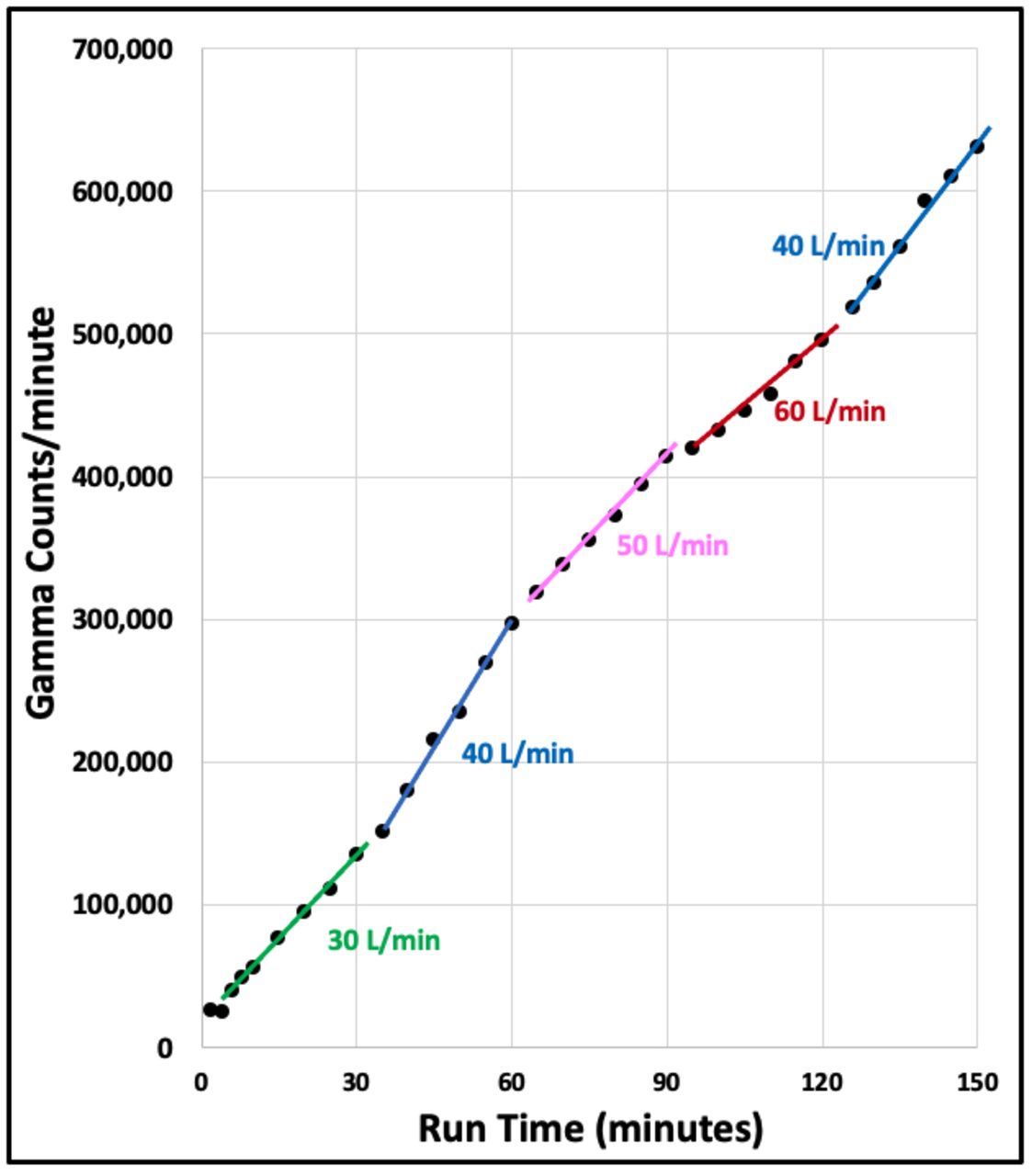
Get full access to this article
View all access options for this article.