




Abstract
Background:
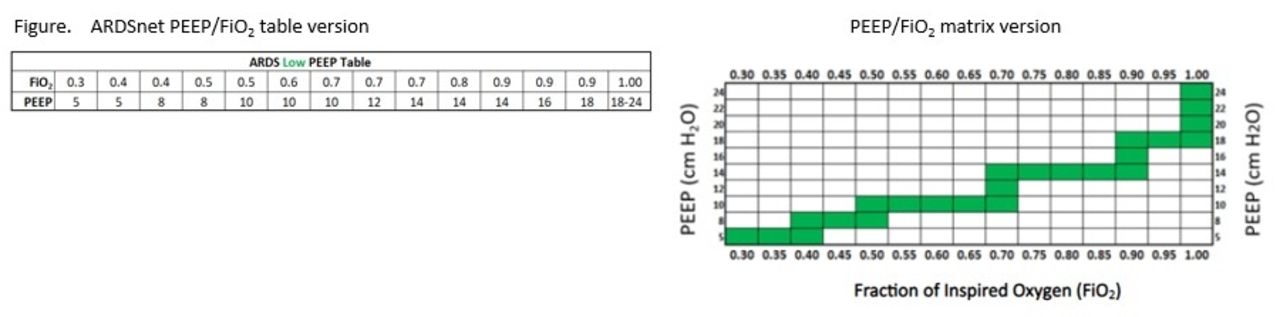
Several methods exist for determining optimum PEEP in ARDS patients. Chiumello’s study supports use of ARDSnet PEEP/FIO2 tables over other methods (PMID: 24434443). A previous QI project uncovered an unexpected inherent ambiguity leading to errors in interpreting tables. This ambiguity creates a problem for two reasons. First without a true table interpretation to follow, tracking adherence to protocols is impossible. Secondly, it introduces unnecessary variability in study results. The purpose of this study was to transform the ambiguous ARDSnet tables into explicit PEEP/FIO2 matrices showing acceptable setting pairs (ie, on the ARDSnet tables) and to determine error of respiratory therapists’ (RTs) interpretations using actual patient data. We hypothesized that RT error in determining acceptability of patient data pairs will be lower for explicit matrices.
Methods:
We transformed the ARDSnet PEEP/FIO2 tables into explicit high and low PEEP/FIO2 matrices (Figure). Next, PEEP and FIO2 data from patients with ARDS with orders to follow the PEEP/FIO2 table were extracted from the hospital electronic medical record. Data pairs (both on and off the table) were used to create a survey. RTs were asked to use first the ARDSnet PEEP/FIO2 tables and then the corresponding explicit matrices to designate whether each data pair was on or off the table/matrix. Surveys were scored according to the number of incorrect interpretations of paired data. Mean error values for table vs matrix were compared using t-test with P < .05 indicating significance.
Results:
We collected data from 43 RTs. For the low PEEP/FIO2 data, mean error was 5% for the table version vs 4% for the matrix version (P = .539). For the high PEEP/FIO2 data, mean error was 4% for the table version vs 2% for the matrix version (P = .011).
Conclusions:
In general, the error we observed in interpreting PEEP/FIO2 tables was no more than 5%. Expressing the ARDSnet PEEP/FIO2 table as a matrix reduces interpretation errors. This effect was only significant for the high PEEP/FIO2 matrix. We recommend using the matrix version of the ARDSnet PEEP/FIO2 tables to potentially improve patient care and facilitate adherence to protocols.
Get full access to this article
View all access options for this article.