




Abstract
Background:
Does a bedside practitioner-led rounding format lead to an increase in interdisciplinary communication? We believe so, by allowing the RT and RN to present the appropriate patient system during daily rounds. This was a change from the current practice of NP and resident-led rounds.
Methods:
An interdisciplinary taskforce was formed that developed a survey for the PICU. The survey used a Likert scale (0-5) to assess components of the rounding format (level of participation, efficiency, important and redundant data shared, level of comfort speaking, questions addressed, satisfaction, clarity of overall plan). The taskforce then met monthly to create a new rounding format with an accompanying rounding tool (patient data sheet organized by system updated q shift). After 6 months of planning and preparing, we trialed this new rounding format with RTs presenting the respiratory system and RNs presenting all other system reviews, concluded by a closed-loop recap led by the resident or NP. Members of the taskforce performed random audits for data collection over the next 6 months after implementation. The taskforce then sent out another, post-implementation, Likert scale survey to the PICU.
Results:
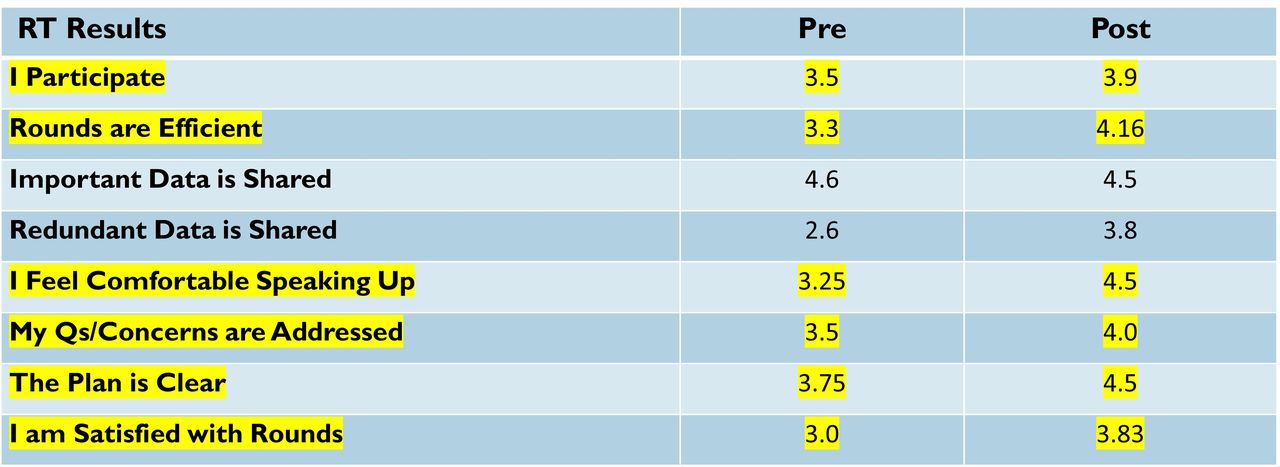
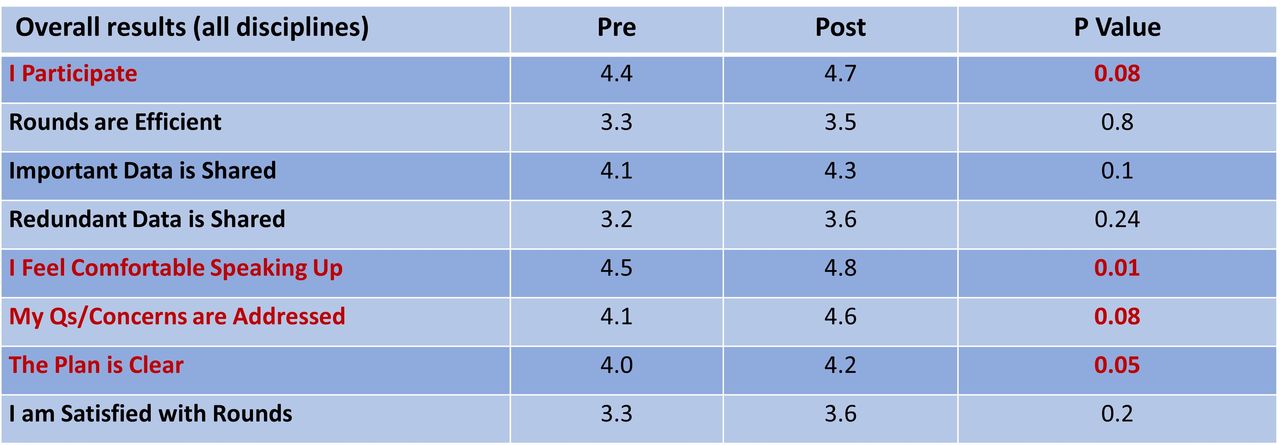
The results of our post-survey indicated an overall positive change in the way our staff felt about the rounding process. There was strong evidence (P = .01) that people were more comfortable speaking up, moderate evidence (P = .05) that the plan of care was clearer, and weak evidence (P < .1) that people participated more, and their questions/concerns were addressed more. When the results were looked at by role, RTs responded positively in all categories except for two - important or redundant data being shared.
Conclusions:
By switching our rounding format to one with RT/RN-led discussions, we were able to measure a significant increase in the level of interdisciplinary communication. Our post-survey results indicated that staff were more likely to engage in the discussion as well as understand the plan afterward. This supports the hypothesis that a beside practitioner-led rounding format can lead to an increase in interdisciplinary communication.
Get full access to this article
View all access options for this article.