




Abstract
Background:
The palpation technique utilized when performing an arterial puncture is often not described or is illustrated as a technique in which two fingers perpendicular to the artery are utilized. A single-finger technique might be simpler to palpate and mentally visualize the artery. Aligning the finger linearly with the artery might provide a more precise target – the center of the fingernail. This single finger aligned linearly (SAL) palpation technique was compared to a multi-finger aligned perpendicular (MAP) palpation technique. The authors conducted this study to determine if palpation technique can affect the number of puncture attempts required to obtain an arterial blood sample.
Methods:
Fifty volunteer participants were randomly assigned to one of two groups and taught either the MAP technique (n = 24) or SAL technique (n = 26). After instruction and practice each participant’s ABG sampling performance was evaluated utilizing an arterial puncture training simulator and each participant completed a perception survey. Exemption was granted by the Youngstown State University IRB.
Results:
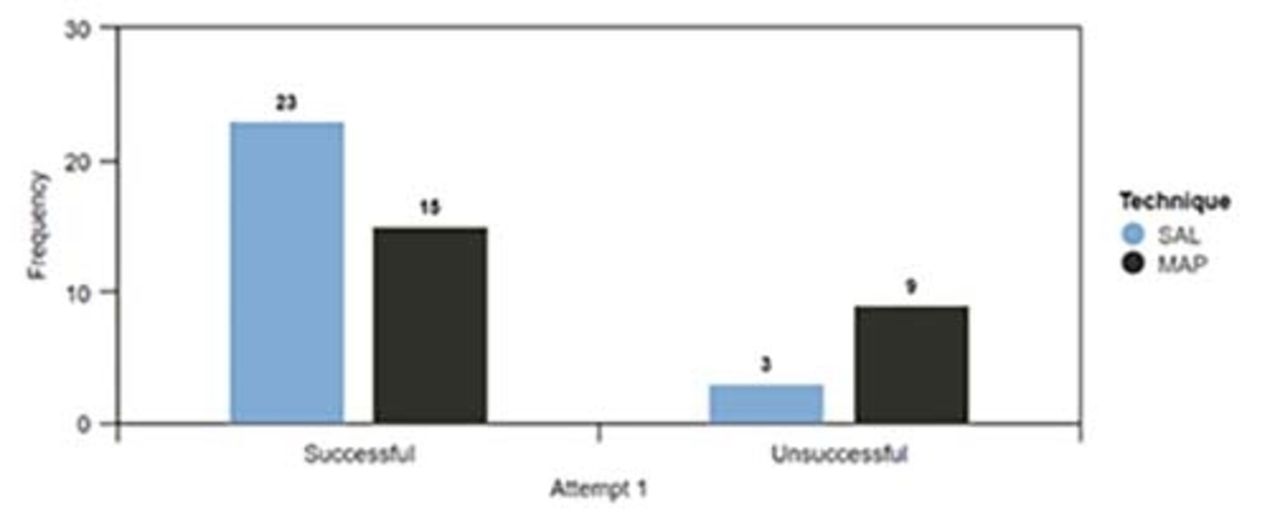
The participants were predominantly female (88%), with a mean age of 23 years. All participants largely perceived that the training prepared them to obtain an arterial sample (MAP: agreed or strongly agreed (n = 23, 96%); SAL: agreed or strongly agreed (n = 25, 96%)). Linear regression and binary linear regression analysis were conducted (alpha = 0.5). The results of the linear regression model were significant, F (1,48) = 4.82, P = .033, R2 = 0.09. The MAP technique significantly predicted attempts, B = 0.51, t (48) = 2.20, P = .033. Moving from the SAL to the MAP technique will increase the mean number of attempts needed to obtain a sample by an average of 0.51. The binary logistic regression model was also significant, χ2 (1) = 4.76, P = .029. The effect of the MAP technique was significant, B = -1.53, OR = 0.22, P = .040, indicating that this technique decreases the odds of obtaining a sample on the first attempt by approximately 78.26% relative to the SAL technique.
Conclusions:
The results of this study suggest that moving from the MAP to the SAL technique will decrease the number of attempts required to obtain a sample and increase the odds of obtaining a sample on the first attempt. Reference: Analysis conducted and reports/results drafted in part using Intellectus Statistics Online computer software 2021. Intellectus Statistics. https://analyze.intellectusstatistics.com/
Multi-finger Aligned Perpendicular (MAP) and Single-Finger Aligned Linearly (SAL) Palpation Techniques Barplot of Attempt 1 by Technique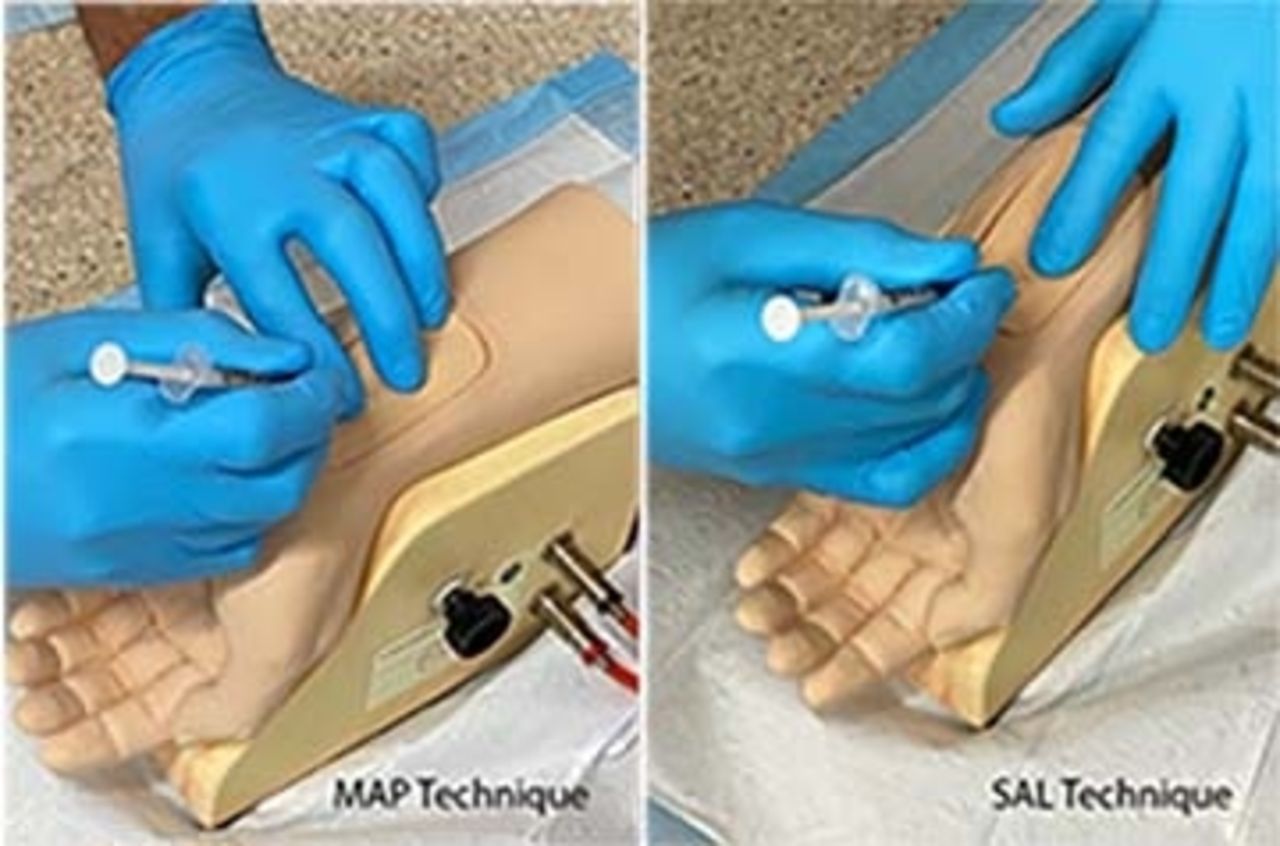
Get full access to this article
View all access options for this article.