




Abstract
Background:
Prolonged mechanical ventilation (PMV) is usually defined as the need for mechanical ventilation for longer than 21 days. It maybe come from some patients have unbalanced respiratory loading and muscle function because of their own disease and body states while weaning from the ventilator. Recently, it is an important issue to improve the success weaning rate and finding out the influencing factors. Unfortunately, various clinical studies are not clear about the prognosis and value of different indicators. It reminded us of using the various clinical values and indicators of PMV patients in our hospital to find out the weaning factors.
Methods:
We collected the baseline characteristics of the patients in the first 3 days of admission. These characteristics included APACHE II score, age, and laboratory data and these characteristics were recorded by reviewing the hospital information system. In more detail, the laboratory data included complete blood count (CBC), electrolyte, liver function, inflammatory biomarkers, renal function, and thyroid function. Clinical outcomes, including weaning rate and analyzing the good weaning characteristics and indexes of PMV patients who successfully weaned from the ventilator in our hospital. We use Mann Whitney U test to analyze and compare the continuous variables between the two groups. A P value of < .05 using a 2-sided test was considered statistically significant. The Institutional Review Board of Show Chwan Memorial Hospital (1091002) approved the study. Since this was a retrospective study, the requirement for informed consent was remitted.
Results:
From the collected 65 patients, 45 were successful in weaning (69.2%) and 20 failed (30.8%). We found the successful weaning group at the time of admission had a higher Glasgow coma scale (GCS) (7.27 ± 2.73 vs. 5.22 ± 2.82, P = .01), a lower APACHE II (20.44 ± 3.47 vs. 26.3 ± 3.36, P < .001), the value of free thyroid was higher (0.97 ± 0.25 vs. 0.78 ± 0.17, P = .027), the value of albumin was higher (3.09 ± 0.44 vs. 2.6 ± 0.46, P = .001), higher calcium (8.67 ± 0.77 vs. 8.23 ± 0.81, P = .042), lower C-reactive protein values (3.57 ± 3.34 vs. 6.36 ± 4.25, P = .02), aspartate transaminase (40.63 ± 27.07 vs. 76 ± 41.28, P = .001) (Table 1).
Conclusions:
In this study, we are finding that APACHE II, GCS, albumin, calcium, CRP, Free T4, GOT are the important weaning factors for PMV patients. This study allows us to focus precisely on the weaning of PMV patients. And identifying risk factors for successful weaning helps us optimizing weaning strategies.
Table 1 . Comparison factors of success and failure weaning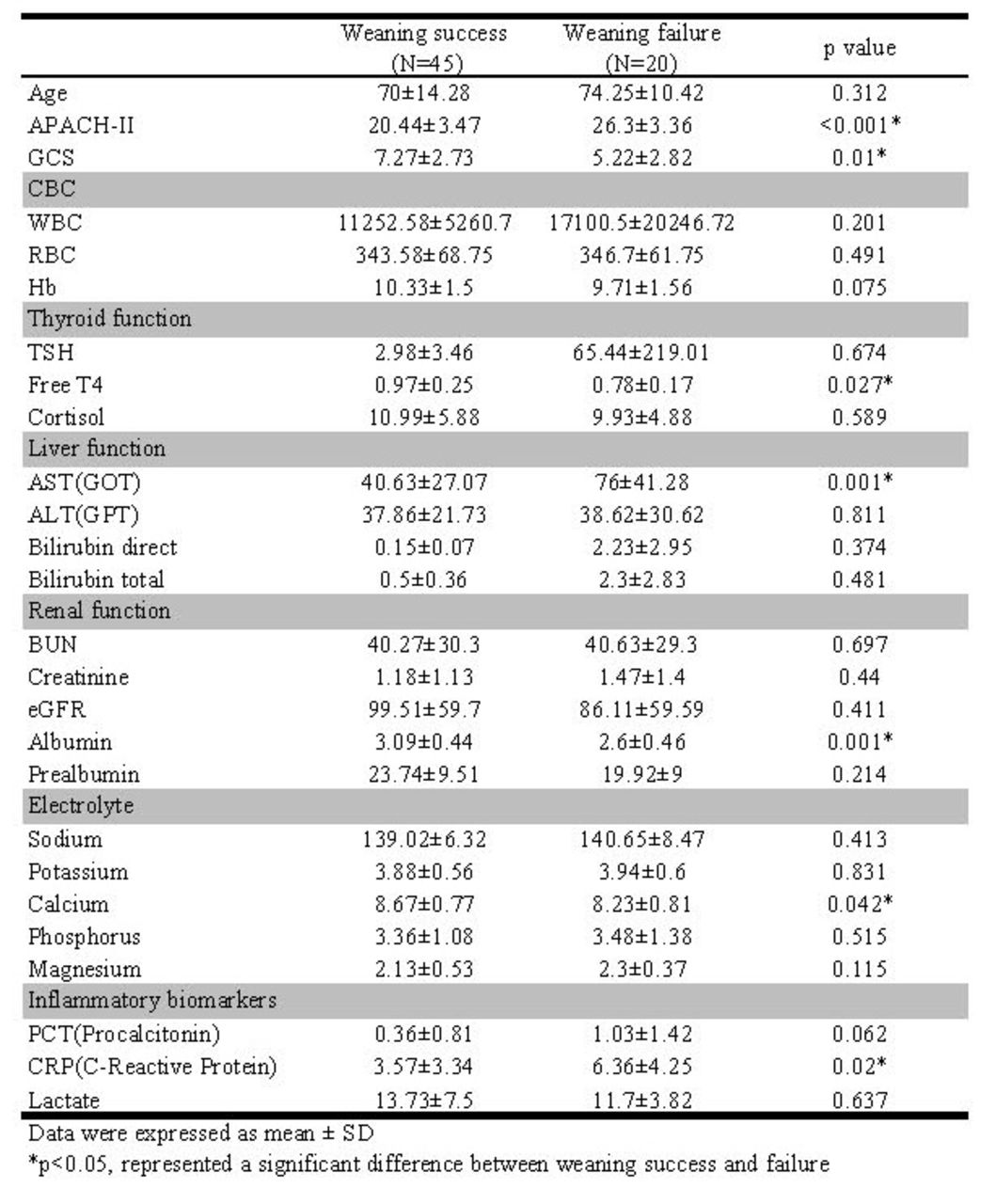
Get full access to this article
View all access options for this article.