




Abstract
Background:
Bronchopulmonary dysplasia is a complex pulmonary complication of prematurity, with limited tools for understanding the underlying lung dz. While cutting-edge 1H chest ultrashort echo time (UTE) MRI techs have overcome many of the challenges associated with x-ray and CT. These modalities depict lung parenchymal macrostructure, providing an incomplete pic of lung function. Hyperpolarized 129Xe gas MRI is an established, non-ionizing tech in pediatrics and adults for sensitively measuring lung function, including ventilation, microstructure, and gas exchange, but has not yet been implemented in infants. Here, we demonstrate feasibility, challenges, and preliminary 129Xe ventilation MRI findings with comparison to structural 1H UTE MRI.
Methods:
IRB approved chest MRI was acquired in 2 non-sedated preterm males (Sub A and Sub B) with severe BPD on a NC using a neo,1.5T scanner and home-built frequency-switch1H/129Xe coil. Coronal 2D 129Xe ventilation slices were acquired via gradient-echo for Sub A and spiral for Sub B. 129Xe gas (100% concentration, ∼40% polarization) was delivered via FM and Tedlar bag compression (3-sec breath-hold with O2 suspended; ∼15 cm H2O). HR and SpO2 were monitored by a RT before, during, and 2 mins after delivery. Following coil-frequency switch without patient repositioning, 3D radial 1H UTE images were acquired during tidal breathing.
Results:
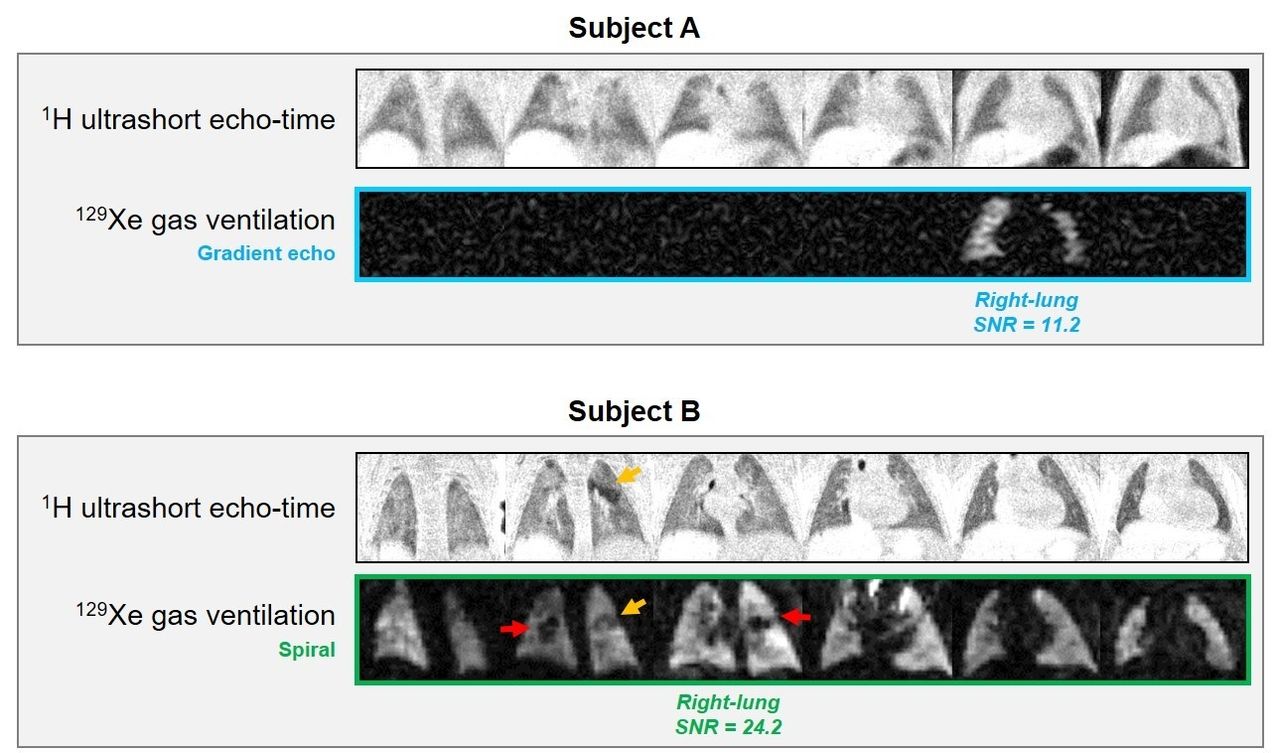
HR and SpO2 were within 40 beats/min and 8% of baseline after 2 min, with no safety concerns at follow-up. Maintaining pressure was challenging, with fluctuations throughout each breath-hold; this likely resulted in significantly improved spiral 129Xe image-quality (Sub B) compared with Cartesian (Sub A), by virtue of repeated k0 sampling (R lung SNR = 24.2 and 11.2, respectively). Comparisons in Sub B reveal a ventilation defect that may be attributable to an air-trapped region (yellow arrows), and 2 large ventilation defects that are less easily attributable to structural pathologies (red arrows).
Conclusions:
We demonstrated preliminary feasibility of neonatal 129Xe MRI, with tolerance consistent with older pediatric studies. Gas delivery and acquisition design are likely challenges for future consideration. Detection of focal ventilation defects via 129Xe MRI that appear unassociated with structural pathologies may provide a new imaging biomarker of regionally impaired lung function, with strong potential value in management of BPD and other lung diseases in infancy, in both the neonatal period and beyond.
Get full access to this article
View all access options for this article.