




Abstract
Background:
The Philips Trilogy 202 ventilator is often used as a home ventilator for ventilator dependent patients. In preparation for its discontinuation, we evaluated the Trilogy EV300 (EV300) as its manufacturer replacement. The EV300 is equipped with permanent tubing compliance (TC) which results in higher volumes delivered than the 202 and restricts use to larger pediatric patients. We aimed to determine if the humification feature on the EV300 had an effect on volumes delivered in consistent and reproduceable way that could expand use in patients who require tidal volumes below the minimum 50 mL setting.
Methods:
A Philips EV300 equipped with a F&P 114 circuit and MR850 heater with a Philips Respironics whisper swivel valve which was interfaced with a Philips NM3 (pediatric adapter) and connected to a Michigan Test Lung (TL). TL compliance (CL) was set at 0.005 & 0.002 L/cm H2O in two models to simulate CL of a normal infant and decreased CL. The EV300 settings included: pediatric category, adult circuit (20-22 mm), AC/VC, RR 15, Ti 0.6 s, PEEP 5. At each CL, 6 trials were performed with 3 VTs (50 mL, 100 mL, 150 mL) with the humidification feature either ON or OFF. After stabilization, pressure and volumes were recorded as displayed from the EV300 and NM3 3 times, 1-min apart and then reported as averages.
Results:
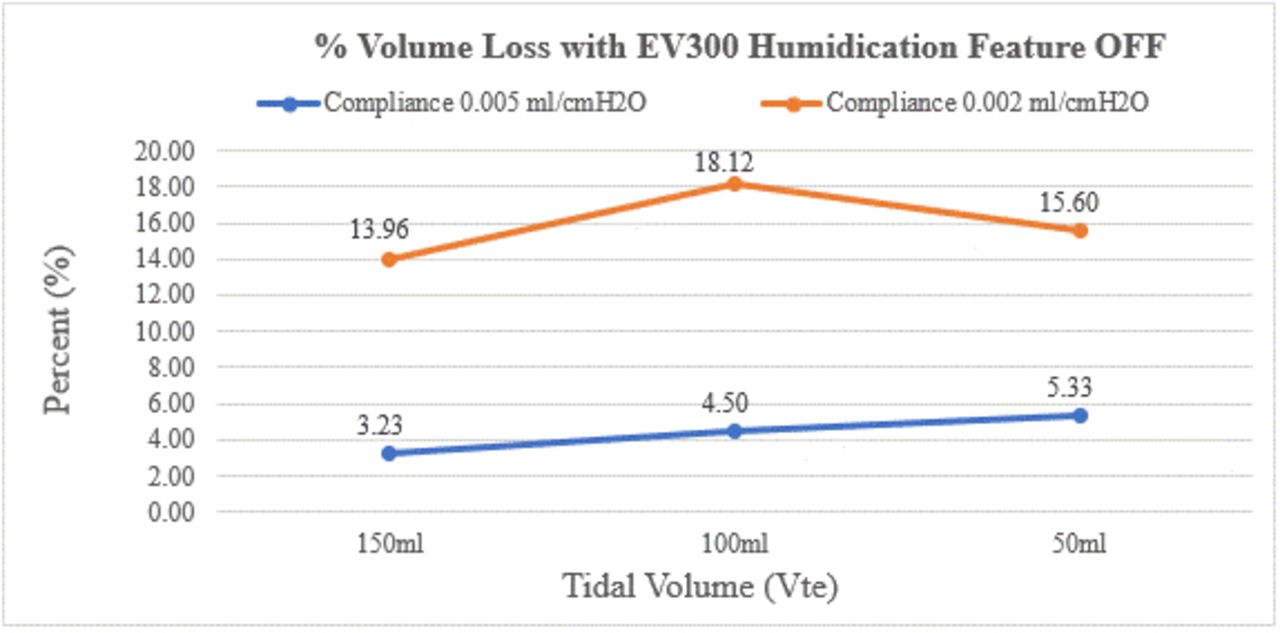
With the humidification feature OFF volumes delivered by the EV300 were decreased by an average of 10% from set VT (Figure 1 and Table 1). This phenomenon is enhanced (up to 18% difference) in the decreased CL model. Differences in volume loss with the humidification feature ON and OFF is not consistent between models and is dependent on a variety of other factors such as: set volume, ΔP, and patient lung compliance and resistance.
Conclusions:
Volume reduction from the humidification feature ON/OFF on the EV300 are present but not independently predicable. The changes in functionality between the 202 and EV300 impact the use and flexibility within pediatrics. Further studies must be performed to access outcomes in pediatrics related to transitions from critical care ventilator to EV300. Data with other CL and/or resistance models would be beneficial to reveal possible patterned correlations.
Table 1 shows the measured differences in pressures on volumes in our bench model.
Figure 1 shows the percentage difference in volumes and pressure when the humidification feature is OFF on the EV300 ventilator. View all access options for this article.Pressure and Volume Comparisons
Compliance 0.005 Humidification Feature ON
Compliance 0.005 Humidification Feature OFF
Compliance 0.002 Humidification Feature ON
Compliance 0.002 Humidification Feature OFF
Set VT (EV300)
50mL
50mL
50mL
50mL
Vte(NM3)
50mL
47.33mL
47mL
39.67mL
PIP (NM3)
15 cmH20
15 cmH20
29 cmH20
25.67 cmH20
Set VT (EV300)
100mL
100mL
100mL
100mL
Vte (NM3)
96.33mL
92mL
75.67mL
78.33mL
PIP (NM3)
24 cmH20
23 cmH20
52 cmH20
44 cmH20
Set VT (EV300)
150mL
150mL
150mL
150mL
Vte (NM3)
144.33mL
139.67mL
148mL
127.33mL
PIP (NM3)
33.67 cmH20
33 cmH20
78.33 cmH20
67.33 cmH20
Get full access to this article