




Abstract
Background:
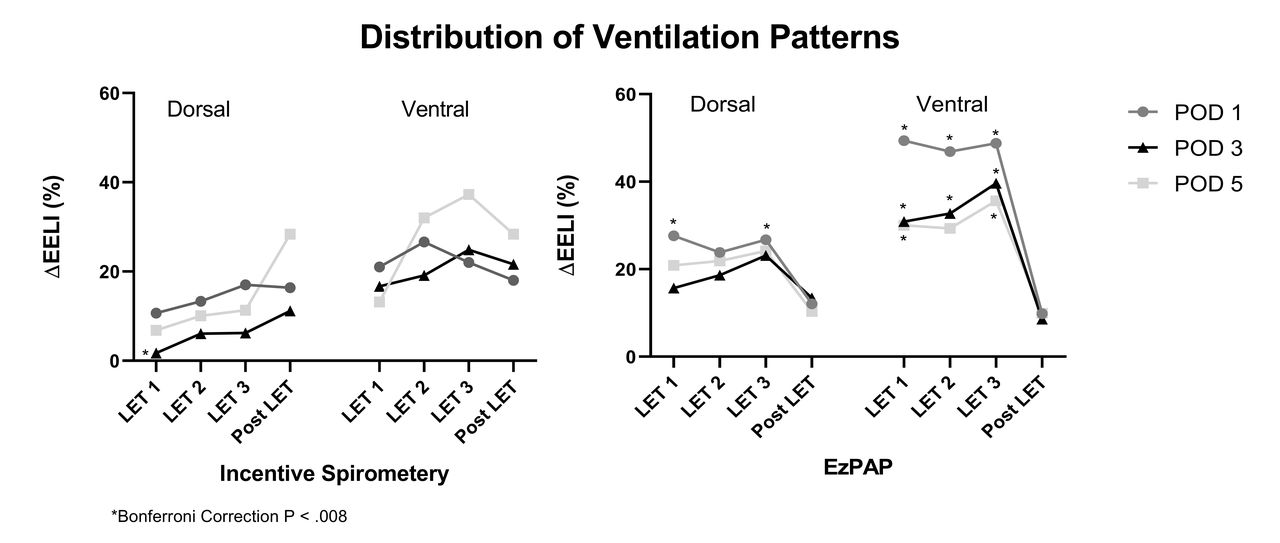
Lung expansion therapy (LET) in post-operative upper abdominal surgery patients is not well described beyond global indicators for patient improvement. Electrical impedance tomography (EIT) reveals changes in lung volume and is an objective measurement tool for lung expansion in patients undergoing LET. The primary purpose of this study is to describe the distribution of ventilation during incentive spirometry (I.S.) and EzPAP comparing breath cycles during LET and post LET period.
Methods:
This is a secondary analysis of an IRB approved randomized control trial on dorsal redistribution of ventilation comparing IS to EzPAP LET after upper abdominal surgery. Subjects were allocated to receive LET with IS (n = 56) targeting predicted inspiratory capacity or EzPAP (n = 56) targeting 15 cm H2O TID on postoperative days (POD) 1-5. An EIT device (Pulmovista 500; Dräger) was connected to subjects for a single LET session on POD 1, 3, and 5 to measure changes in during breath cycles of LET end-expiratory lung impedance (ΔEELI%) and post LET ΔEELI%. LET sessions with EIT included 2-min normal breathing, 3 breath cycles x 10 breaths, and 2-min normal breathing after breath cycle 3. The EIT device was removed after monitoring sessions. LET cycle ΔEELI% was compared individually to the post LET ΔEELI% measurement with a paired samples T-test. Data are reported as mean (SD). Effect size is described by eta squared (η2). Alpha (2-tail) is .05. A Bonferroni Correction was applied due to the multiple comparisons in each group (P < .008)
Conclusions:
Increases in distribution of ventilation seen during EzPAP in dorsal and ventral regions were not sustained and decreased immediately following termination of therapy. Dorsal distribution of ventilation during I.S. increased with successive LET cycles and was maintained post LET, but the increases seen in the ventral regions were not maintained.
Get full access to this article
View all access options for this article.