




Abstract
Background:
Esophageal balloon catheters can be used to estimate effort of breathing by measuring the change in pressure during inspiration (dPes) as well as estimating actual pleural pressure (Pes) for transpulmonary pressure calculations. The reliability depends on balloon filling volume. We evaluated the accuracy of pediatric and adult sized esophageal balloons over a range of balloon inflation volumes and surrounding pressures to measure dPes and Pes, and sought to derive an algorithm for inflation which would be accurate for both values.
Methods:
Esophageal catheters housed in a model esophagus (6Fr pediatric and 8Fr adult) were submerged to depths of 5, 10, and 15 cm of water within a sealed chamber. dPes was simulated by attaching a syringe to the top of the chamber to create cyclic negative pressure. Balloon inflation volume was adjusted for each catheter and the difference between dPes and delta chamber pressure was reported as total error (dPes) and the difference between Pes at baseline and the water depth was reported as total error (Pes). An algorithm was developed using Pes values and inflation volume to estimate the optimal filling volume, and error at this filling volume was reported.
Results:
Over or under-inflation of the balloon results in significant error for both dPes and Pes. The range of inflation volume with minimal error < 3cm H2O, is larger for the adult catheter (0.2-0.8ml) than it is for the pediatric catheter (0.2-0.4ml). When applying the filling volume derived from the algorithm, total error ranged from -2.8 to 1.0 cm H2O, for both dPes and Pes.
Conclusions:
Esophageal balloon inflation volume affects the accuracy of dPes and Pes, particularly with smaller pediatric balloons. However, a calibration algorithm which targets stability on the balloon elastance curve can be applied to ensure accuracy of both dPes and Pes, and should be used in-vivo.
Total error of dPes (white triangles) and Pes (black circles) as a function of esophageal balloon filling volume, stratified by simulated pleural pressure (water depth) and catheter size. Vertical black lines show the location of the optimal filling volume identified by the algorithm that seeks to identify the beginning of the flat part of the esophageal balloon elastance curve.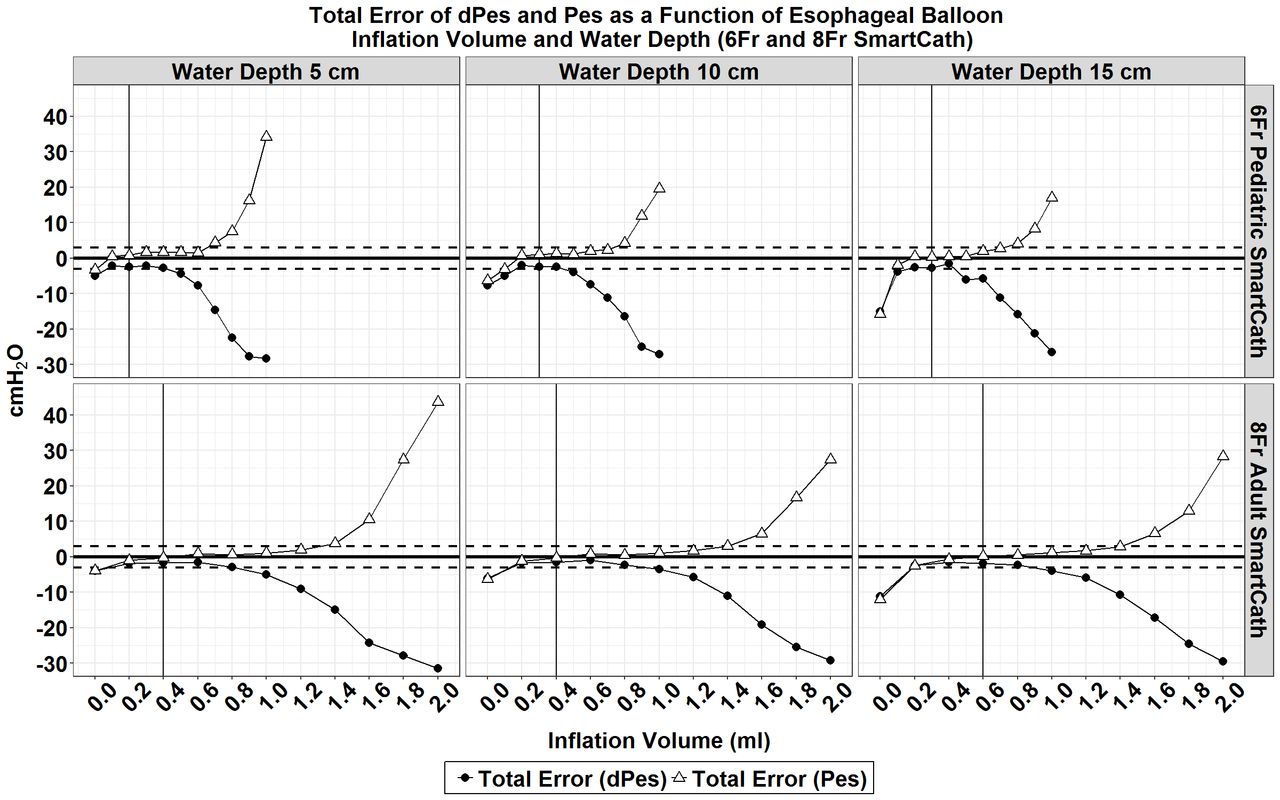
Get full access to this article
View all access options for this article.