




Abstract
Background:
Automated Dispensing Cabinets (ADC) are a pharmacy adjunct that assists hospital pharmacies in ensuring medication is safely stored and delivered at the point of care. One of the functions of ADC is the ability for users to override medications. The Joint Commission recommends that medication overrides only occur in emergent situations. When medications are removed via override, the risk for adverse events increases. We aimed to establish a benchmark for ADC overrides for aerosolized medications at a children’s health care system.
Methods:
IRB approval was obtained to conduct this retrospective single-center study. This study was performed at a 200-bed pediatric hospital (Level 1 Trauma Center, Level 4 NICU) and was part of a performance improvement project. The observation time of this trial was from January 1st to March 31st, 2019. All medications were maintained and dispensed via Pyxis ADC using standard medication procurement procedures. The override function allows for the clinician to obtain medications independent of a physician’s order if approved by the institution. A standard dispense is any medication dispensed with the patient’s name, medical record number, and physician’s order. An override dispense is any medication dispensed to a clinician without a physician order as required for a standard dispense. The pharmacy team downloaded all medication data from the Pyxis server to an Excel spreadsheet for review. The following data was collected: number of drugs dispensed, date and time of dispense, name and profession of the clinician requesting the medication, type of medication, and type of dispense (standard or override).
Results:
A total of 24,114 aerosolized medications were dispensed in the 3-month observation phase. 0.8% of the aerosolized medications were obtained via ADC override. See graph for additional information.
Conclusions:
This study can be used to develop and establish a benchmark for aerosolized ADC medication overrides. The total number of aerosolized medications that were overridden by the RT Team was minimal but accounted for 16.5% of total ADC medications for our institution. It is important to utilize the medication safety processes that are in place to protect our patients. Further studies should be completed to assess the impact of medication overrides in the field of Respiratory Care. Future research should also focus on the establishment of a similar benchmark for the adult patient population.
Graph displays the total number of aerosolized medications given and the total number of ADC overrides for the months of January-March of 2018.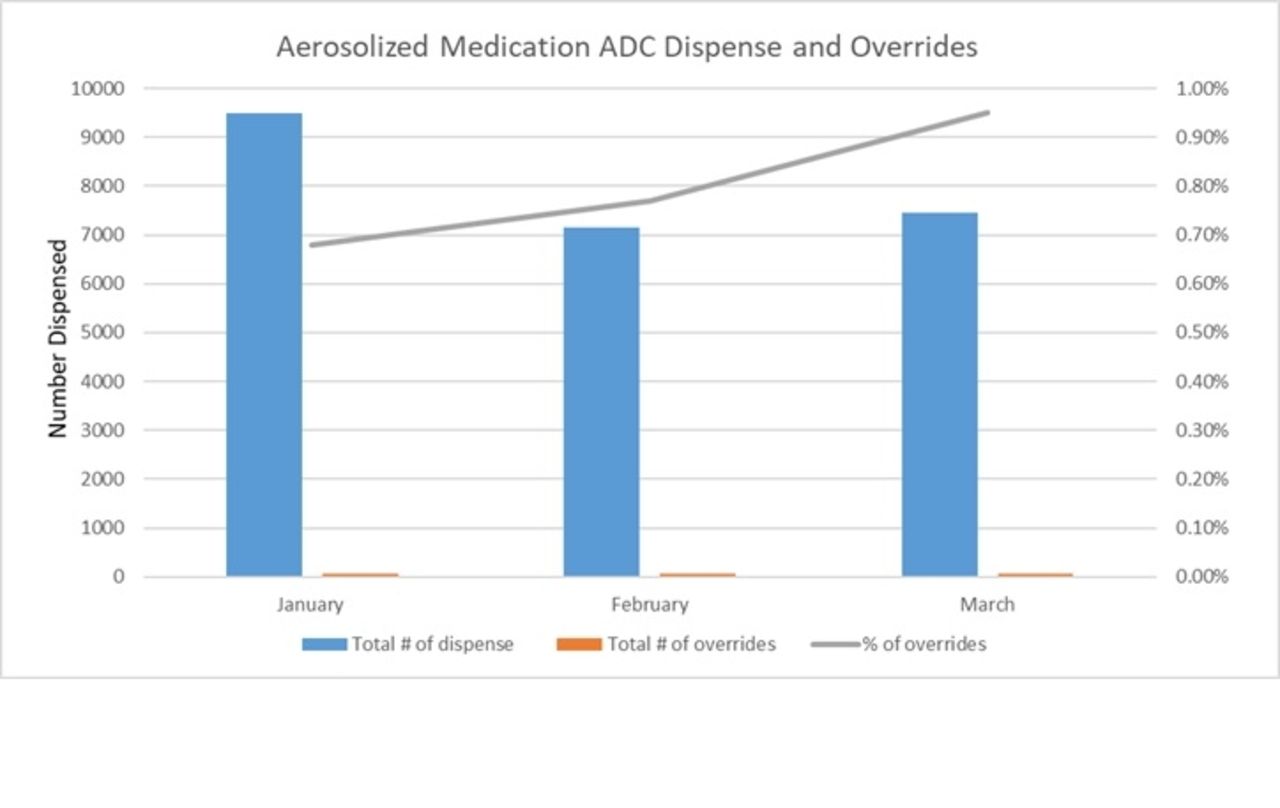
Get full access to this article
View all access options for this article.