




Abstract
Background:
Determining an appropriate staff to workload ratio can be a daunting task. Utilizing a quantifiable approach to match labor resources to work volume is key to fair and manageable assignments for frontline staff. Development of the Fair Assignment Tool at Penn Medicine Lancaster General Hospital provided a safe and fiscally responsible solution. Guided by the nationally accepted time standards from the AARC Uniform Reporting Manual, the Fair Assignment Tool assisted in quantifying the workload using a point system, dividing it evenly amongst scheduled staff, and determining staff productivity. With further development, we found it could monitor trends in workload and the number of staff members required to safely manage fluctuations in work volume and patient acuity.
Methods:
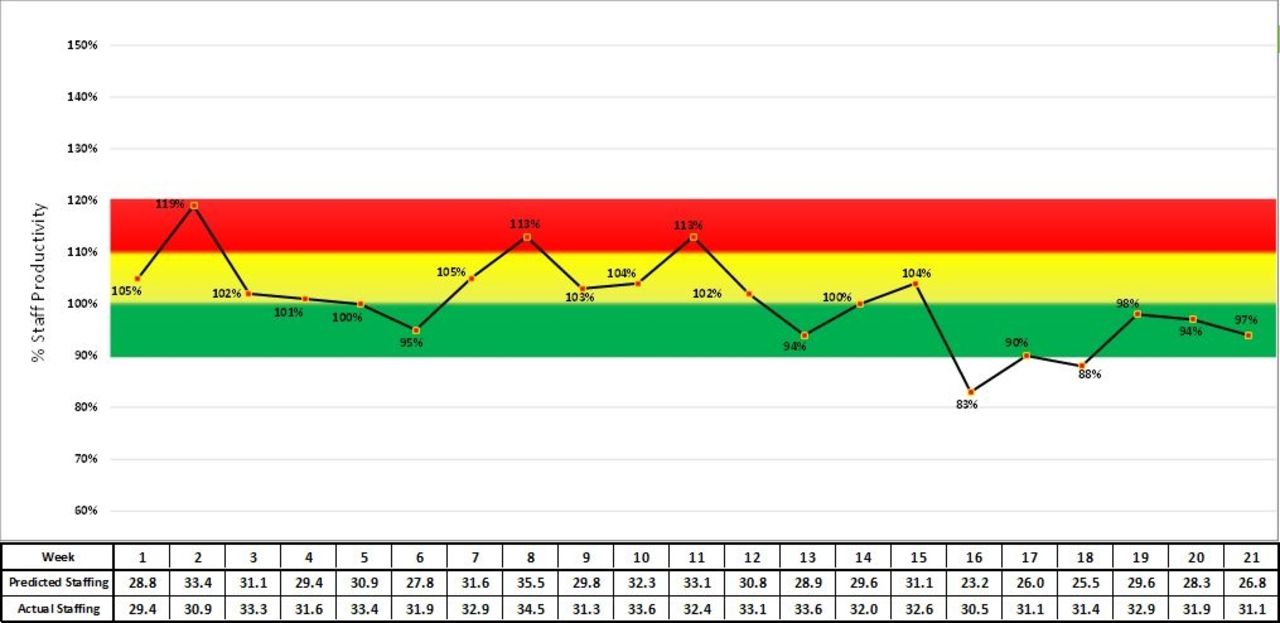
The original version of the Fair Assignment Tool was inherently descriptive. Revisions made in January 2019 added predictive elements. Average productivity during a set seven day interval was assessed weekly. If the average productivity was >110%, incentives were offered to staff working additonal hours in the following week. Average workload from the same seven day interval was used to determine the number of staff needed for each shift in the following week to maintain a productivity ≤ 110% where predicted staffing = average workload divided by desired % productivity. The work schedule was reviewed and extra shifts were posted in attempt to bring scheduled staffing numbers to predicted staffing levels. A 21-week analysis was then conducted to track the impact of these revisions on staffing and productivity.
Results:
The new features of the Fair Assignment Tool allowed us to adjust staffing numbers to manage fluctuations in the workload. Staffing numbers were increased to maintain a productivity less than or equal to 110% for 18 out of the 21 weeks (85%). This analysis was communicated to executive leadership in order to have an objective discussion for adding more FTEs.
Conclusions:
The revised Fair Assignment Tool allowed us to manage labor resources while maintaining high quality work and safe patient care. Maintaining the proper staff to workload ratios also increased staff morale as staff felt they had more time to provide proper patient care when faced with heavier than normal work volume as often seen during the winter months. We hypothesize that this tool could be used to manage non-labor resources such as equipment inventory and determine when equipment is rented.
Get full access to this article
View all access options for this article.