




Abstract
Background:
Similar to most healthcare providers, many respiratory therapists are wanting to advance into leadership roles. However, there are not clear guidelines on what competencies are most desired for future respiratory care managers. The aim of this study was to determine what competencies and education are most desired for future respiratory care managers.
Methods:
Survey Monkey was used to conduct an online survey for this study, exempt by A.T. Still University IRB. The sample was recruited by the Texas Society for Respiratory Care and clinical affiliates of Midwestern State University. The on-line survey was replicated with modifications from a previous survey. Upon completion of modifications the survey was pilot tested with various peers in respiratory care and past respiratory care directors. The survey was used with permission granted from Robert M. Kacmarek. The quantitative data were analyzed and consisted of descriptive statistics and inferential statistics. Responses were separated based on positions held by participants then further divided into groups of small and large hospital sizes. Hospitals were separated into small sized, less than or equal to 299 beds, and large sized, 300 or more beds. Independent t-tests were used to determine whether there was a difference in the competencies and qualities desired for future respiratory therapy managers between small and large hospitals. A two-tailed test was considered statistically significant with a P -value less than .05. The open-ended questions were also analyzed to determine if common themes existed.
Results:
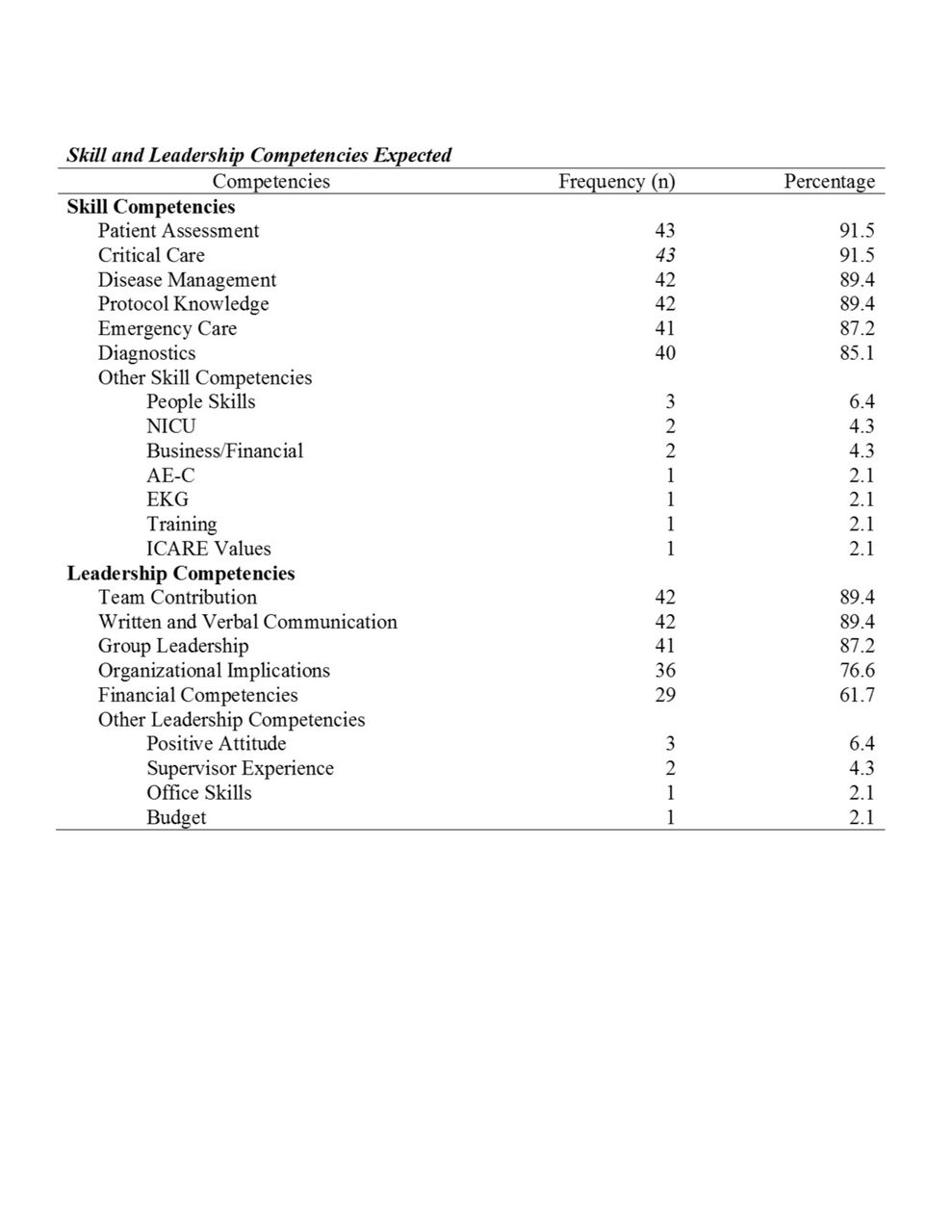
Forty-seven responses were received and all responses were used for the study. The desired education for future managers was a baccalaureate degree (63%) and the recommended education level was also a baccalaureate degree (65%). The most desired skill competencies are patient assessment (92%) and critical care (92%). The most desired leadership competencies are team contribution (89%) and written and verbal communication (89%). The desired competencies did not vary much across facility sizes.
Conclusions:
The facility size does not really affect the desired competencies for future respiratory managers. The majority of the participants selected a baccalaureate degree as the preferred level of education because it shows the desire for advanced knowledge. The skill and leadership competencies selected appear to be desired to improve patient care and team dynamics. Disclosures: None.
Get full access to this article
View all access options for this article.