




Abstract
Background:
Recent advanced ventilation modes (AVMs) of mechanical ventilation are closed-loop modes that have the ability to automatically adjust some respiratory settings. Despite their effectiveness in several clinical trials, it is unclear to what extent these modes are actually used in daily clinical practice. The aim of this study is to define the practice of AVMs in intensive care units (ICUs) in the Eastern Province of Saudi Arabia, and to explore reasons for not applying AVMs.
Methods:
A cross sectional survey was conducted among all adult ICUs in the Eastern Province of Saudi Arabia. ICU respiratory therapists were identified for each ICU and were asked to participate in the survey. We have divided the ICUs into three levels depending on the number of beds. Use of closed-loop modes was classified as frequently, occasionally or never. From (1 to 10) as level 1, (11 to 20) as level 2, and more than 20 as level 3. Institutional Review Board (IRB) approval was obtained.
Results:
A total of 100 ICU respiratory therapists were approached, only 83 including 60 male were completed the survey. Of those 83, 70 were holding bachelor degree, 13 were diploma, and only 40 of 83 have more than 5 years’ experience. The percentage of ICUs that had access to AVMs was 73.5%, which 62.7% were occasionally or never use them. Table 1 shows the frequency of use (frequently or occasionally/never) per ICU levels (1, 2 and 3). The most frequent used modes were neurally-adjusted ventilatory assistance (NAVA) (35.34%), airway pressure release ventilation (APRV) (19.83%), proportional assist ventilation (PAV) (17.25%), while INTELLiVENT-ASV mode was rarely used with only (0.86%). Reported reasons for not using AVMs were lack of knowledge (50.8%), no enough trust in these systems (23.4%), lack of value (20.5%) and no AVMs in the ICUs (5.3%).
Conclusions:
The results showed that AVMs were clinically underused and their value seems to be underestimated in the adult critical care areas. Further investigations are needed to overcome possible barriers that may hinder the utilization of the newer ventilation modes, which would improve patients’ outcome.
The frequency of use (frequently or occasionally/never) per ICU levels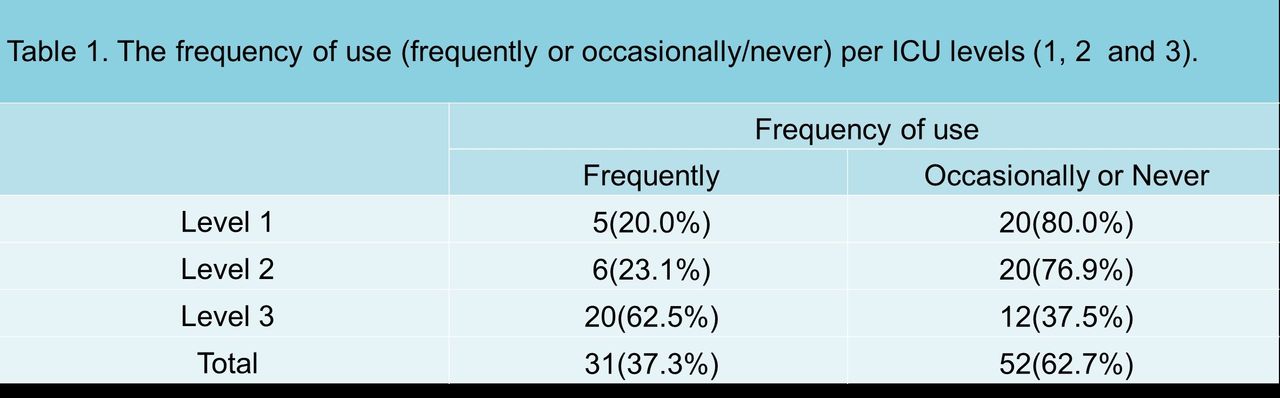
Get full access to this article
View all access options for this article.