




Abstract
Background:
High-frequency jet ventilation (HFJV) has been utilized as a modality in infants with respiratory distress syndrome who are refractory to conventional ventilation. There is a paucity of data informing initial PEEP selection during HFJV. Therefore, we sought to describe parameters that were associated with PEEP levels following conversion to HFJV.
Methods:
An IRB approved single-center retrospective review was conducted on subjects who underwent HFJV between 01/2015-01/2019. Subjects were enrolled if birth weight ≤ 2,000 grams and ≤ 34 weeks gestational age. Subjects were excluded if they received HFJV as a first line therapy upon admission. Ventilator parameters and laboratory data were extracted and analyzed prior to HFJV transition and at hours 1, 4, 6 and 12 following conversion. Data included: PEEP, mean airway pressure, FIO2, peak inspiratory pressure (PIP), pH, capillary carbon dioxide level and sigh-breaths. Since the data were not normally distributed, they are reported as median (interquartile range). The Kruskal-Wallis test with Dunn posttest were used in order to evaluate differences in parameters over time.
Results:
Fifty-three premature subjects (n = 37 male) were studied. Median gestational age was 25.5 weeks (24.1 – 27.8) and birthweight of 900g (695 – 1,555). Subjects received conventional ventilation for a median of 50 hours (13.8 – 218) prior to HFJV; with PIP 20 cm H2O (18 – 24) and frequency 40 breaths/min (38 – 44) respectively. A HFJV frequency of 420 breaths/min and on-time of 0.02 seconds were used for all subjects. A target pH ≥ 7.25 and FIO2 ≤ 0.4 was achieved in 54% and 60% of subjects at four hours, respectively. Ventilator parameters and laboratory data are displayed in Table 1.
Conclusions:
We observed a statistically significant increase in PEEP, PIP, pH and decrease in PcCO2 compared with baseline. Our findings may inform initial PEEP during conversion to HFJV.
Results are presented as median (interquartile range)* PEEP significantly higher than baseline † PIP significantly higher than baseline ‡ pH significantly higher than baseline§ PcCO2 significantly lower than baseline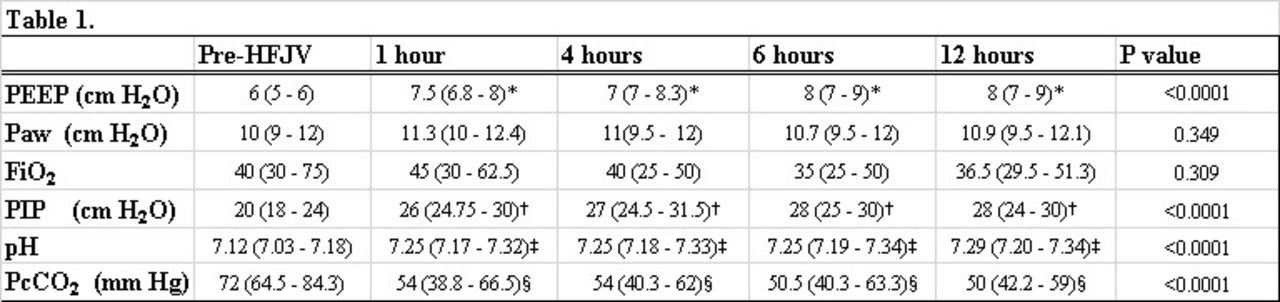
Get full access to this article
View all access options for this article.