




Abstract
Background:
The role of mechanical ventilation is to improve gas exchange and reduce the patient’s work of breathing. Unfortunately, prolonged ventilation is associated with many negative sequelae. It is imperative when clinical stability is achieved that the goal of ventilator liberation is facilitated. Adaptive support ventilation (ASV) is a novel mode of ventilation that provides a closed loop assessment of mechanically ventilated patients. The mode will adjust delivered tidal volume and set respiratory rate based on feedback physiological data and patient interaction. If the patient starts breathing spontaneously, the mode adjusts from time-cycled ventilation to flow-cycled ventilation and may wean the patient without clinician ventilator interaction. This facilitation of weaning may decrease ventilator duration and facilitate ventilatory liberation. Mechanical ventilation in a neuro-science ICU (NSICU) is often utilized for patients with a normal respiratory status but an altered neurological function. The goal of mechanical ventilation in the majority of patients is to optimize gas exchange until the patient is neurologically stable and awake. Typically pedestrian ventilator parameters are required to achieve these clinical end-points. The standard practice to facilitate ventilator liberation was to transition the patient from volume target CMV ventilation to flow-cycle PSV and then perform a spontaneous breathing trial prior to extubation.
Methods:
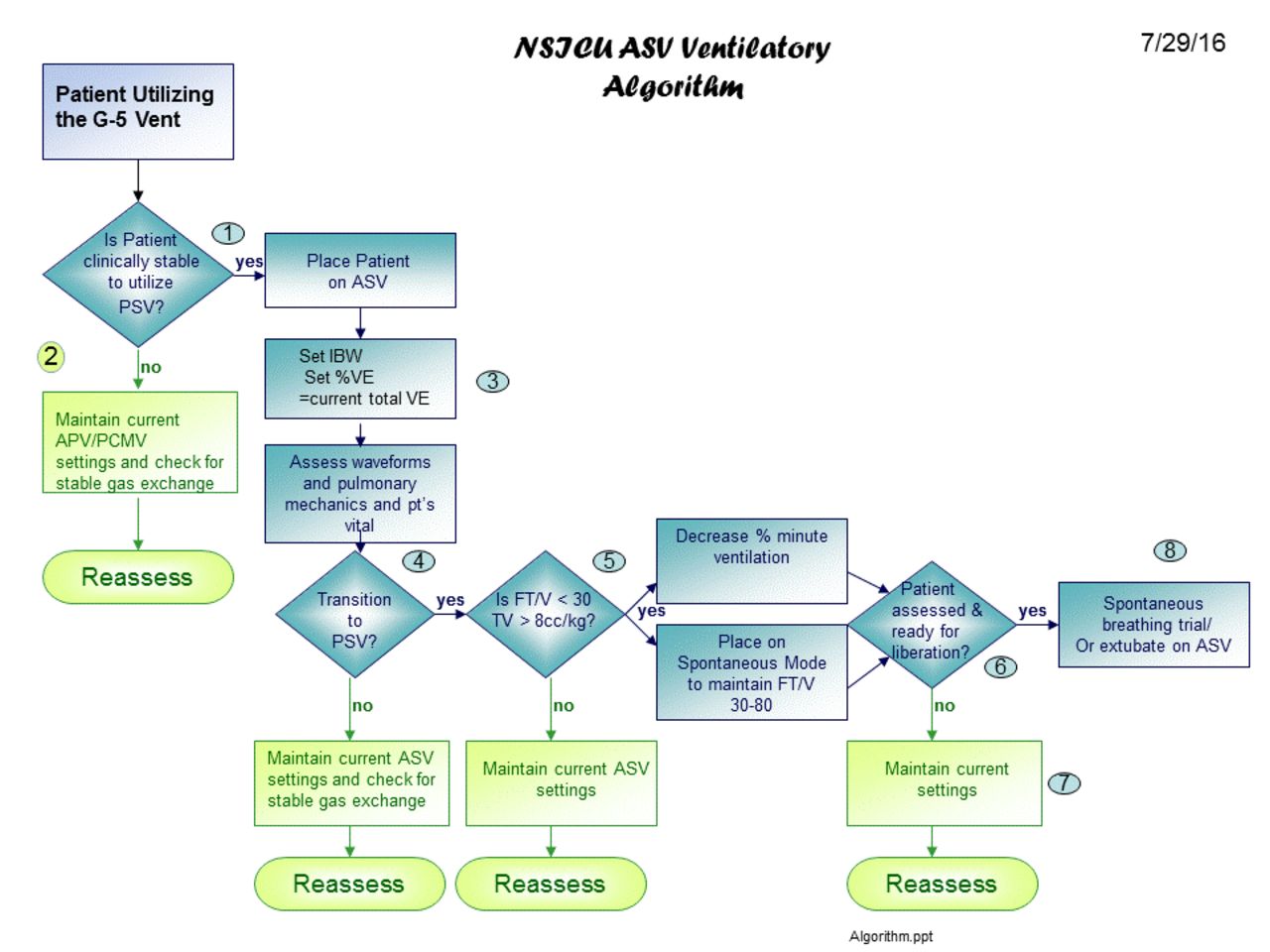
In attempt to facilitate ventilator liberation thus decrease ventilator duration we implemented ASV as the default ventilator mode in stable NSICU patients. An ASV ventilator protocol was developed and any patient meeting the inclusion criteria was placed on 100% MV via ASV mode (figure 1).
Results:
Over a 6-month time frame the utilization the ASV mode in the NICU reduced ventilator duration from the historical length of 5.6 days to 4.1 days. Re-intubation rates remained < 5% and ventilator-associated pneumonia< 1%.
Conclusions:
Based on our clinic experience ASV can facilitate the weaning process and reduce ventilator duration in a NSICU. By automatically transitioning from time-cycle to flow cycle ventilation and titrating PSV levels to a desired tidal volume the ASV mode can expedite the weaning process in clinically stable patients.
Get full access to this article
View all access options for this article.