




Abstract
Background:
Aerosol delivery via high flow nasal cannula (HFNC) during distress breathing generated higher lung deposition than quiet breathing. Both in vitro and radiolabeled in vivo studies report lung deposition decreased as flow increased. We hypothesize that aerosol deposition is related to the ratio of HFNC flow:patient's inspiratory flow and that an optimal ratio could improve aerosol delivery via HFNC.
Methods:
An adult patient mannikin (Laerdal adult airway management trainer), with realistic airway anatomy was used. A collecting filter connected between the trachea and a model lung (TTL, Michigan Instruments), simulating distress and quiet breathing for adults with tidal volumes of 300, 500 and 700 mL. A flow and volume monitor (NICO) was placed distal to the collecting filter. HFNC was set at 5, 10, 20, 40 and 60 L/min. A mesh nebulizer (Aerogen) was placed at the dry side of humidifier (Fisher & Paykel), with large size of nasal cannula. Albuterol (2.5 mg in 1 mL) was nebulized for each condition (n=3). Drug eluted from the filter and assayed with UV spectrophotometry (276 nm).
Results:
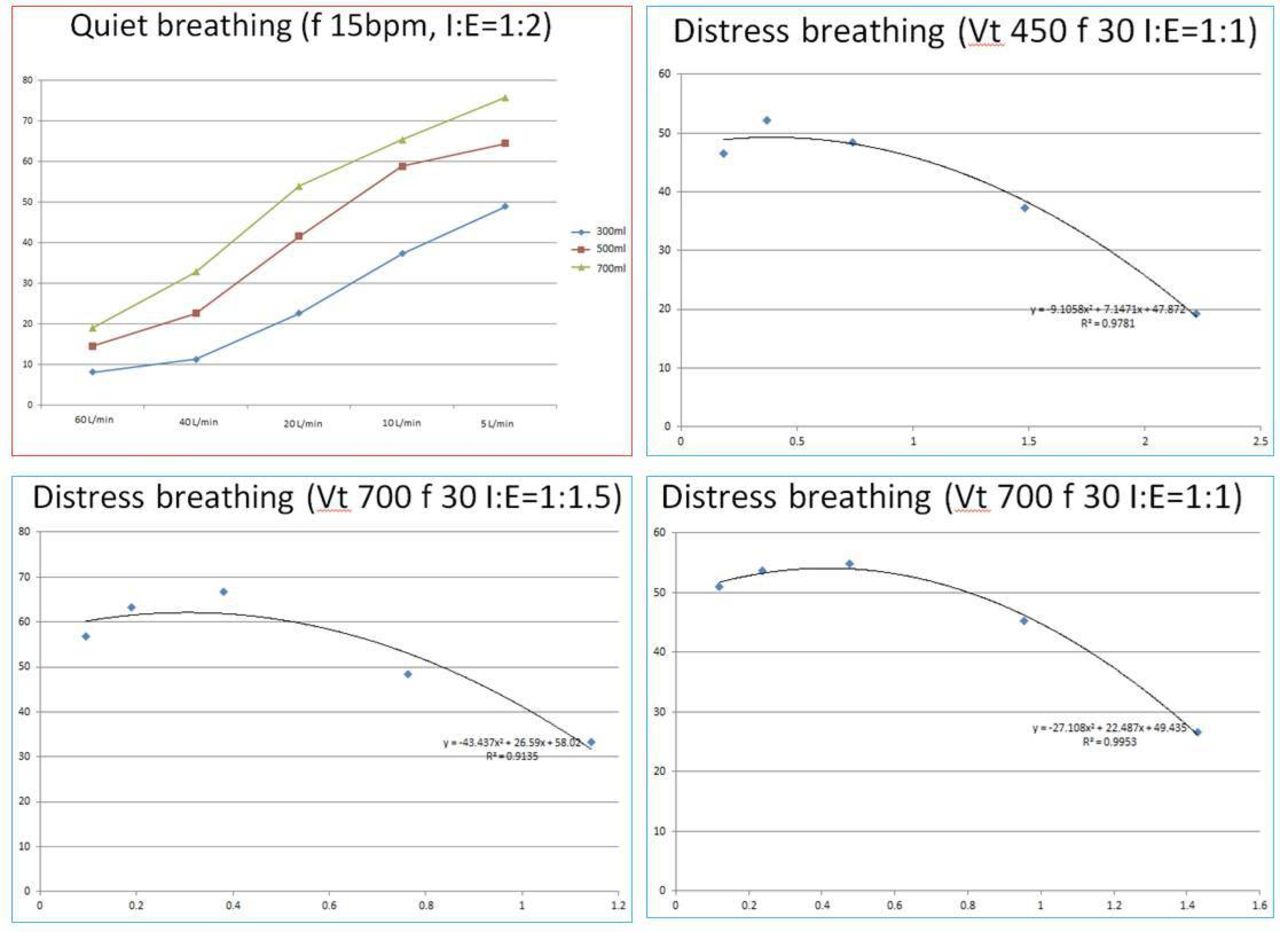
During quiet breathing (f=15 breaths/min, I:E=1: 2, VT was 300, 500 and 700 mL), delivered dose increased as HFNC flow decreased (P<0.001), delivered dose was greatest at the lowest HFNC flow (5L/min) and delivered dose increased as tidal volume increased (P=0.027). During distress breathing (f=30 breaths/min, I: E=1: 1, VT of 450 and 700ml), delivered dose was similar with both VTs, Max delivery for VT 450 mL with 10 L/min while VT 700 mL was 20 L/min. In the distress breathing delivered dose was greater with I: E=1: 1.5 than I: E=1: 1 at HFNC flows of 10 — 60 L/min (P=0.05), with a trend at 5L/min (P=0.077). A multiple linear regression identified the ratio of HFNC flow:patient's inspiratory flow (P<0.001) and I: E (P=0.013) as predictors of delivered dose. The optimal ratio was between 0.37 and 0.5 in distress breathing.
Conclusions:
In aerosol delivery via HFNC for adults, the minimum flow produced optimal lung deposition in quiet breathing, while in distress breathing, HFNC flow:patient's inspiratory flow of 0.37 to 0.5 produced optimal 'lung' deposition.
Get full access to this article
View all access options for this article.