




Abstract
Background:
Pressure Support Ventilation (PSV) is a spontaneous mode that is patient triggered and flow cycled. Spontaneous breaths on PSV are triggered, which alters spontaneous breaths from sinusoidal to decelerating assisted mechanical breaths. Because PSV breaths are assisted, they may be under-compensated or overcompensated for the artificial airway resistance based on the amount of support set at the ventilator. Alternatively, CPAP with the use of automatic tube compensation (ATC) provides dynamic inspiratory flow in proportion to the pressure drop across the artificial airway size (length and diameter). As a result, the sinusoidal flow pattern of spontaneous breathing is preserved with an unassisted breath. Electrical Impedance Tomography (EIT) technology provides non-invasive and radiation-free medical imaging. In addition, EIT provides regional information of changes in ventilation, which could help with gaining information on where a regional distribution of ventilation occurs during spontaneous modes of ventilation such as PSV and CPAP. We chose to use EIT to observe patients in various spontaneous modes.
Methods:
This observational study, approved by the University of Maryland Institutional Review Board (IRB) enrolled ICU patients receiving mechanical ventilation set in either PSV or CPAP. The PulmoVista 500 EIT device by Draeger Medical (Lubeck, Germany) was used to visualize regional distribution of ventilation.
Results:
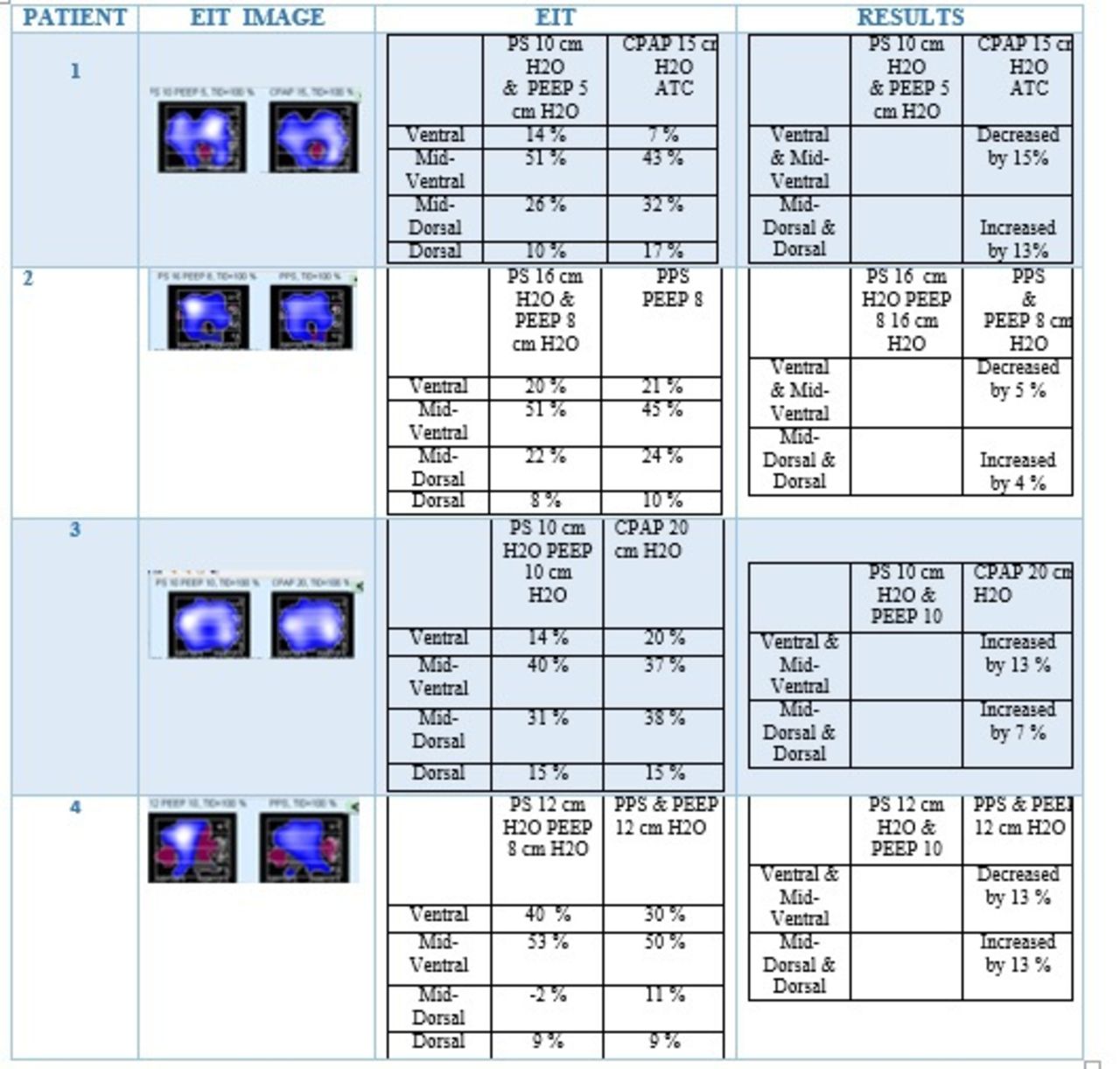
Four patients were observed during PSV that were transitioned to CPAP or proportion pressure support (PPS) per physician orders. After transitioning from an assisted mode (PSV) to an unassisted mode (CPAP or PPS), dorsal and mid-dorsal ventilation was seen to have increased in each patient. The gas distribution to the mid-dorsal and dorsal increased by an average of 9. 25% in all four patients. Two of the patients did see an increase in gas distribution by 13% and two by 4% and 7% within min of transitioning to the unassisted mode of ventilation.
Conclusions:
This small observational study demonstrated the benefit of preferential volume distribution with unassisted breathing. Further research in comparing assisted versus unassisted ventilation is warranted.
Get full access to this article
View all access options for this article.