




Abstract
Background:
Inhaled epoprostenol (iEPO) has been described in clinical practice for patients with pulmonary hypertension or ARDS for 20 years. iEPO using a pump system with mesh nebulizer has been administered with 2 strategies: 1) Using one concentration adjusting dose with the pump rate across full range of doses; and 2) limiting the pump rate range and changing the concentration of iEPO. We wanted to determine whether a single formulation concentration could be used across prescribed dose ranges.
Methods:
A collection filter was placed between the model lung (TTL, Michigan Instruments) and a critical care ventilator (PB840, Covidien) with a heated wire circuits and humidifier (MR850, Fisher & Paykel). A mesh nebulizer (Aerogen) was placed at the dry side of humidifier. Epoprostenol (Veletri) (1.5g) was reconstituted with sterile water to concentrations of 30, 15 and 7.5 mg/mL. The solution was drawn into a 60 mL syringe and attached to a continuous tubing set, which was connected to the mesh nebulizer. Tidal volumes were set to simulate adults of 50, 70 and 90 kg of ideal body weight. iEPO dosage was set at 50 and 30 ng/kg/min. Aerosol was collected for 20 min. Drug eluted from the filter was assayed with UV spectrophotometry (205 nm).
Results:
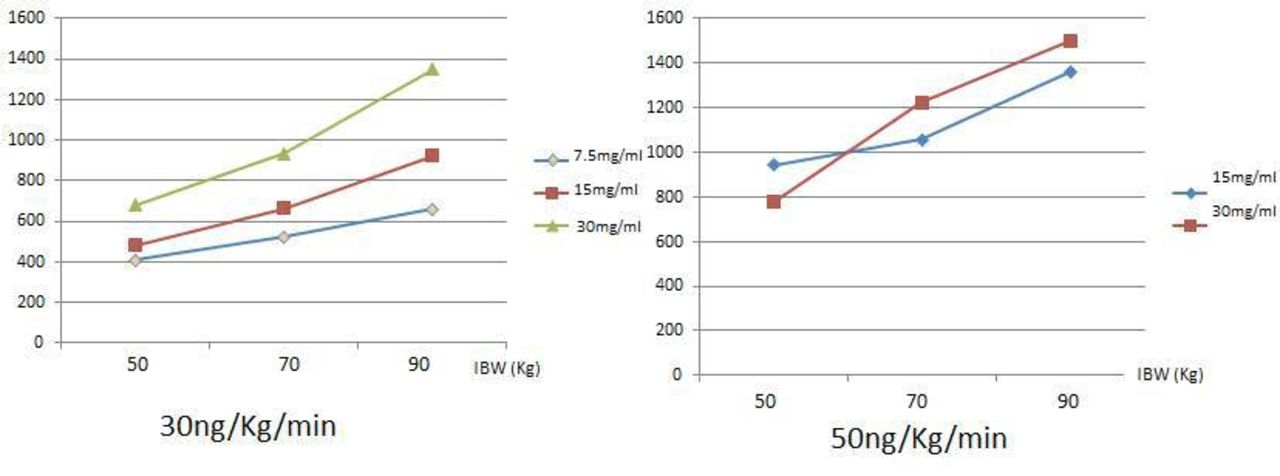
In the bench study with iEPO, at 50ng/kg/min, delivered dose was similar between 30mg/mL and 15mg/mL (11,676. 2 ± 1,093.8 vs 11201.7 ± 653. 4 ng, P=0.693). However, at 30 ng/kg/min: delivered dose rate for 30 mg/mL (9,768. 1 ± 1,040.3) was greater than 15 mg/mL (7,069.6 ± 686.6) which was greater than 7.5 mg (5229.5 ± 418.5 ng; P=0.003), representing delivered 'lung' deposition of 23.0 ± 0.8, 16.9 ± 0.7 and 12.5 ± 0.4 %, respectively (P<0.001). Conclusion To deliver prescribed dose range of inhaled epoprostenol l in adult subjects during mechanical ventilation, one high concentration was more efficient and consistent than lower concentration with higher pump rates.
Get full access to this article
View all access options for this article.