




Abstract
Background:
Monitoring pressure while ventilating patients using manual resuscitation devices is important to prevent lung injury and gastric inflation. Our goal for this study is to determine whether each device's pressure manometer reading is accurate when compared to what is being measured inside the lung. Our hypothesis is that there will be no difference between the pressures on the manometers and the four targeted pressures, also there will be no difference between each device.
Methods:
A model composed of a single adult Michigan Instruments Test lung with a compliance of 0.015 (L/cm H2O), a 22-mm adapter in line, and a Michigan Instruments Pneuflo Resistor of 5 (cm H2O/L/s) was used to test each device. A software program called Pneuview3 was used to graph delivered pressures over time inside the test lung. A single investigator static held each device until the graph on the Pneuview3 software remained constant for two seconds, while targeting pressures of 10, 20, 30, and 40 cm H2O with 0 PEEP. Three trials were conducted for each device at the four targeted pressures. The devices that were used include the Air Flow Manual Resuscitator/Ventilator (Vent Lab, Grand Rapids, MI), the Adult BVM, the Neo-Tee, and Reusa-Tee T-Piece Resuscitators (Mercury Medical, Clearwater, FL) and the Neo-Puff T-Piece Resuscitator (Fisher & Paykel, Tamaki, New Zealand).
Results:
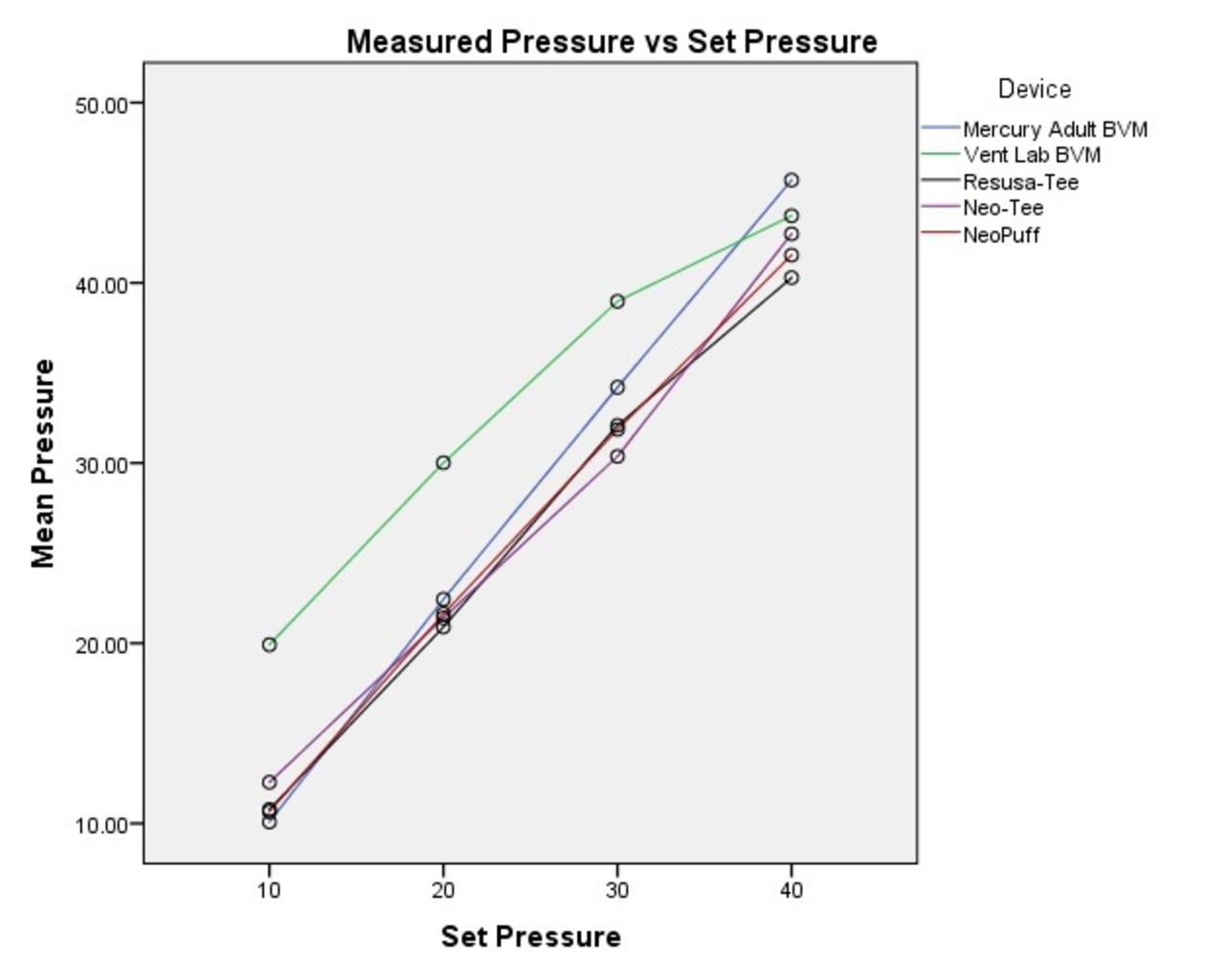
All resuscitation device pressure manometers were significantly different from one another (P=.001), except the Neo-Tee and NeoPuff (P=. 137). The pressure manometer on the Reusa-Tee by Mercury Medical tested to be the most accurate of all devices tested with an average of 1.01 cm H2O difference than the targeted pressures. The Vent Lab BVM tested to be the least accurate of all devices tested with an average of 8.65 cm H2O difference than the target pressures. In general, accuracy decreased as ventilating pressure increased.
Conclusions:
All devices tested had a less than 5 cm H2O difference than the targeted pressure except the Vent Lab BVM. The majority of the devices manometers proved to be accurate when targeting the four specific pressures. Having an accurate pressure manometer helps clinicians insure that proper ventilation of the lungs is occurring while minimizing hazards and complications.
Get full access to this article
View all access options for this article.