




Abstract
Background:
In airway pressure release ventilation (APRV), there have been questions about whether increases in pressure low (Plow) will impact flow characteristics while maintaining a time low (Tlow) of 75%. We hypothesize that the addition of Plow will not change the flow characteristics.
Methods:
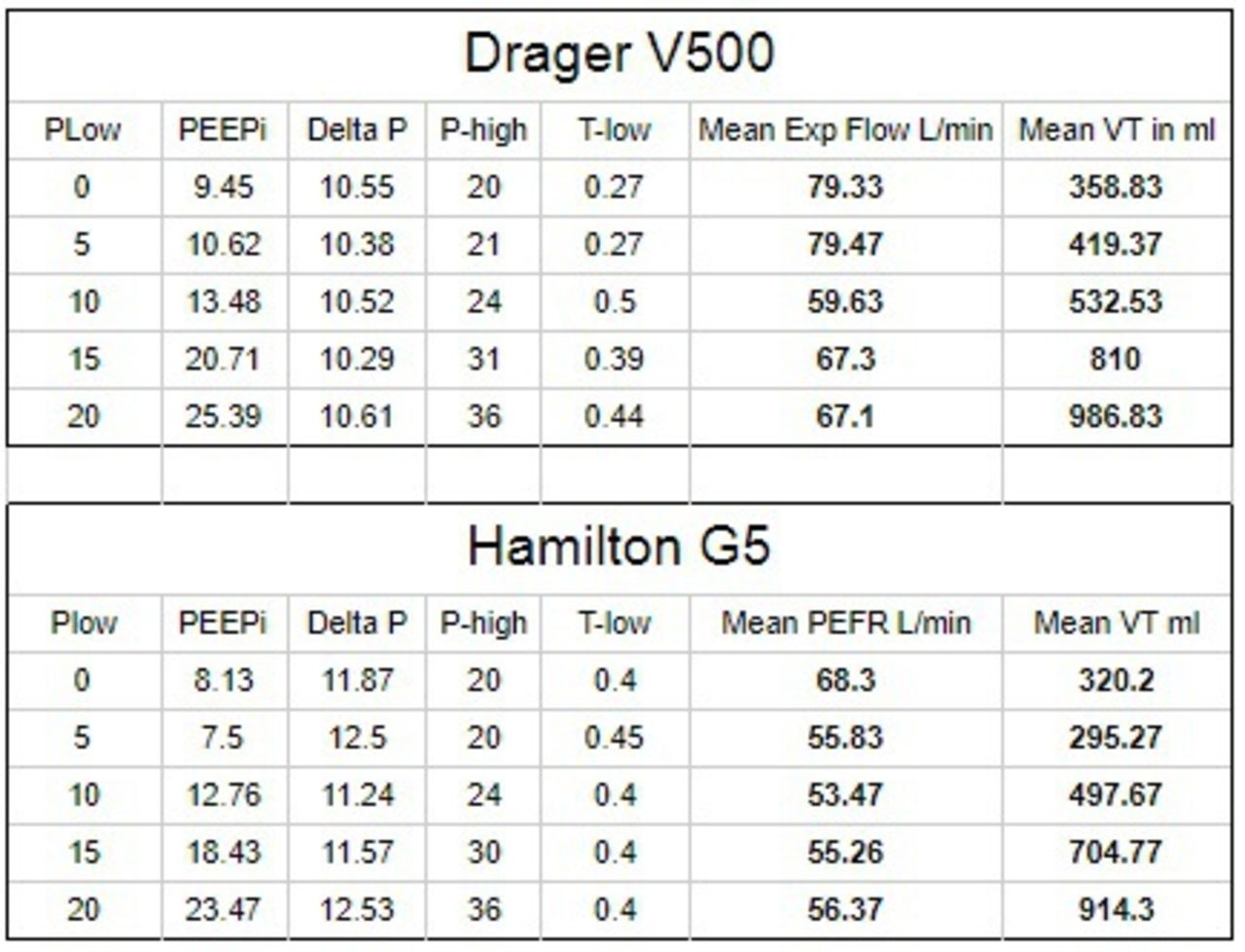
Utilizing the Hamilton G5 (Bonaduz, Switzerland) and Drager V500 (Lubeck, Germany) mechanical ventilators, we created a baseline with the following settings: High pressure (Phigh) 20 cm H2O, low pressure (Plow) 0 cm H2O, time high (Thigh) 6 s, time low (Tlow) 75% of peak expiratory flow (PEF). Intrinsic PEEP and the change in pressure from <Phigh to intrinsic PEEP (ΔP) were measured and the Phigh was adjusted with increases in set Plow to maintain the same ΔP. Plow was increased in increments of 5 cm H2O up to 20 cm H2O. The T-low was adjusted to as close to 75% of PEF as possible. A Thigh of 6 S, and ΔP of 12 cm H2O was maintained for the Hamilton G5 and a ΔP of 11 cm H2O for the Drager V500. The ASL 5000 was set to passive breathing, PEF, VT, intrinsic PEEP and T-low were recorded every 5 breaths.
Results:
The addition of Plow resulted in a expiratory flow decrease of 12 L/min on both ventilators from a Plow of 0 to 20 cm H2O. the tidal volumes increased by almost triple even while maintaining the same ΔP. Additionally, the increases in PEEP did not simply increase by the same number in Plow.
Conclusions:
With the addition of Plow, flow characteristics did change, the intrinsic PEEP increased by unpredictable values, and the VT increased by almost triple despite maintaining the same ΔP. The addition of Plow does impact the flow, VT, and intrinsic PEEP in patients and caution should be taken when applying it to APRV.
Get full access to this article
View all access options for this article.