




Abstract
Background:
Lateral violence (LV) happens in many different areas of the workforce and is prevalent in the medical field. LV can be seen on all levels impacting all health care providers. The Joint Commission (TJC) defines lateral violence as 'repeated, health harming mistreatment of one or more persons by one or more perpetrators'. Abusive conduct can be verbal abuse; threatening, intimidating or humiliating behaviors. This behavior can interfere with work productivity and have an effect on workers. In health care, this can be a patient safety issue. TJC states that 38% of health care workers reported psychological harassment. LV has been researched in nursing, however it has not been investigated in respiratory therapy.
Methods:
An anonymous survey on LV, exempt by the Children's Hospital of Philadelphia (CHOP) IRB, was sent to all respiratory therapists employed to the inpatient respiratory therapy department.
Results:
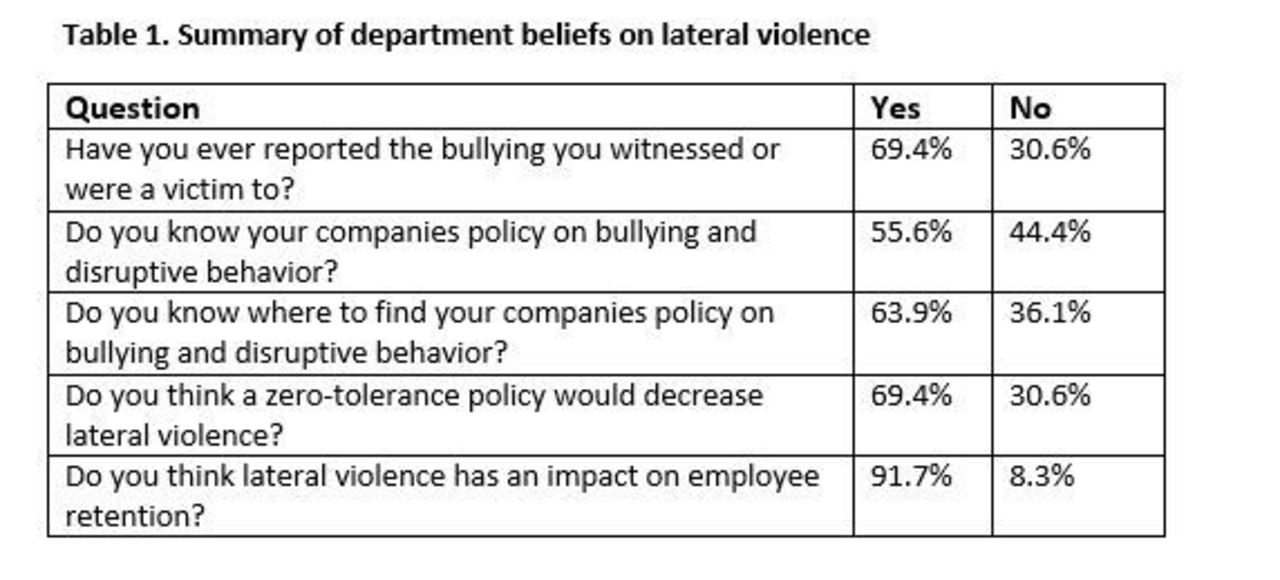
87 of 233 therapists responded to the survey (37%). Participants had 1-20+ y of experience and had been employed at CHOP for > 1 y.86% work in the ICU, 2.8% on general pediatric floors, 2.8% in long term care, and 8.3% in leadership. 42% had been a victim of lateral violence.91% felt bullying is present in the department and 9 % felt they were a victim of LV. The most common form of LV (61%) within the department was found to be bullying from a peer. 77.8% believed bullying was not gender specific. When asked about the tactics of the bully, 44.4% believed humiliation was the main form of LV. Verbal abuse and shouting tied with slander at 22.2% and 75% believed the bully did not work alone.83.3% believed staff sometimes tolerated the behavior and 16.7% believed it was always tolerated. However it is believed that leadership is sometimes tolerating the behavior 75% of the time and 25% all of the time and 63.9% of participants believed that behavior has never been addressed. When asked if LV can have a negative effect on patient care, 55.6% responded with sometimes, 41.7% with always, and 2.8% with never.52.8% responded they had been a victim or witnessed bullying by someone in a different department. Results on beliefs of how the company handles LV can be seen in Table 1.
Conclusions:
This survey indicates that LV is believed to be present within the respiratory therapy department and the organization as a whole. Further inquiry should be initiated to gain a better understanding of the current issue and how to combat it.
Get full access to this article
View all access options for this article.