




Abstract
Background:
Respiratory muscle weakness characterized by a low negative inspiratory force (NIF) is a risk factor for extubation failure in children. Obtaining accurate NIFs may aid clinicians in deciding appropriate timing of extubation, but uncuffed endotracheal tubes may result in an airway leak and potentially inaccurate pressure measurements. We sought to investigate the accuracy of assessing a simulated NIF in a laboratory environment across a range of leak percentages.
Methods:
A 3-L plastic chamber was used to house an infant test lung that was connected to an airway leak apparatus outside the chamber. The adjustable leak apparatus was arranged with two three-way stopcocks in series that terminated into a 3.5 ETT that was occluded and proximal airway pressure continuously sampled. Leak percentage was recorded by connecting an AVEA ventilator set to standardized ventilator settings to the test lung prior to each test and recording the calculated leak percent. Negative pleural pressure was simulated inside the chamber by connecting a 500-mL syringe through a second opening and withdrawing 160 mL which resulted in a negative pressure approximating 47 ± 1.6 cm H2O. For each test the difference between airway pressure at the proximal end of the ETT and chamber pressure at the most negative point of the breath after correcting for elastance of the test lung was termed the total error. Leak percentages of 0, 10, 20, 30, 40, and 50 were tested and each test was performed three times.
Results:
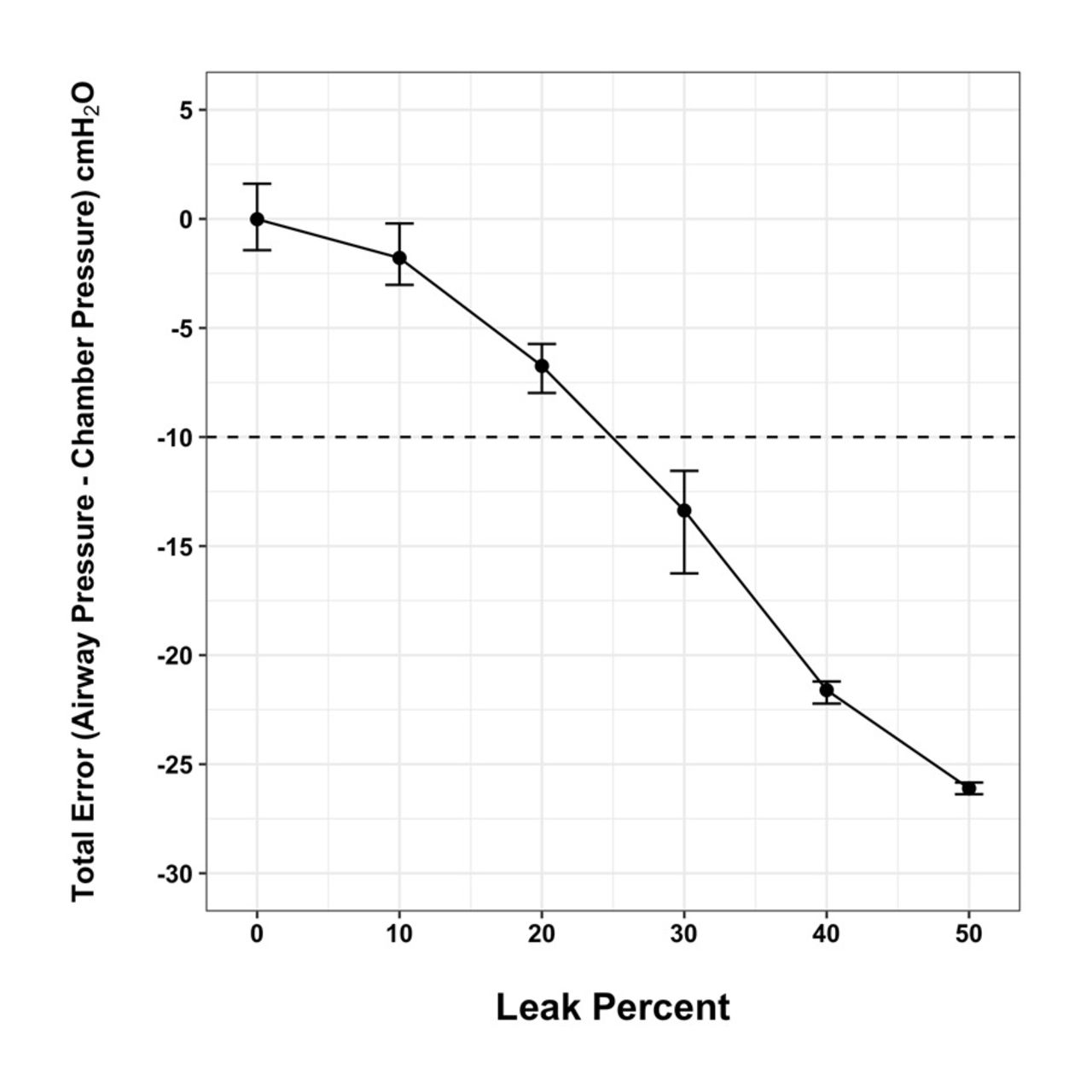
The mean and range total error for each leak percentage is shown in the Figure. As leak percentage increases, total error increases. Tests performed with a calculated leak percentage > 20% all had a total error that exceeded 10 cm H2O.
Conclusions:
Total error between simulated pleural pressure and airway pressure increases as a function of leak at the airway and may result in an inaccurate assessment of negative inspiratory force when leak is elevated. When leak is minimal (< 20%) the total error is less than 10 cm H2O in an infant bench model. Future work is needed to characterize this error as a function of absolute NIF values, and should consider alternative, dynamic models to characterize leak.
Get full access to this article
View all access options for this article.