




Abstract
Background:
The TXP-2D and Sinusoidal are routinely used to deliver high frequency ventilation (HFV) during infant transport. The complex flow dynamics within the Phasitron challenges the location for introducing humidified gases into the patient circuit with these ventilators. As such, many infants are transported using dry medical gases, which may increase the risk for mucous plugging, mucosal and alveolar damage, and hypothermia. We hypothesized that humidified low flow medical gas applied proximal to the Phasitron Connector Tee with a specialized adaptor would provide greater relative humidity (RH) levels than without humidity and without impacting delivered pressures and volumes during simulated infant HFV.
Methods:
Two test lungs were configured based on RDS and MAS lung mechanics. The Sinusoidal was adjusted based on clinical settings used during infant transport. Pressures and volumes were obtained from the lung models and RH measurements were obtained with a hygrometer (Fisher Scientific). Each model was supported at different mean airway pressures settings with/without humidified gases and at flows ranging from 0.5-4 L/min. Humidified gases (40°C; Fisher & Paykel: 850) were directed toward the endotracheal tube using a Neo-Verso (CareFusion) ancillary port/check-valve. We determined a priori that acceptable relative humidity output should be ∼100%. Differences in RH, pressure and volumes at different settings were compared using ANOVA.
Results:
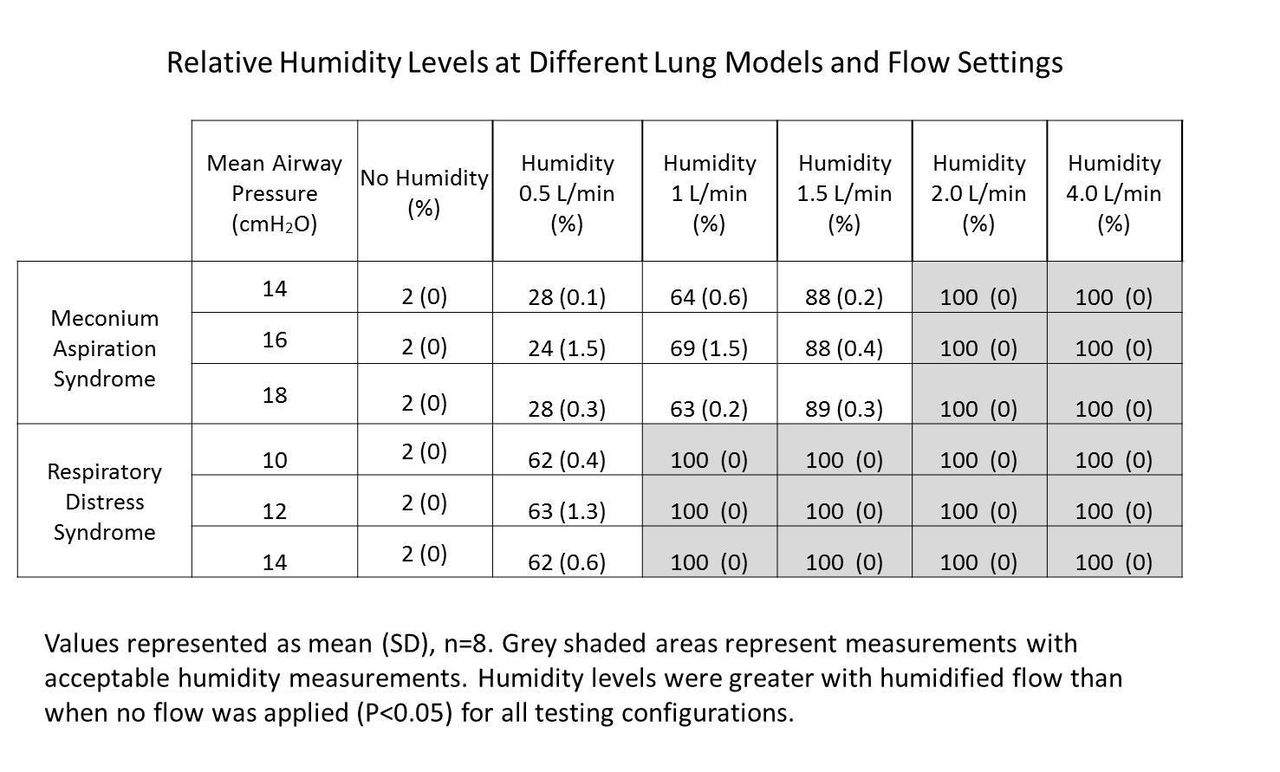
Flows (>2 L/min) resulted in mean airway pressures that exceeded the pre-set pressures by ∼1-1.5 cm H2O and were reflected in the Bronchotron digital pressure display. No differences in ΔP or volumes in lung models between no flow and different humidified flow settings were observed. We observed greater relative humidity levels in all models between no flow and at each of the humidified flow settings (P<0.05). Optimal humidity levels (99.9%) were obtained at flows of 1 L/min and 2 L/min for RDS and MAS lung models, respectively (see Figure).
Conclusions:
We found that optimal humidification can be obtained during HFV transport using this novel system without having a significant impact on simulated ventilation. Based on our findings, this can only be accomplished using a specialized adaptor and check-valve to prevent pressure and humidity loss into the delivery tubing.
Get full access to this article
View all access options for this article.