




Abstract
Background:
Dynamic hyperinflation is reported as a potential risk during HFOV. Electrical impedance tomography (EIT) has been proven as a method suitable for lung volume measurement. The aim of the study was to design and test a non-invasive radiation-free method for measurement of dynamic hyperinflation of the lungs during HFOV.
Methods:
The animal study was approved by the Institutional Animal Care and Use Committee (IACUC) of the 1st Fac. of Medicine, Charles University in Prague. Twelve paralyzed pigs under general anesthesia were ventilated by 3100B (CareFusion) HFO ventilator (f=5 Hz, normocapnic ΔP) Chest EIT (PulmoVista 500, Draeger), esophageal pressure (Pes) and continuous distending pressure (CDP) (iMON monitor, CTU, Prague) were measured continuously. CDP was stepwise set to 12, 18 cm H2O (and 24 cm H2O when tolerated), each 10 min, with I:E = 1:1 and 1:2. At the end of each CDP step for both I:E, oscillations were stopped in order to equilibrate alveolar pressure (Palv) with CDP. The changes in Pes and EIT caused by switching the oscillations off corresponded to the magnitude of dynamic hyperinflation. Then, a calibration maneuver was conducted in order to make possible recalculation of the changes in EIT to the actual changes in Palv. After the first 15 s without oscillations the ETT was occluded using a ball valve and 60 mL of air was injected into the lungs. The change in EIT corresponding to the change in CDP induced by the air injection was used for recalculation of the recorded EIT to real Palv values. Magnitudes of dynamic hyperinflation determined from EIT were verified by measured Pes. Wilcoxon test was used for statistical comparison and P<0.05 was considered as statistically significant.
Results:
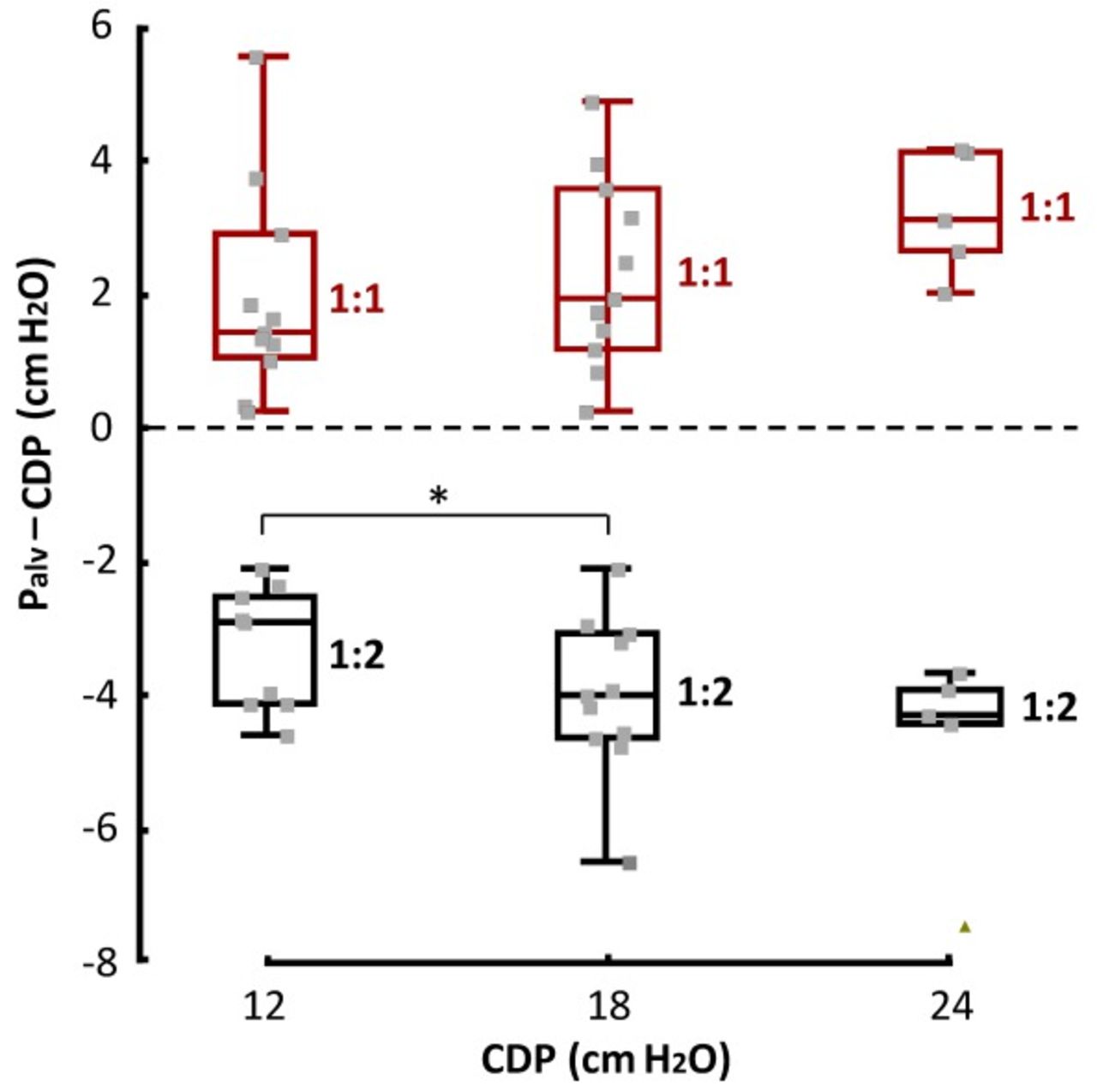
Eleven pigs completed the full protocol; only 5 of them tolerated the highest CDP level of 24 cm H2O. The evaluated differences between CDP and Palv during HFOV are presented in the Figure. In all the animals, a dynamic hyperinflation (ie, Palv > CDP) was detected for I:E = 1:1, whereas in all the animals a dynamic hypoinflation (Palv < CDP) was identified for I:E = 1:2. The data derived from EIT were confirmed by Pes measurement.
Conclusions:
Except for dynamic hyperinflation occurring at I: E=1: 1, a strong dynamic hypoinflation developed at I:E = 1:2. EIT is a suitable modality for dynamic hyper/hypoinflation determination during HFOV.
Disclosures:
The authors declare no conflict of interest. Supported by CTU grant SGS17/203/OHK4/3T/17.
Get full access to this article
View all access options for this article.