




Abstract
Background:
Tracheal intubation is a routine practice in the operating unit as well as in the care of critically ill patients. It is estimated that 13 to 20 million intubations are done annually in the United States. The primary functions of an ETT cuff include prevention of air leaks during mechanical ventilation and protection of the airway from aspiration. Respiratory therapists often check the ETT cuff pressure as part of the overall respiratory care procedure. Due to the design of cuff pressure manometers, a small air leak from the cuff is a common occurrence when the cuff pressure manometer sampling tube opens the one-way valve in the pilot balloon. The purpose of this study was to evaluate the degree of air leaks during routine cuff pressure checks.
Methods:
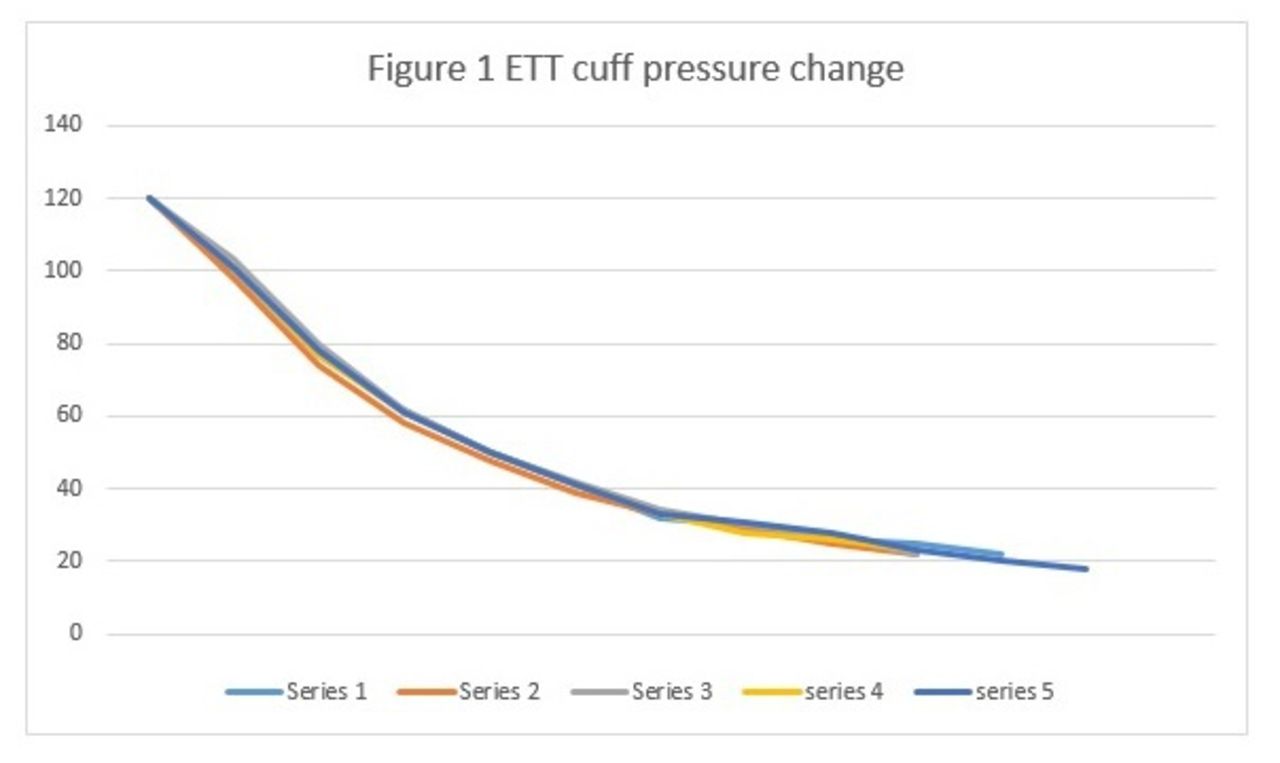
An adult airway management trainer (Laerdal, Wappingers Falls, NY) was orally intubated with a new, size 8 ETT (Covidien Shiley TaperGuard Evac, Mansfield, MA). The resting position of the ETT was 21 cm at the incisors. Following intubation, the ETT cuff was deflated completely and re-inflated with 12 mL of air. The cuff pressure was measured with a cuff pressure manometer (Posey Cufflator, Arcadia, CA) at baseline with 12 mL of air in cuff and again after each removal and re-attachment of the cuff pressure manometer to the pilot balloon. These removal/re-attachment steps are repeated until an air leak around the cuff was heard. Five trials were done using the same ETT and protocol.
Results:
Changes of ETT cuff pressure are shown in Figure 1. Air leak around the ETT cuff was heard at these cuff pressures: 25 cm H2O, 25 cm H2O, 27 cm H2O, 26 cm H2O, and 20 cm H2O.
Conclusions:
The cuff pressures measured with initial air leak around the ETT cuff are within or below the recommended cuff pressure range (25 cm H2O to 30 cm H2O). Cuff pressure checks may cause unintended air leaks around the cuff. Since air leak around the ETT cuff poses a risk for aspiration, routine or frequent cuff pressure checks should be performed with caution. In addition, routine use of a cuff pressure that falls within the recommended cuff pressure range does not guarantee a leak-free ETT cuff.
Get full access to this article
View all access options for this article.