




Abstract
Background:
The implementation of clinical specialists to help improve processes and drive evidence-based practices has been shown to have positive outcomes in several different settings and disciplines. In this study the implementation of respiratory clinical specialists (RCS) into the intensive care units (ICU) setting to improve the compliance of assessing for appropriateness of spontaneous breathing trials (SBT) and the completion of SBTs when deemed appropriate. It is our belief that the implementation of RCS into the ICU setting can be used to drive outcomes of SBT compliance.
Methods:
Data is extracted daily from a specific field on every patient requiring mechanical ventilation. The field is addressed by respiratory therapists (RT) selecting "Yes" or "No" in the appropriateness for performing an SBT. If the field is addressed before 14:00 that day the software counts the first section of SBT compliance, or performing the safety screen, as compliant. The second part of SBT compliance is the performing of SBTs when appropriate. To track this the software looks at all patients in which the RT answered "Yes" to passing the safety screen, and then looks for a time in which SBT was initiated. If the SBT is charted as being completed by 14:00 the software counts the second part of performing SBT as compliant. This data was tracked prior to the implementation of RCS into the ICUs and then continued to be tracked once they were put into place.
Results:
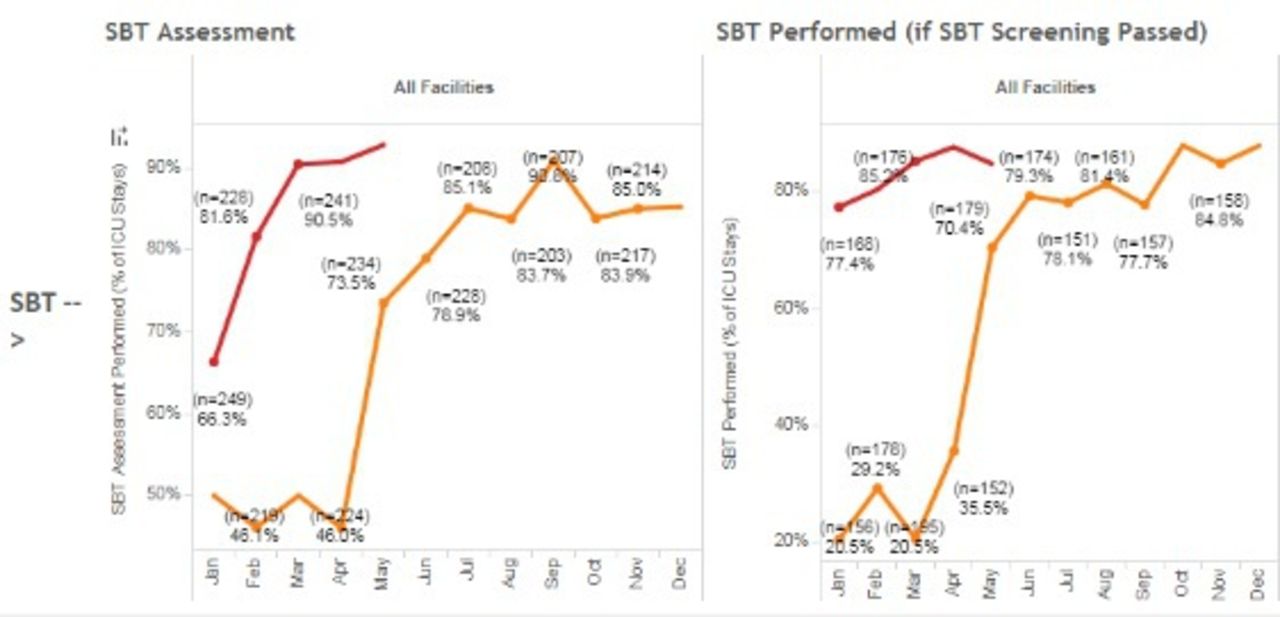
In January of 2017, prior to implementation of RCS, compliance with SBT safety screening was approximately 50% and performing of SBTs even less, at 20.5%. From January to April of 2017 SBT safety screen compliance remained between 46% and 50%, and SBT compliance between 20.5% and 35.5%. In April 2017 RCS were assigned to the ICUs, and in May of 2017 SBT safety screen compliance was 73.5% and SBT compliance 70.4%. That is an increase of approximately 23.5% and 38% in just the first month. Continuing to rise over the last year our most recent results show compliance of safety screens at 90.5% and SBT performance 79.3%.
Conclusions:
The implementation of RCS into the ICU setting showed an immediate impact in SBT compliance. Compliance of SBT safety screens has increased by 40.5% and SBTs performed by 43.8% from that of the same time period one year prior. This study concludes that the implementation of RCS into the ICU setting can be used to drive outcomes of SBT compliance.
Get full access to this article
View all access options for this article.