




Abstract
Background:
Rigid bronchoscopy yields a unique challenge for mechanical ventilation. An uncuffed and rigid bronchoscope requires mechanical ventilation strategies not often used. Manual jet ventilation is the most common approach and gold standard. At our hospital, we previously used either manual jet or an LTV-1200 ventilator during rigid bronchoscopy. We recently started using the Philips Respironics V60 ventilator because of its capabilities to ventilate with a leak. The rigid bronchoscopy cases subjectively had better and more stable ventilation. The purpose of this study was to perform a bench evaluation of various leak conditions comparing the V60 to the manual jet for ventilation during simulated rigid bronchoscopy.
Methods:
We performed a bench evaluation of rigid bronchoscopy with an intubation mannikin airway attached to the Ingmar ASL-5000 test lung with a Novametrix NM3-NICO flow sensor between the mannikin airway and the ASL-5000. Normal apneic adult settings were used on the ASL-5000. The manual jet was tested at 40 and 60 PSI with two breath types, "Burst" - shortest but full actuation of the jet valve and "Hold" - full actuation until inspiration ended. The V60 was tested with I-Times of 0.6 seconds and 1 second, with a delta pressure of 20cm H2O and 30 cm H2O. Two different leak scenarios were tested: "Low Leak" - typical setup of the rigid bronchoscope with the silicon cap in place. "High Leak" - setup without silicon cap in place. Inspiratory tidal volume was collected with each of the different scenario combinations with the NM3 device.
Results:
See graphic for the results of the inspiratory volume delivered with each device for the different scenarios.
Conclusions:
While the manual jet produced similar results regardless of leak it also produced the widest variation in tidal volumes: volumes that would be too low to maintain stable gas exchange ("burst" breaths) and large tidal volumes that could cause lung injury ("hold" breaths). This is dependent on the duration of the actuation of the manual jet with no user feedback for breaths that are too large. The V60 produced reasonable breaths during low leak (∼300 to 500 mL) and dropped to ∼100 mL during high leak. The results of this bench show that the V60 may be better from a lung injury standpoint and should support the patient through rigid bronchoscopy if high leak situations are kept short.
Tidal Volumes Delivered with V60 and Manual Jet During Simulated Rigid Bronchoscopy in Both "Low Leak" and "High Leak" Situations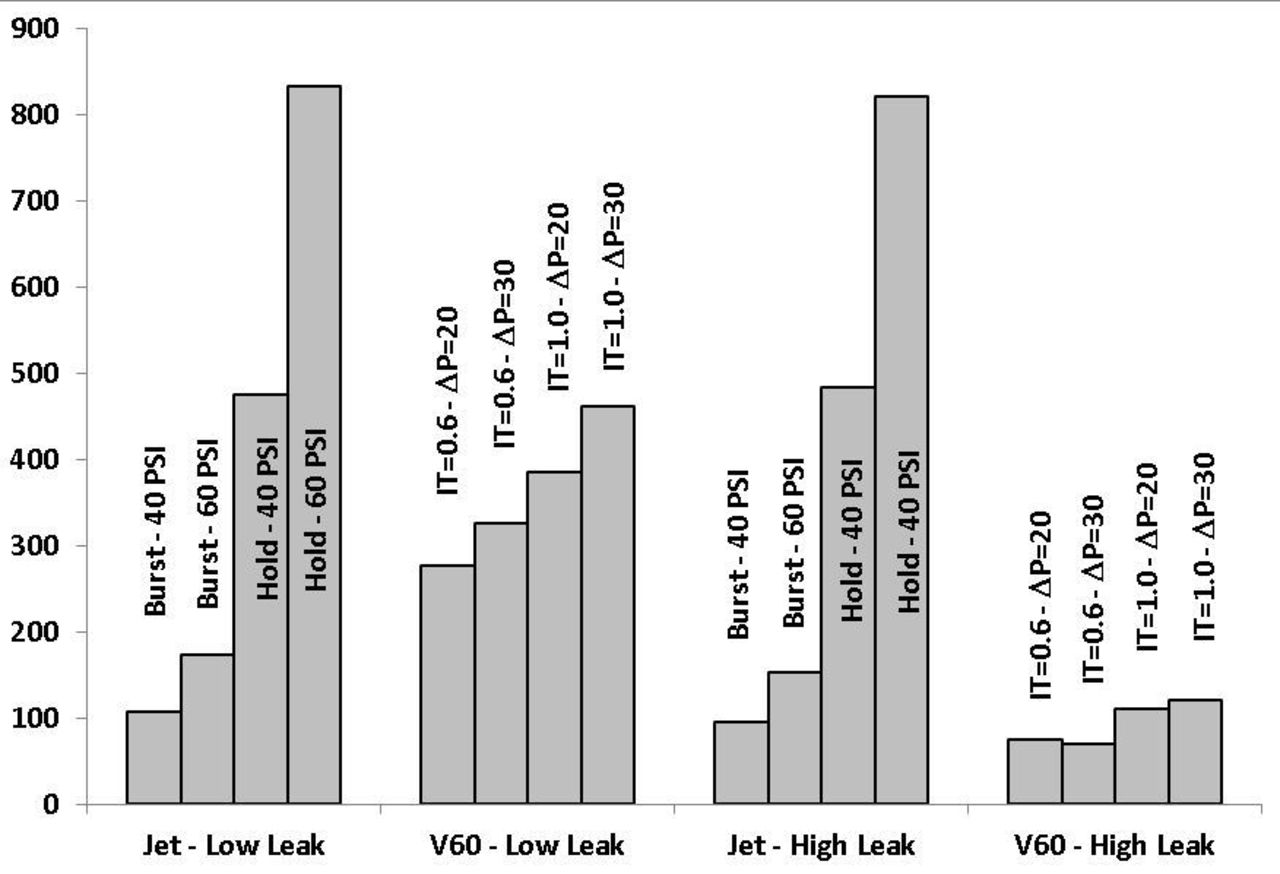
Get full access to this article
View all access options for this article.