




Abstract
Background:
Increases in tobacco taxes are widely considered as an effective strategy to reduce tobacco consumption and it is related health consequences. Therefore, this study aims to investigate the relationship between taxation and smoking consumption among Saudis.
Methods:
It is a cross-sectional research methodology. Arabic translated questionnaire were adapted from validated national tobacco use survey, which used by Centers for Disease Control and Prevention (CDC) and Global Adult Tobacco survey (GATS) that helps in determining the effect of taxation on smoking consumption. Questions consist of 3 parts. First, smoking status before and after taxation by asking 'Do you smoke cigarettes every day, some days, or not at all?' Second, purchasing behavior after the taxation by asking about the brands they buy before and after taxation. Finally, changes in smoking habits 'How have you changed your smoking habits since taxation?' The questionnaires were randomly distributed in malls, cafes and restaurants in Saudi Arabia after IRB approval was obtained.
Results:
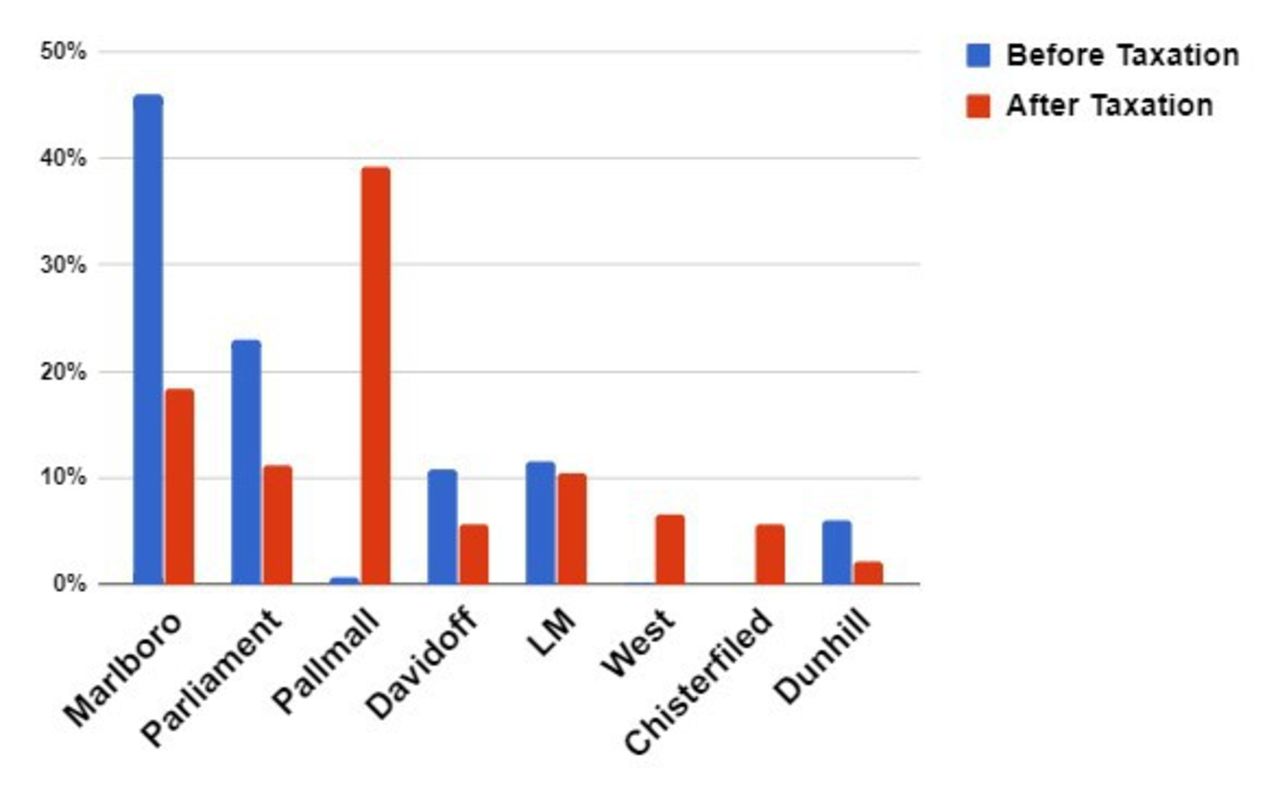
A total of 266 individuals were included in the study. All collected data were male with mean age (25 years ± 9). 27% (72) of them have high school education and 22% (58) were unemployed. There were 91% (243) of the smokers consume smoking daily. After taxation, 18% (48) of the participants decrease their smoking consumption that is slightly significant. However, the major impact were in the brand they were buying, there were 46% (123) of the smokers buy Marlboro as their usual brand before taxation, whereas after taxation, it decreased to 18% (48), most of the participants who were buying Marlboro as their usual brand changed to cheaper brand (Figure-1). Second, 'How have you changed your smoking habits since taxation' this question shows how smokers changed their smoking habits after taxation, and the result shows 27.8% (74) of participants thought seriously about quitting and reduce their consumption . Finally, the result shows that there is 97% (258 of participants) did not seek any smoking cessation clinics or programs. This reflects lack of knowledge of the effectiveness of smoking cessation programs.
Conclusions:
The study concludes that increasing both taxation and price have potential benefit to decrease smoking consumption in Saudi Arabia. Most of them react to taxation in two ways: by reducing their consumption or by seeking cheaper brands. Thus, further taxation and pricing policies can be more effective.
Get full access to this article
View all access options for this article.