




Abstract
Background:
Insomnia and obstructive sleep apnea (OSA) are the two most prevalent sleep disorders reported in the United States, and affect many Americans each year (Centers of Disease Control and Prevention, 2015). These disorders are expected to become more prevalent due to the rise in poor sleep habits and obesity in the United States (CDC, 2014, 2012). Unfortunately, healthcare professionals are not fully aware of or knowledgeable about sleep and its related disorders, or its profound impact on an individual's health (Allen and Seaman 2013, Ingram et al 2015). The use of a hybrid or online sleep learning module may provide an alternative to traditional learning platforms.
Methods:
Before conducting this study, Institutional Review Board (IRB) approval was obtained. This study compared the impact of sleep knowledge acquisition when using a hybrid method of instruction compared to a fully online learning module. A quasi-experimental design using a four-group convenience sample was conducted at a mid-size regional university in the mid-Atlantic United States. A convenience sample of 64 4th-year nursing students (RN) and 39 respiratory therapy (RT) students was used. The Dartmouth Sleep Knowledge and Attitude Survey (DSKAS) was the assessment tool used to compare scores between the hybrid (H) and online (O) groups, and across disciplines, RN and RT. The data were analyzed using SPSS. Analysis of co-variance (ANCOVA) was used when comparing groups' post-test data. The learning tool contained information that targeted basic sleep knowledge, signs and symptoms of sleep disorders, the most common sleep disorders, and diagnostic and treatment options for both diseases.
Results:
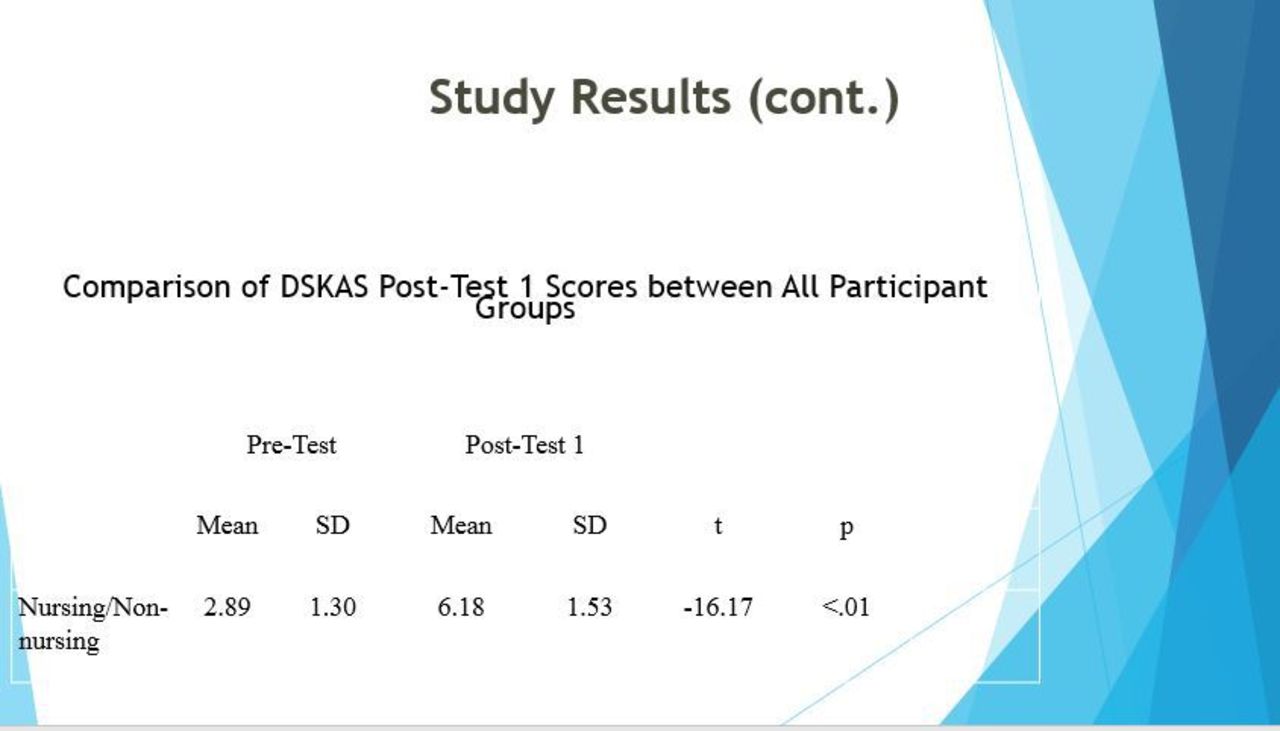
The data suggest that the sleep learning module facilitated an increase in knowledge of sleep medicine for all participants, 2.89 to 6.18, t (102) = -16. 17, p < .01. Furthermore, the sleep learning module provided comparative learning outcomes in both learning formats, 6.53 (O) to (H) 5.91, F (1, 97) = 3.54, p > .05, as well as between disciplines, RN 6.34, RT 5.93, F (1, 97) = .746, p > .05.
Conclusions:
The conclusion supported by the data suggests that the sleep learning module and associated activities facilitated an increase in knowledge of sleep medicine, as students appeared to be able to recognize classical signs and symptoms of OSA and Insomnia more after being exposed to the sleep learning module using either an online or hybrid learning environment.
Get full access to this article
View all access options for this article.