




Abstract
Background:
High frequency oscillatory ventilation (HFOV) and high frequency percussive ventilation (HFPV) are both used effectively in neonatal patients but investigation of the gas exchange they provide on comparable settings has been limited. Previous study in a piglet saline lavage injury model found no overall difference in oxygenation or ventilation. However, post hoc analysis suggested a hypothesis that HFPV improved oxygenation more quickly than HFOV. Objective: To test the hypothesis that oxygenation improves at a different rate on HFOV vs. HFPV in a prospective, randomized, crossover experimental animal model.
Methods:
Sixteen 3-7 d old, 2-4 kg neonatal piglets were studied in a saline lavage lung injury model. After injury each animal was randomized to be ventilated on HFOV or HFPV for 30 min then, after re-injury, switched to the other HF ventilator for 30 min, in both cases on a matching fixed mean airway pressure (Paw) and matching frequency and tidal volume (VT). The process was then repeated with each ventilator using a recruitment maneuver prior to the fixed Paw. Blood gases were measured every 5 min. Data were analyzed using repeated measures ANOVA.
Results:
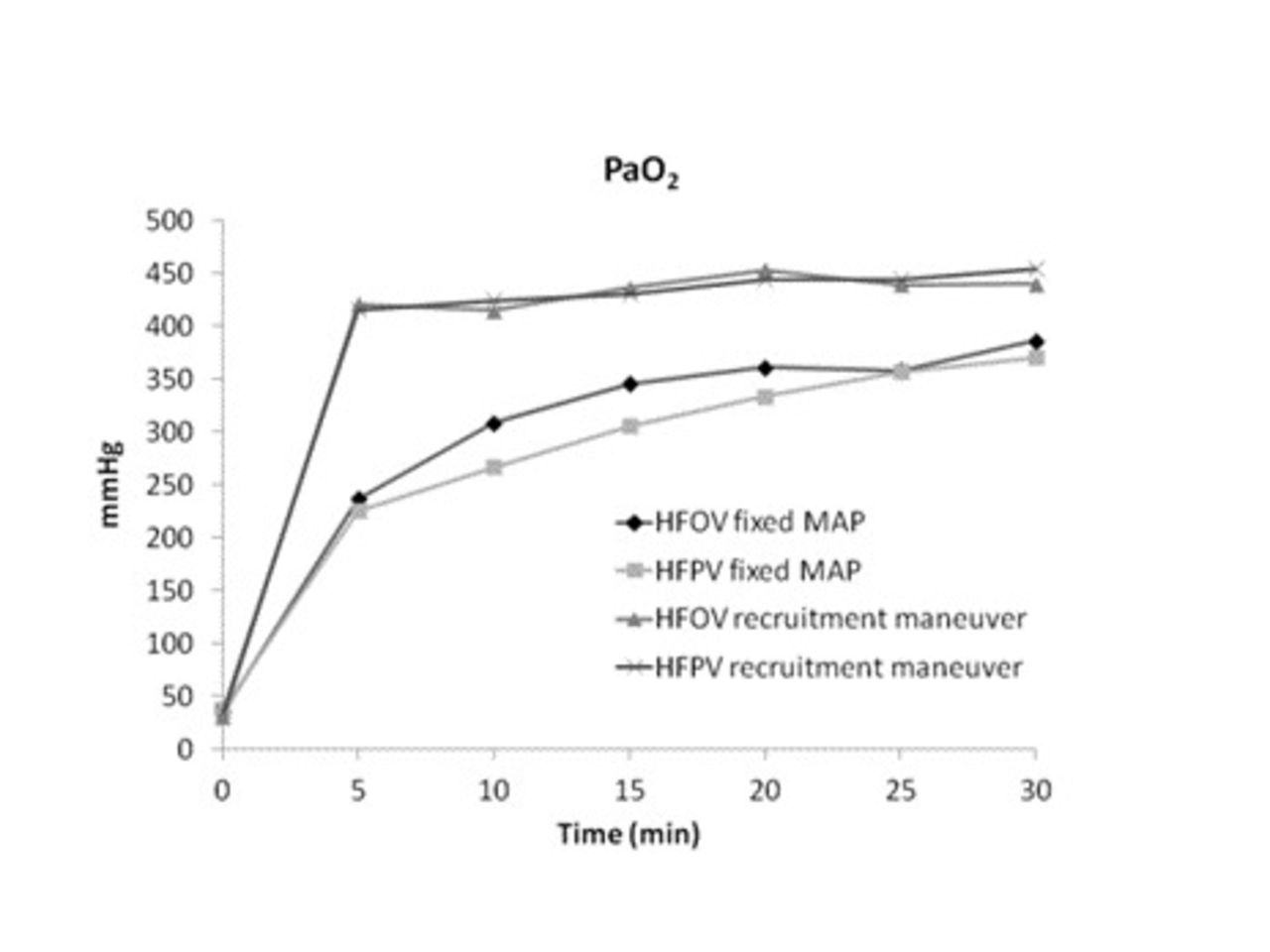
There were significant improvements (P<0.001) in oxygenation and ventilation over time during all four 30 minute experimental periods. No differences were found between ventilators in the rate of improvement in oxygenation (P=0.46 on fixed Paw, P=0.63 after recruitment maneuver), however the rate of improvement was greater after a recruitment maneuver than on fixed Paw for both HFOV (P<0.017) and HFPV (P<0.004) (Fig. 1). Also, no differences were found between devices in the rate of improvement in ventilation (P=0.65 on fixed Paw, P=0.18 after recruitment maneuver), nor any differences based on using a recruitment maneuver on either ventilator (P=0.13 on HFOV, P=0.71 on HFPV). The peak-to-trough pressure difference (ΔP) required for matched VT was significantly higher on HFPV (P<0.001), while the ΔP readings on the HFPV's mechanical gauge were far below the electronically measured pressures on either device.
Conclusions:
No difference could be detected in the rate of improvement in gas exchange between HFPV and HFOV when initiated following an acute lung injury, with or without a recruitment maneuver. With both ventilators oxygenation but not ventilation improved more rapidly using a recruitment maneuver than on a fixed Paw.
Get full access to this article
View all access options for this article.