




Abstract
Background:
In 2012, the Affordable Care Act established the Hospital Readmission Reduction Program (HRRP). The intent of this program is to reduce hospital readmission rate in six medical conditions. COPD and pneumonia are two conditions in the HRRP. Patients with COPD are prone to develop pneumonia and require hospitalization if it is not recognized and treated promptly. The goal of this study is to evaluate the knowledge of COPD patients on the signs and symptoms of pneumonia in a public hospital setting.
Methods:
Institutional IRB approvals were obtained. A patient interview form was developed to collect patient data and verbal responses. From review of literatures, seven common signs and symptoms of pneumonia were included in the interview form: (1) cough, (2) mucus production, (3) fever, (4) shortness of breath, (5) chest pain, (6) fatigue, and (7) nausea, vomiting and diarrhea (N/V/D). Patients admitted to a public hospital in Alabama with a diagnosis of COPD were asked "Do you know the signs and symptoms of a lung infection or pneumonia?" Responses to this and other questions were recorded on the interview form. Data analysis was done by using the frequency count method.
Results:
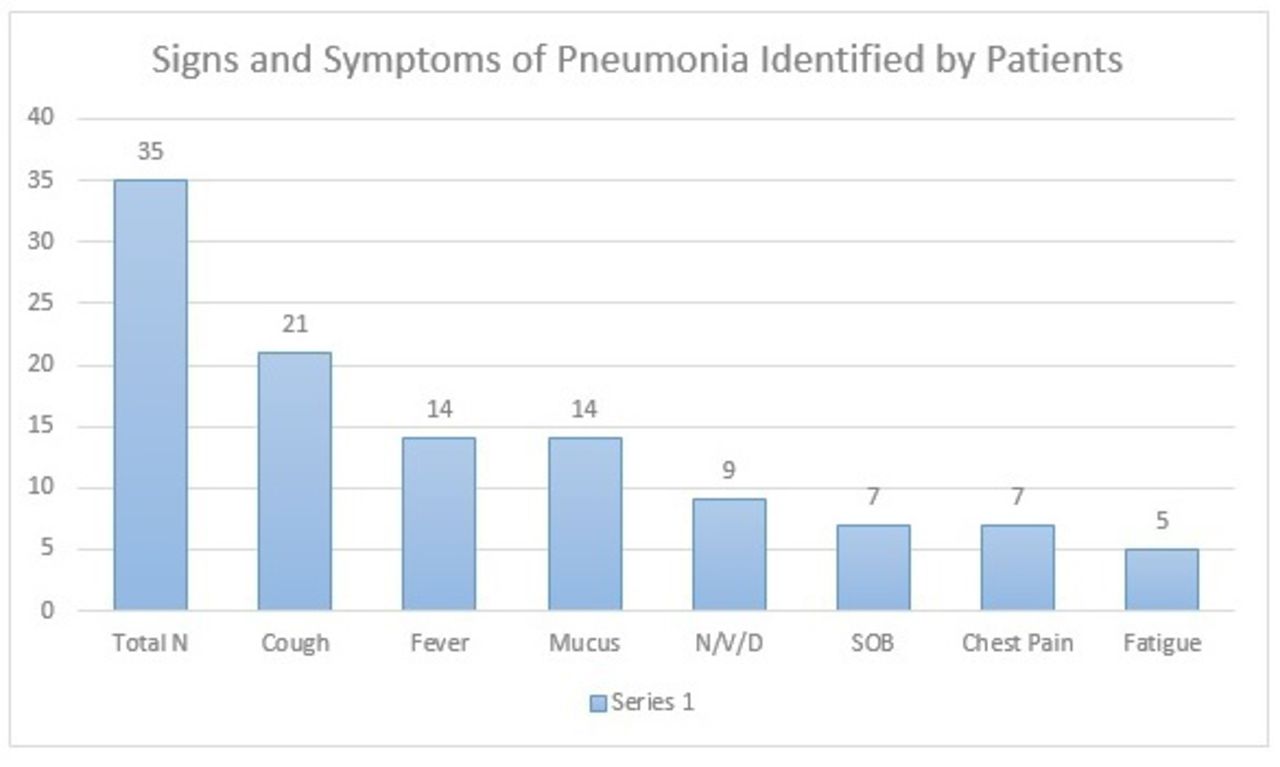
The results are summarized in the Figure where N represents the total number of patients (20 M and 15 F). The signs and symptoms identified by these patients are as follows: Cough - 21 patients (60%) ; Fever / Mucus production - 14 patients (40%) ; N/V/D - 9 patients (26%) ; SOB / Chest pain - 7 patients (20%) ; Fatigue - 5 patients (14%).
Conclusions:
With a total of 35 patients with COPD in a public hospital setting, seven (20%) could not name at least one of the common signs and symptoms of pneumonia. Patient education on the recognition of signs and symptoms of pneumonia should be emphasized in all patient care settings. If recognized early, pneumonia can readily be treated in a subacute or home care setting. Early recognition and effective treatment of pneumonia may reduce the needs and frequency of hospital admissions.
Get full access to this article
View all access options for this article.