




Abstract
Background:
Some athletes train at higher altitudes to allow their bodies to produce more red blood cells and increase their exercise performance and endurance. Elevation mask is an adjustable facial device that simulates different altitudes. Athletes may use this device anywhere and be able to train at the desired altitudes. Since high altitudes lower the partial pressure of oxygen, elevation masks may produce undesirable physiologic effects such as oxygen desaturation and arrhythmias. The purpose of this study was to evaluate changes in pulse oxygen saturation (SpO2) and heart rate (HR) when using the elevation mask.
Methods:
Institutional IRB approval was obtained. Eight healthy volunteers (4 F and 4 M) above 18 years old participated in this study. The treadmill speed was set at walking speed (3. 2) with no incline. The SpO2 and HR were recorded every 3 min following each altitude change. The first session was done without the mask while on treadmill (baseline) and the second session was done on treadmill with the Elevation mask set at baseline, 3, 000 feet, 6, 000 feet, and 9, 000 feet above sea level. The One-Way ANOVA was used to analyze the data.
Results:
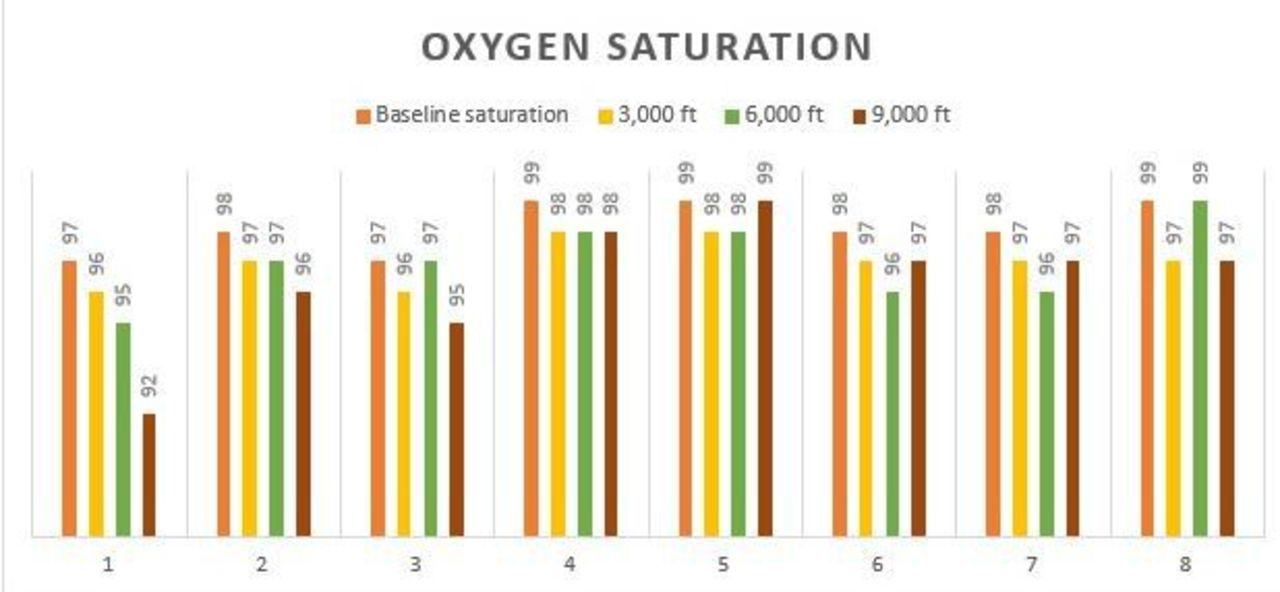
A majority (21 of 24) of SpO2 measurements at high altitudes were lower than the baseline value (Figure). The lowest high altitude SpO2 was 92%. Most HR measurements (20 of 24) at high altitudes were higher than the baseline value. The highest HR at high altitude was 138/min and no arrhythmias were observed. ANOVA analysis of the SpO2 yielded an F of 2.2559 with a p of 0.1038. For the heart rate, the F was 2.2294 with a p of 0.1068. Based on these results, there were no significant differences between the measurements recorded at baseline and all 3 high altitude settings.
Conclusions:
Elevation mask with an altitude setting of up to 9,000 ft is a safe device for training purposes because SpO2 remain above 92% on the test subjects and no arrhythmias were observed. Limiting the highest altitude at 9,000 ft on the Elevation mask and having a small sample size of 8 subjects were two main limitations of this study.
Get full access to this article
View all access options for this article.