




Abstract
Background:
Weaning from mechanical ventilation (MV) is a prominent process in patients with acute respiratory failure when their cause of respiratory failure begins to reverse or stabilize. The rate of patients in weaning success after the first spontaneous breathing trial (SBT) is about 31-40%. Furthermore, there are still about 15% of patients who are prolonged weaning or ventilator dependent. Tracheostomy is an alternative way to promote weaning from MV because of the benefits of decreasing airway resistance and improving patient comfort. Meanwhile, it is crucial to determine the time of weaning from MV by weaning parameters. Rapid shallow breathing index (RSBI) has been thought as an accurate predictor of weaning from MV for decades. In recent years, there are studies that are determining the better predictive effects on modified RSBI and weaning index (WI) than the traditional RSBI in orotracheally intubated patients before weaning from MV. To the best of our knowledge, there is no study to determine the predictive effect of the modified predictors of weaning from MV in tracheostomized patients with prolonged weaning. Purpose: To determine predictive effects of the modified predictors of weaning from MV in tracheostomized patients with prolonged weaning.
Methods:
This retrospective study was researched the electrical chart database at the intensive care units and respiratory care center in a medical center in a 5-year period. Weaning parameters, body mass index (BMI), ventilator parameters, arterial blood gas (ABG), and the outcome of weaning from MV were recorded. The receiver-operating characteristic (ROC) curves, thresholds, area under the curves (AUC), PPV, NPV, specificity, and sensitivity of RSBI, the modified RSBI and WI were analyzed. We also used univariate and multivariate logistic regression model to determine different predictors in weaning success.
Results:
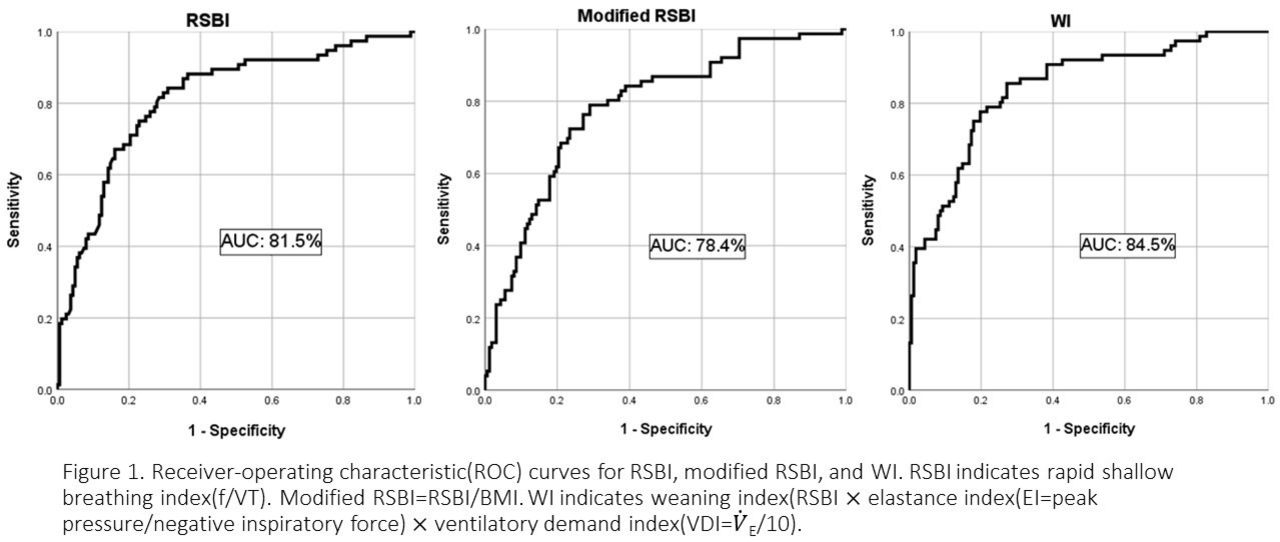
Among three indices nRSBI (sensitivity 69%, specificity 84%, PPV 90%, NPV 56%, AUC 81.5%) and WI (sensitivity 73%, specificity 86%, PPV 91%, NPV 60%, AUC 84.5%) had better predictive power than modified RSBI (sensitivity 71%, specificity 78%, PPV 87%, NPV 56%, AUC 78. 4%). The significant predictors in weaning success in tracheostomized patients with prolonged weaning were neurologic disease, RSBI and WI.
Conclusions:
The traditional RSBI and WI had good and the same predictive effects in weaning from MV in tracheostomized patients with prolonged weaning.
Get full access to this article
View all access options for this article.